







Question: Problem Statement The goal of this project is to develop an Excel sheet that can be used by industrial truss manufacturers to design truss systems
Problem Statement
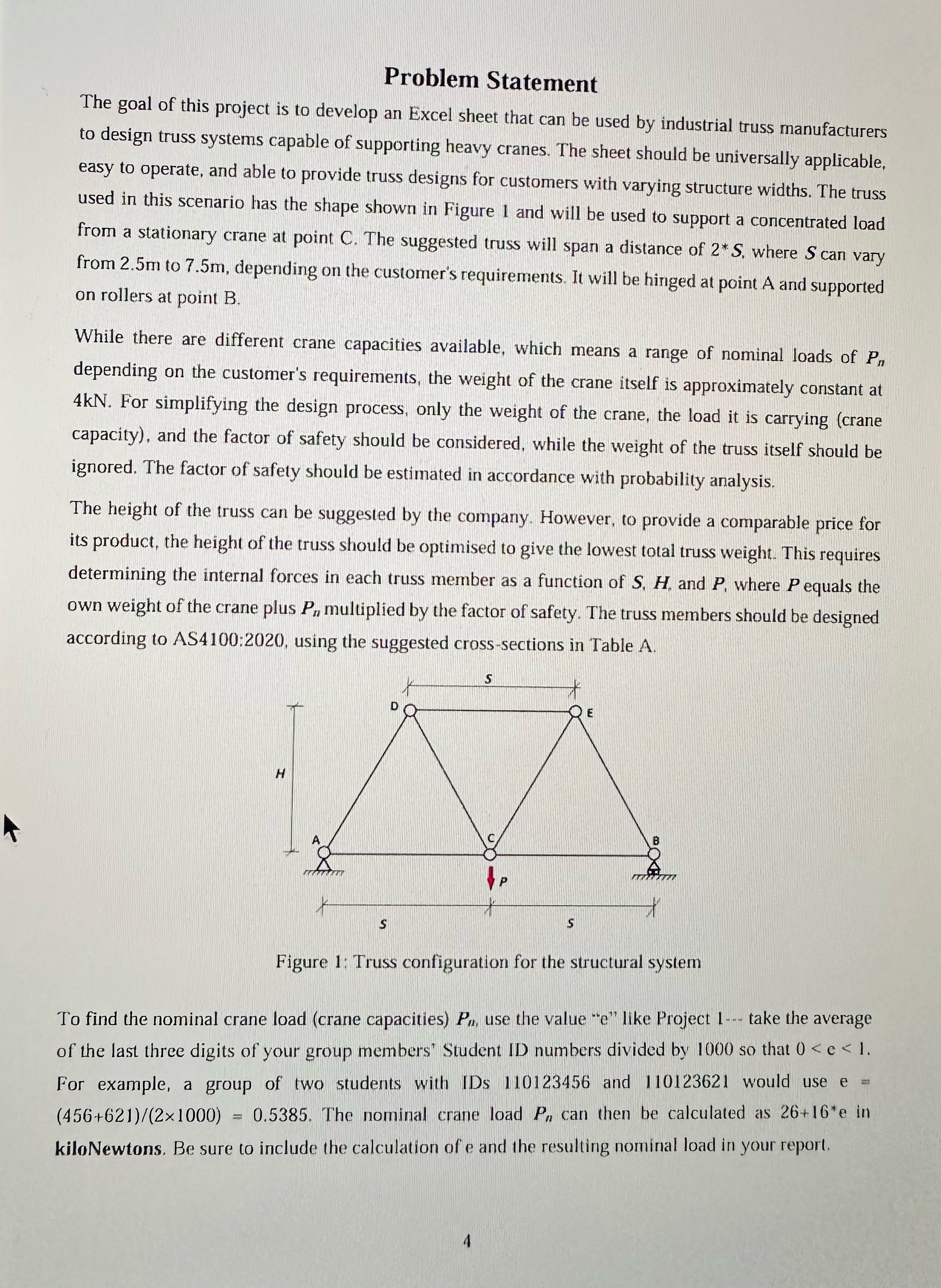
The goal of this project is to develop an Excel sheet that can be used by industrial truss manufacturers to design truss systems capable of supporting heavy cranes. The sheet should be universally applicable, easy to operate, and able to provide truss designs for customers with varying structure widths. The truss used in this scenario has the shape shown in Figure and will be used to support a concentrated load from a stationary crane at point The suggested truss will span a distance of where can vary from to depending on the customer's requirements. It will be hinged at point A and supported on rollers at point
While there are different crane capacities available, which means a range of nominal loads of depending on the customer's requirements, the weight of the crane itself is approximately constant at For simplifying the design process, only the weight of the crane, the load it is carrying crane capacity and the factor of safety should be considered, while the weight of the truss itself should be ignored. The factor of safety should be estimated in accordance with probability analysis.
The height of the truss can be suggested by the company. However, to provide a comparable price for its product, the height of the truss should be optimised to give the lowest total truss weight. This requires determining the internal forces in each truss member as a function of and where equals the own weight of the crane plus multiplied by the factor of safety. The truss members should be designed according to AS: using the suggested crosssections in Table A
Figure : Truss configuration for the structural system
To find the nominal crane load crane capacities use the value e like Project dots take the average of the last three digits of your group members' Student ID numbers divided by so that For example, a group two students with IDs and would use The nominal crane load can then calculated kiloNewtons. sure include the calculation and the resulting nominal load your report.
Step by Step Solution
There are 3 Steps involved in it
1 Expert Approved Answer
Step: 1 Unlock

Question Has Been Solved by an Expert!
Get step-by-step solutions from verified subject matter experts
Step: 2 Unlock
Step: 3 Unlock
 Study Help