







Question: 1. Steam at 300 C flows through a 100 mm OD metal pipe with a wall thickness of 3 mm. To prevent heat loss
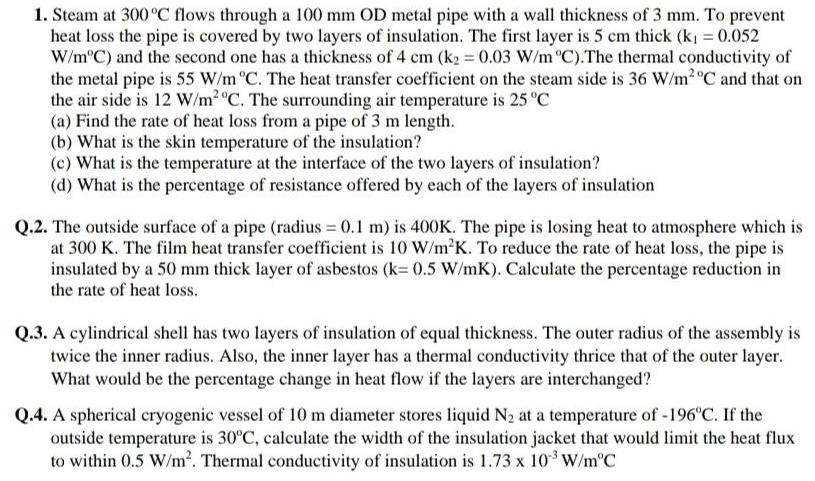
1. Steam at 300 C flows through a 100 mm OD metal pipe with a wall thickness of 3 mm. To prevent heat loss the pipe is covered by two layers of insulation. The first layer is 5 cm thick (k = 0.052 W/mC) and the second one has a thickness of 4 cm (k = 0.03 W/m C). The thermal conductivity of the metal pipe is 55 W/m C. The heat transfer coefficient on the steam side is 36 W/m C and that on the air side is 12 W/m2 C. The surrounding air temperature is 25 C (a) Find the rate of heat loss from a pipe of 3 m length. (b) What is the skin temperature of the insulation? (c) What is the temperature at the interface of the two layers of insulation? (d) What is the percentage of resistance offered by each of the layers of insulation Q.2. The outside surface of a pipe (radius= 0.1 m) is 400K. The pipe is losing heat to atmosphere which is at 300 K. The film heat transfer coefficient is 10 W/mK. To reduce the rate of heat loss, the pipe is insulated by a 50 mm thick layer of asbestos (k= 0.5 W/mK). Calculate the percentage reduction in the rate of heat loss. Q.3. A cylindrical shell has two layers of insulation of equal thickness. The outer radius of the assembly is twice the inner radius. Also, the inner layer has a thermal conductivity thrice that of the outer layer. What would be the percentage change in heat flow if the layers are interchanged? Q.4. A spherical cryogenic vessel of 10 m diameter stores liquid N at a temperature of -196C. If the outside temperature is 30C, calculate the width of the insulation jacket that would limit the heat flux to within 0.5 W/m. Thermal conductivity of insulation is 1.73 x 10 W/mC
Step by Step Solution
3.58 Rating (158 Votes )
There are 3 Steps involved in it
Question 1 To solve this problem we can use the concept of thermal resistance and apply it to each layer of insulation and the pipe The rate of heat transfer can be determined using the formula Q T1 T... View full answer

Get step-by-step solutions from verified subject matter experts
 Study Help