







Question: problem to the OL S estimativer statement: Multicollinearity causes a more severe (c) (4 marks) What is the name we thatecorrelation does, Discuss how we
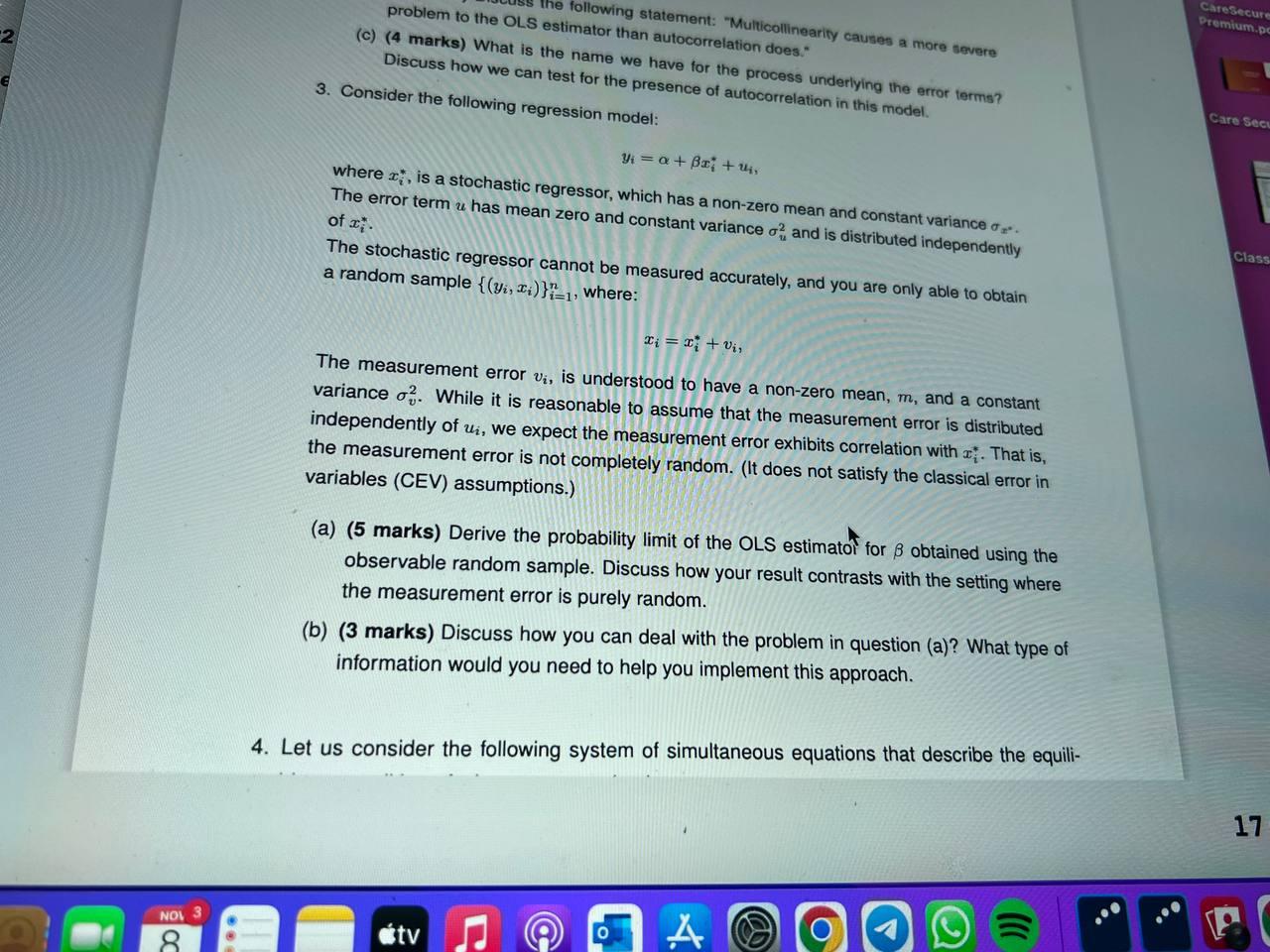
problem to the OL S estimativer statement: "Multicollinearity causes a more severe (c) (4 marks) What is the name we thatecorrelation does," Discuss how we can test for the presence for the process underlying the error terms? 3. Consider the following regression model: 3. Consider the following regression model: yi=+xi+ui, where xi, is a stochastic regressor, which has a non-zero mean and constant variance x. The error term u has mean zero and constant variance u2 and is distributed independently of xi. The stochastic regressor cannot be measured accurately, and you are only able to obtain a random sample {(yi,xi)}i=1n, where: xi=xi+vi The measurement error vi, is understood to have a non-zero mean, m, and a constant variance v2. While it is reasonable to assume that the measurement error is distributed independently of ui, we expect the measurement error exhibits correlation with xi. That is, the measurement error is not completely random. (It does not satisfy the classical error in variables (CEV) assumptions.) (a) (5 marks) Derive the probability limit of the OLS estimatoi for obtained using the observable random sample. Discuss how your result contrasts with the setting where the measurement error is purely random. (b) (3 marks) Discuss how you can deal with the problem in question (a)? What type of information would you need to help you implement this approach. 4. Let us consider the following system of simultaneous equations that describe the equili- problem to the OL S estimativer statement: "Multicollinearity causes a more severe (c) (4 marks) What is the name we thatecorrelation does," Discuss how we can test for the presence for the process underlying the error terms? 3. Consider the following regression model: 3. Consider the following regression model: yi=+xi+ui, where xi, is a stochastic regressor, which has a non-zero mean and constant variance x. The error term u has mean zero and constant variance u2 and is distributed independently of xi. The stochastic regressor cannot be measured accurately, and you are only able to obtain a random sample {(yi,xi)}i=1n, where: xi=xi+vi The measurement error vi, is understood to have a non-zero mean, m, and a constant variance v2. While it is reasonable to assume that the measurement error is distributed independently of ui, we expect the measurement error exhibits correlation with xi. That is, the measurement error is not completely random. (It does not satisfy the classical error in variables (CEV) assumptions.) (a) (5 marks) Derive the probability limit of the OLS estimatoi for obtained using the observable random sample. Discuss how your result contrasts with the setting where the measurement error is purely random. (b) (3 marks) Discuss how you can deal with the problem in question (a)? What type of information would you need to help you implement this approach. 4. Let us consider the following system of simultaneous equations that describe the equili
Step by Step Solution
There are 3 Steps involved in it

Get step-by-step solutions from verified subject matter experts
 Study Help