Question: Problems 1) A local brewer is trying to determine how much beer to provide for an upcoming brew festival. The decision has boiled down to
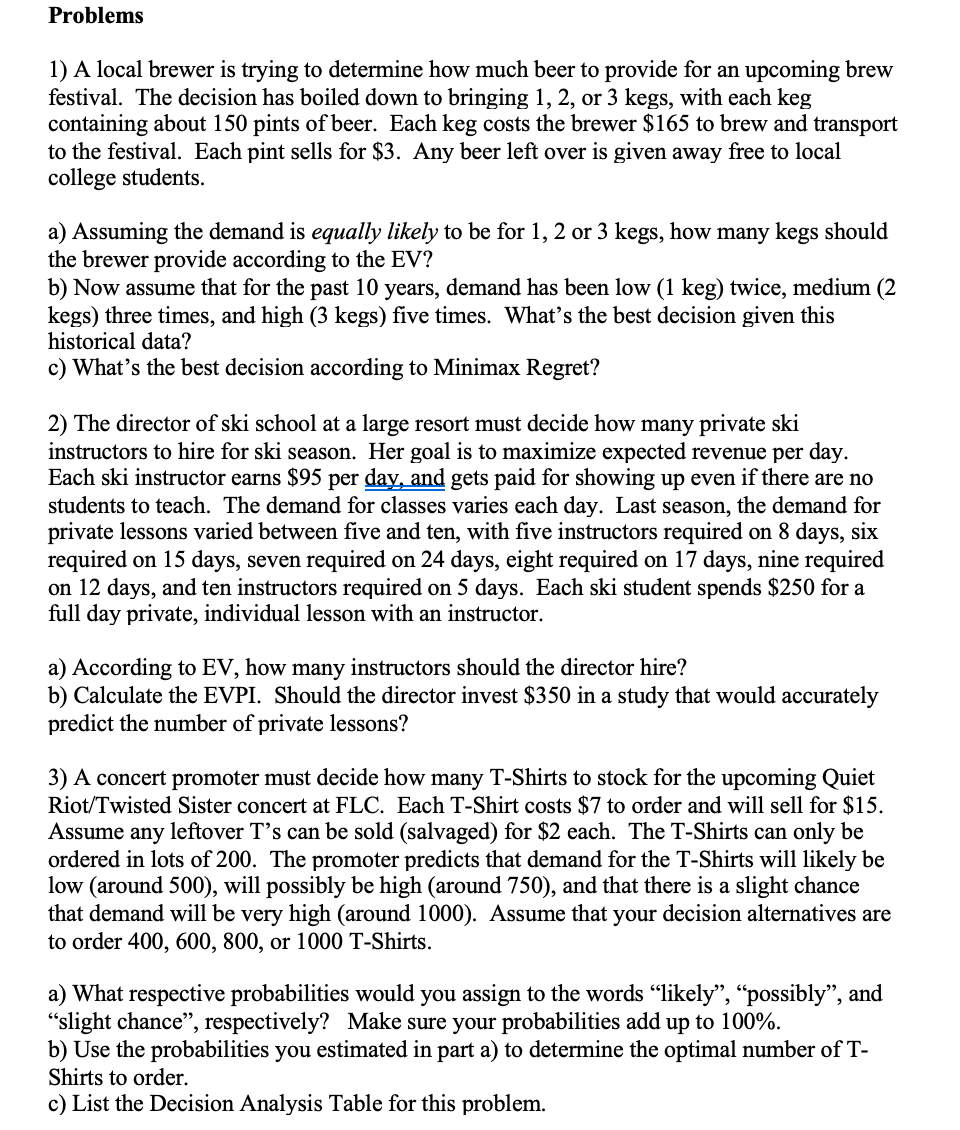
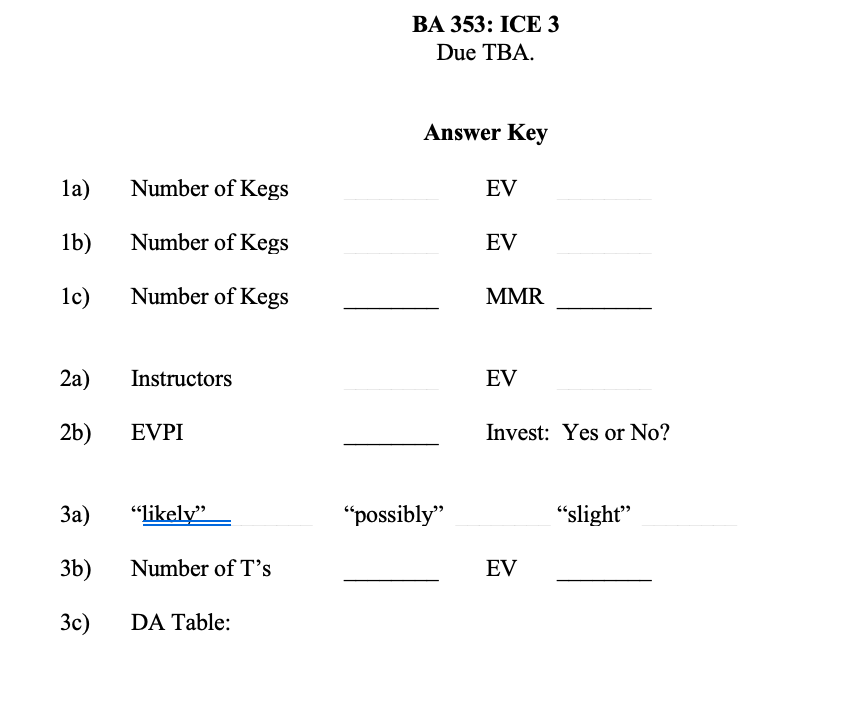
Problems 1) A local brewer is trying to determine how much beer to provide for an upcoming brew festival. The decision has boiled down to bringing 1, 2, or 3 kegs, with each keg containing about 150 pints of beer. Each keg costs the brewer $165 to brew and transport to the festival. Each pint sells for $3. Any beer left over is given away free to local college students. a) Assuming the demand is equally likely to be for 1, 2 or 3 kegs, how many kegs should the brewer provide according to the EV? b) Now assume that for the past 10 years, demand has been low (1 keg) twice, medium (2 kegs) three times, and high (3 kegs) five times. What's the best decision given this historical data? c) What's the best decision according to Minimax Regret? 2) The director of ski school at a large resort must decide how many private ski instructors to hire for ski season. Her goal is to maximize expected revenue per day. Each ski instructor earns $95 per day, and gets paid for showing up even if there are no students to teach. The demand for classes varies each day. Last season, the demand for private lessons varied between five and ten, with five instructors required on 8 days, six required on 15 days, seven required on 24 days, eight required on 17 days, nine required on 12 days, and ten instructors required on 5 days. Each ski student spends $250 for a full day private, individual lesson with an instructor. a) According to EV, how many instructors should the director hire? b) Calculate the EVPI. Should the director invest $350 in a study that would accurately predict the number of private lessons? 3) A concert promoter must decide how many T-Shirts to stock for the upcoming Quiet Riot/Twisted Sister concert at FLC. Each T-Shirt costs $7 to order and will sell for $15. Assume any leftover T's can be sold (salvaged) for $2 each. The T-Shirts can only be ordered in lots of 200. The promoter predicts that demand for the T-Shirts will likely be low (around 500), will possibly be high (around 750), and that there is a slight chance that demand will be very high (around 1000). Assume that your decision alternatives are to order 400, 600, 800, or 1000 T-Shirts. a) What respective probabilities would you assign to the words likely, possibly", and slight chance, respectively? Make sure your probabilities add up to 100%. b) Use the probabilities you estimated in part a) to determine the optimal number of T- Shirts to order. c) List the Decision Analysis Table for this problem. BA 353: ICE 3 Due TBA Answer Key la) Number of Kegs EV 1b) Number of Kegs EV 10) Number of Kegs MMR 2a) Instructors EV 2b) EVPI Invest: Yes or No? ) "likely possibly" "slight" 3b) Number of T's EV 3c) DA Table




