







Question: ### Problems ### 1 > Read in the 'chimpanzee.csv' data file. Consider only those trials with a partner. Make an assumption that there is a
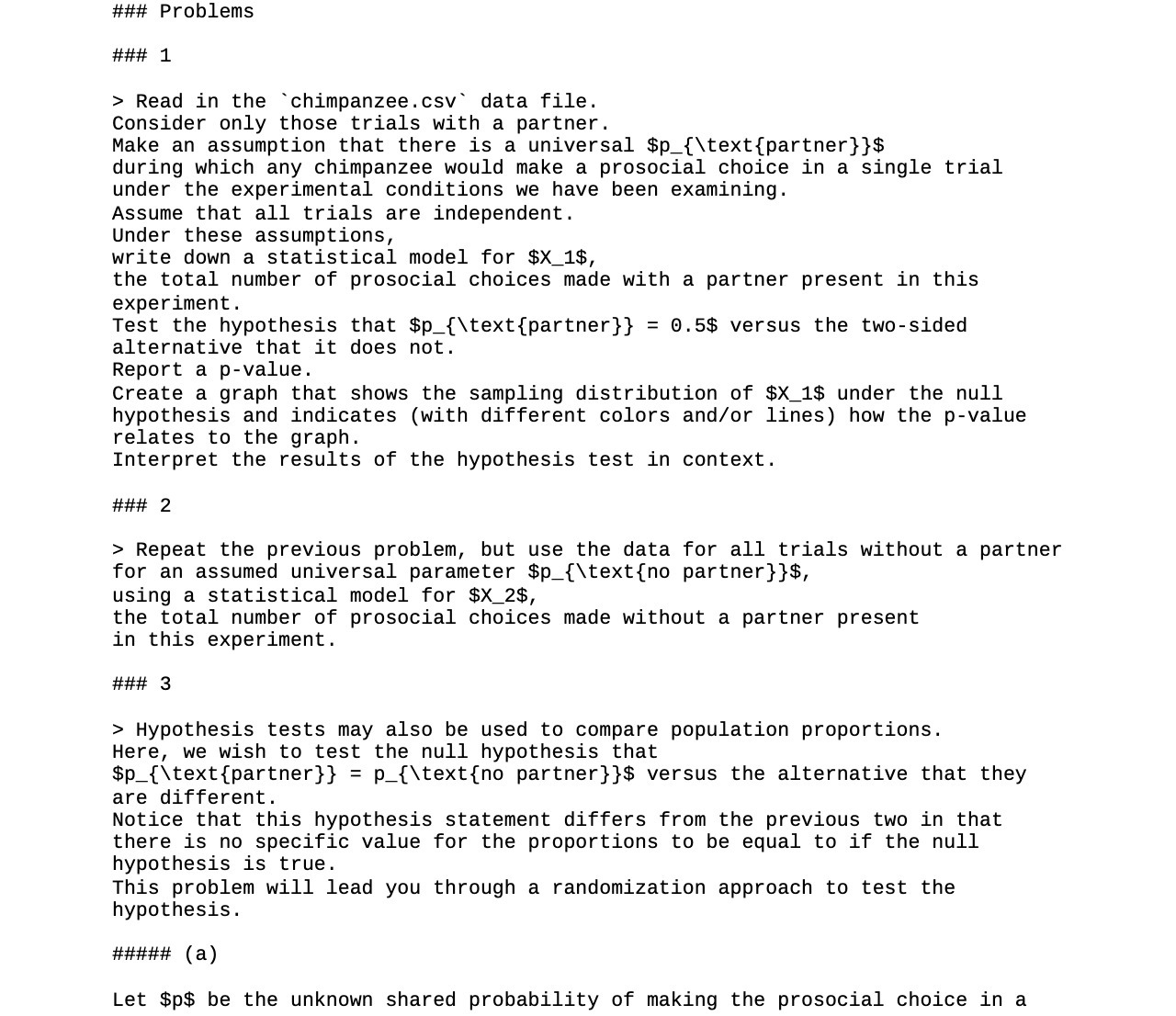
### Problems ### 1 > Read in the 'chimpanzee.csv' data file. Consider only those trials with a partner. Make an assumption that there is a universal $p_{\\text{partner}}$ during which any chimpanzee would make a prosocial choice in a single trial under the experimental conditions we have been examining. Assume that all trials are independent. Under these assumptions, write down a statistical model for $X_1$, the total number of prosocial choices made with a partner present in this experiment. Test the hypothesis that $p_{\\text{partner}} = 0.5$ versus the two-sided alternative that it does not. Report a p-value. Create a graph that shows the sampling distribution of $X_1$ under the null hypothesis and indicates (with different colors and/or lines) how the p-value relates to the graph. Interpret the results of the hypothesis test in context. ### 2 > Repeat the previous problem, but use the data for all trials without a partner for an assumed universal parameter $pw{\\text{no partner}}$, using a statistical model for $X_2$, the total number of prosocial choices made without a partner present in this experiment. ### 3 > Hypothesis tests may also be used to compare population proportions. Here, we wish to test the null hypothesis that $p_{\\text{partner}} = p_{\\text{no partner}}$ versus the alternative that they are different. Notice that this hypothesis statement differs from the previous two in that there is no specific value for the proportions to be equal to if the null hypothesis is true. This problem will lead you through a randomization approach to test the hypothesis. ##### (a) Let $p$ be the unknown shared probability of making the prosocial choice in a
Step by Step Solution
There are 3 Steps involved in it

Get step-by-step solutions from verified subject matter experts
 Study Help