







Question: PROBLEMS 6.1. Imagine that the production function for tuna cans is given by q=6K+4L, where q = Output of tuna cans per hour K =
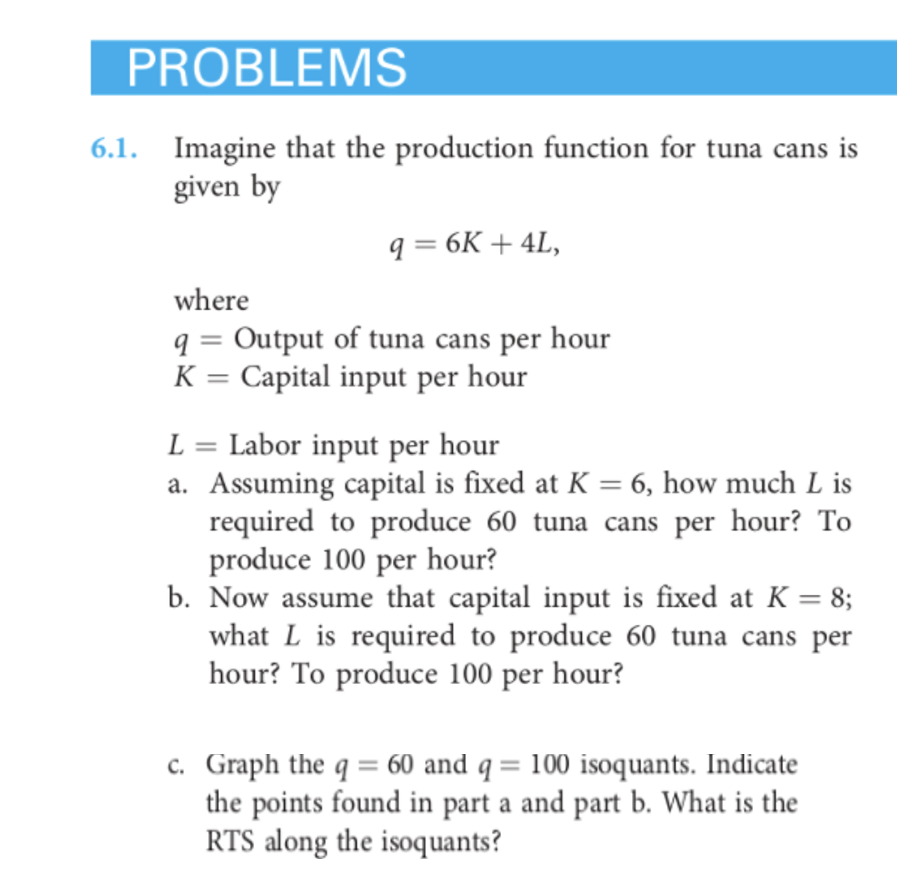
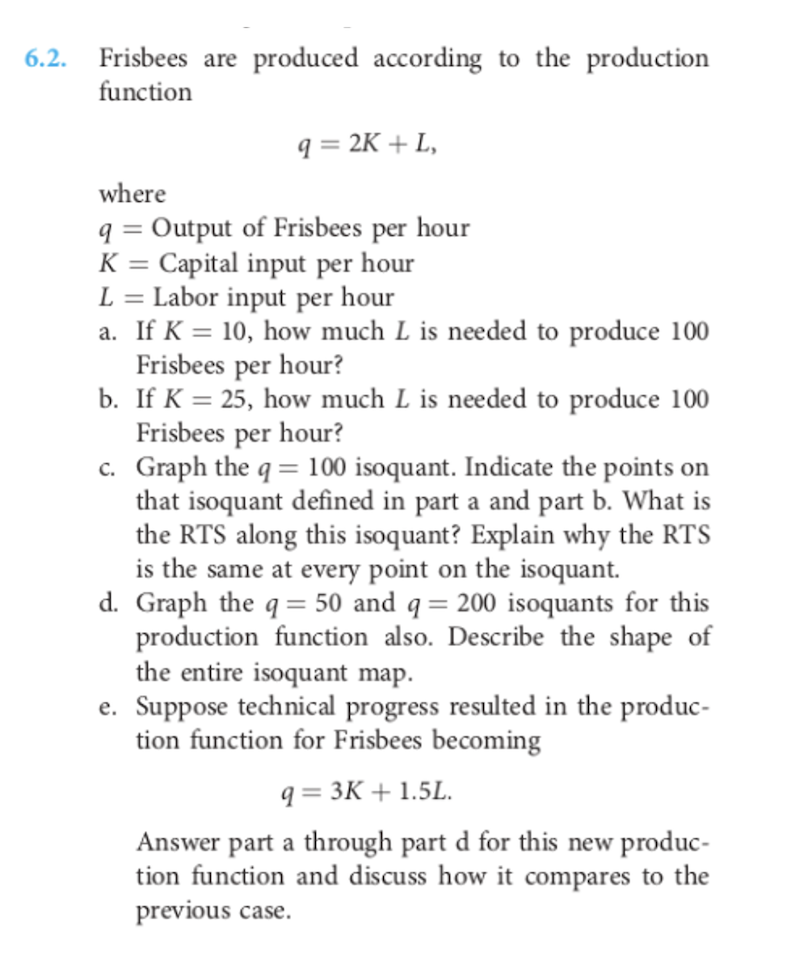
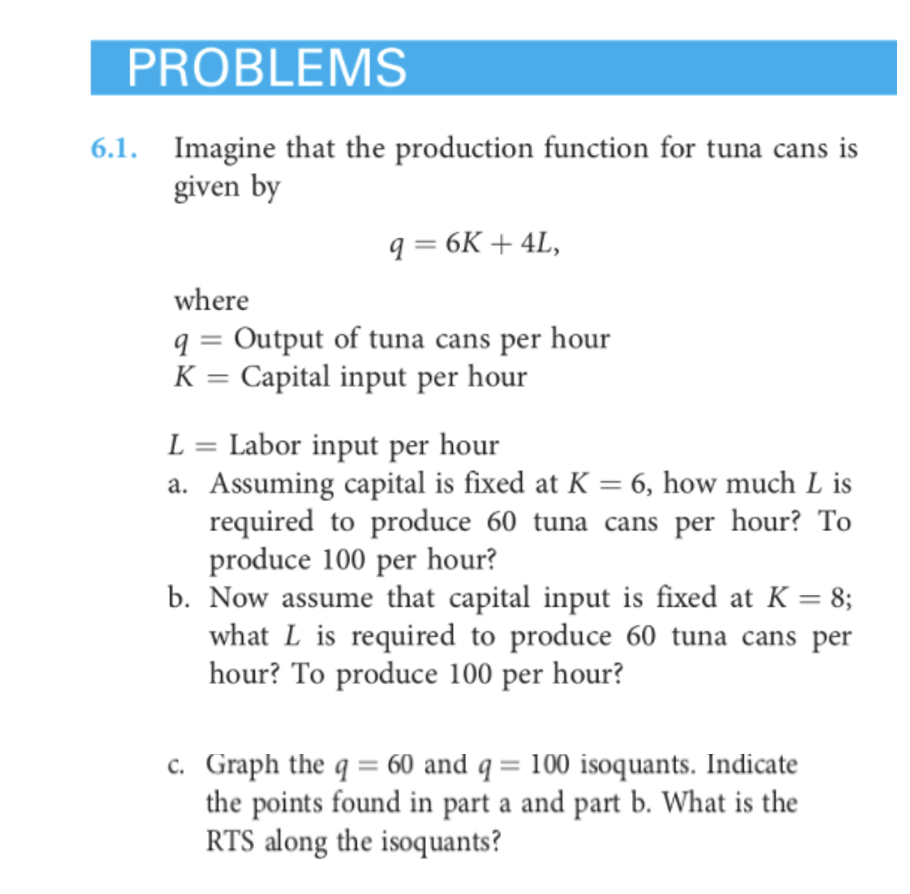
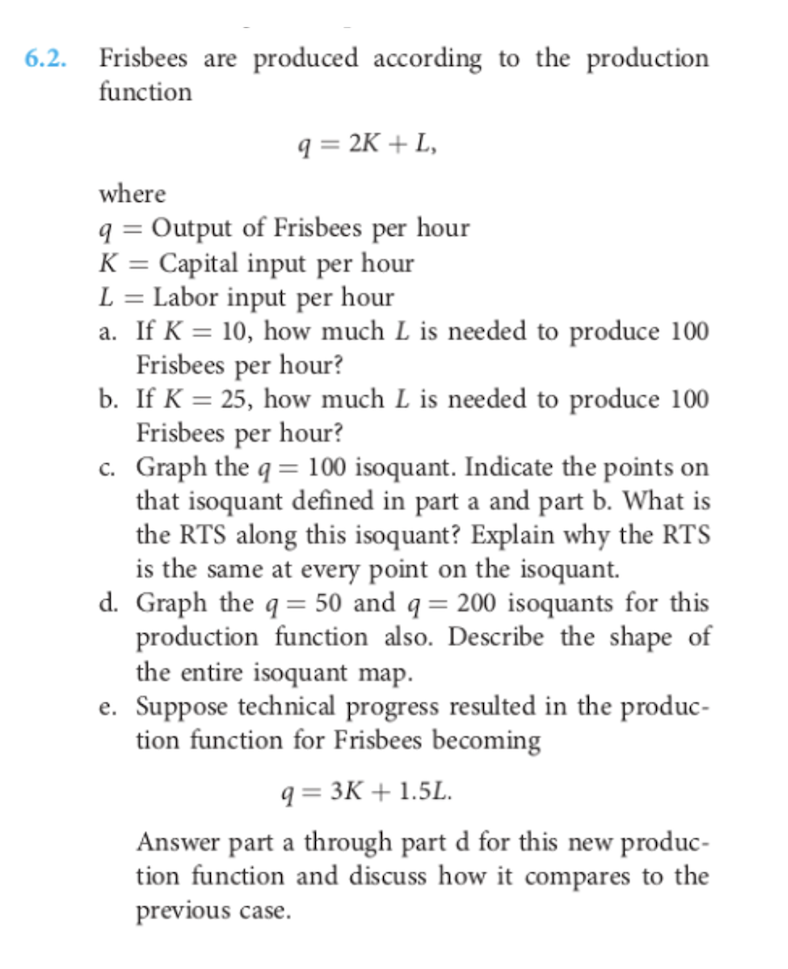
PROBLEMS 6.1. Imagine that the production function for tuna cans is given by q=6K+4L, where q = Output of tuna cans per hour K = Capital input per hour L = Labor input per hour a. Assuming capital is xed at K = 6, how much L is required to produce 60 tuna cans per hour? To produce 100 per hour? b. Now assume that capital input is xed at K = 8; what L is required to produce 60 tuna cans per hour? To produce 100 per hour? c. Graph the q = 60 and q = 100 isoquants. Indicate the points found in part a and part b. What is the RTS along the isoquants? 6.2. Frisbees are produced according to the production function q = 2K + L, where q = Output of Frisbees per hour K = Capital input per hour L = Labor input per hour a. If K = 10, how much L is needed to produce 100 Frisbees per hour? b. If K = 25, how much L is needed to produce 100 Frisbees per hour? c. Graph the q = 100 isoquant. Indicate the points on that isoquant defined in part a and part b. What is the RTS along this isoquant? Explain why the RTS is the same at every point on the isoquant. d. Graph the q = 50 and q = 200 isoquants for this production function also. Describe the shape of the entire isoquant map. e. Suppose technical progress resulted in the produc- tion function for Frisbees becoming q = 3K + 1.5L. Answer part a through part d for this new produc- tion function and discuss how it compares to the previous case
Step by Step Solution
There are 3 Steps involved in it

Get step-by-step solutions from verified subject matter experts
 Study Help