







Question: problems from introduction to chemical engineering analysis from T.W Fraser Russell chapter 143 5.11 Problems 14 In most cases it will be necessary to consult
problems from "introduction to chemical engineering analysis" from T.W Fraser Russell chapter 143
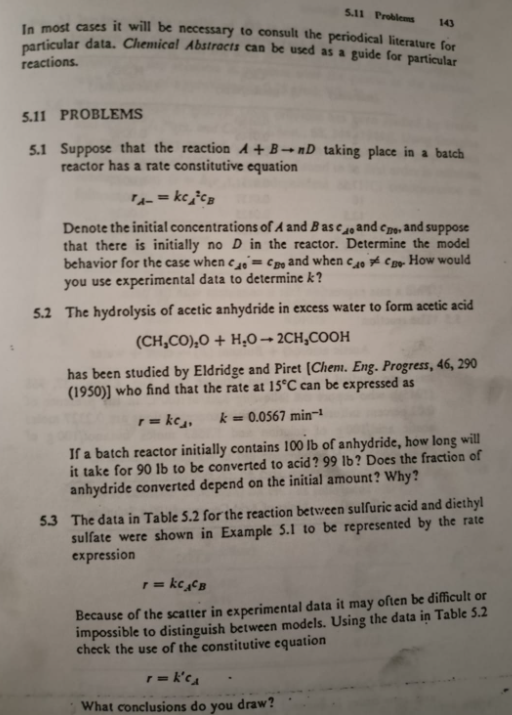
5.11 Problems 14 In most cases it will be necessary to consult the periodical literature for particular data. Chemical Abstracts can be used as a guide for particular reactions. 5.11 PROBLEMS 5.1 Suppose that the reaction A + B - D taking place in a batch reactor has a rate constitutive equation TA-= kc, CB Denote the initial concentrations of A and B as Cdo and C po, and suppose that there is initially no D in the reactor. Determine the model behavior for the case when cho = po and when cdo so. How would you use experimental data to determine k? 5.2 The hydrolysis of acetic anhydride in excess water to form acetic acid (CH,CO),0 + H,0 - 2CH,COOH has been studied by Eldridge and Piret (Cheni. Eng. Progress, 46, 290 (1950)] who find that the rate at 15C can be expressed as =kce k= 0.0567 min-1 If a batch reactor initially contains 100 lb of anhydride, how long will it take for 90 lb to be converted to acid ? 99 lb? Does the fraction of anhydride converted depend on the initial amount? Why? 53 The data in Table 5.2 for the reaction between sulfuric acid and diethyl sulfate were shown in Example 5.1 to be represented by the rate expression r = kcCB Because of the scatter in experimental data it may often be difficult or impossible to distinguish between models. Using the data in Table 5.2 check the use of the constitutive equation r r = k'ca What conclusions do you draw
Step by Step Solution
There are 3 Steps involved in it

Get step-by-step solutions from verified subject matter experts
 Study Help