







Question: Problems marked with an icon may be more conveniently solved on a personal computer with a mathematical program. 4.1 One mole of nitrogen gas is
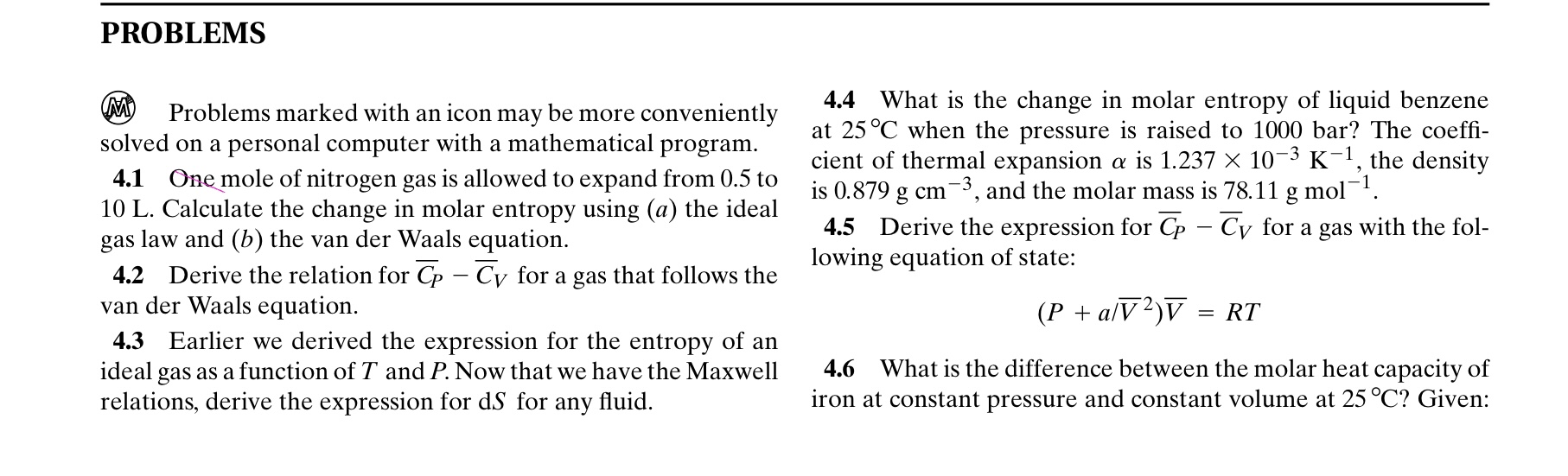
Problems marked with an icon may be more conveniently solved on a personal computer with a mathematical program. 4.1 One mole of nitrogen gas is allowed to expand from 0.5 to 10 L. Calculate the change in molar entropy using (a) the ideal gas law and (b) the van der Waals equation. 4.2 Derive the relation for CPCV for a gas that follows the van der Waals equation. 4.3 Earlier we derived the expression for the entropy of an ideal gas as a function of T and P. Now that we have the Maxwell relations, derive the expression for dS for any fluid. 4.4 What is the change in molar entropy of liquid benzene at 25C when the pressure is raised to 1000 bar? The coefficient of thermal expansion is 1.237103K1, the density is 0.879gcm3, and the molar mass is 78.11gmol1. 4.5 Derive the expression for CPCV for a gas with the following equation of state: (P+a/V2)V=RT 4.6 What is the difference between the molar heat capacity of iron at constant pressure and constant volume at 25C ? Given
Step by Step Solution
There are 3 Steps involved in it

Get step-by-step solutions from verified subject matter experts
 Study Help