







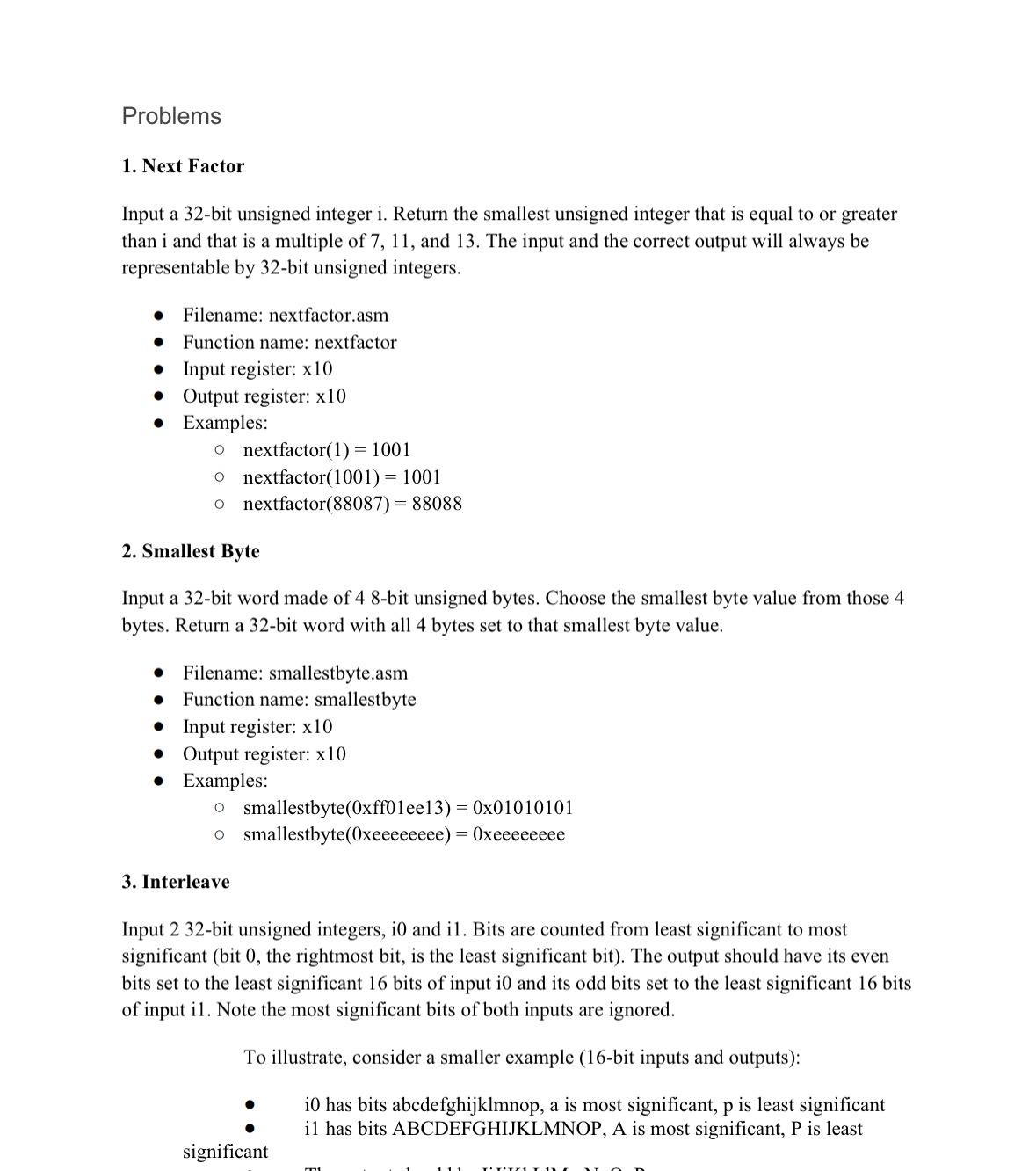
Question: Problems Next Factor Input a 3 2 - bit unsigned integer i . Return the smallest unsigned integer that is equal to or greater than
Problems
Next Factor
Input a bit unsigned integer i Return the smallest unsigned integer that is equal to or greater than i and that is a multiple of and The input and the correct output will always be representable by bit unsigned integers.
Filename: nextfactor.asm
Function name: nextfactor
Input register: x
Output register: x
Examples:
@ nextfactor
@ nextfactor
@ nextfactor
Smallest Byte
Input a bit word made of bit unsigned bytes. Choose the smallest byte value from those bytes. Return a bit word with all bytes set to that smallest byte value.
Filename: smallestbyte.asm
Function name: smallestbyte
Input register: x
Output register: x
Examples:
@ smallestbyte
@ smallestbyte xeeeeeee oeeeeeee
Interleave
Input bit unsigned integers, and Bits are counted from least significant to most significant bit the rightmost bit, is the least significant bit The output should have its even bits set to the least significant bits of input and its odd bits set to the least significant bits of input il Note the most significant bits of both inputs are ignored.
To illustrate, consider a smaller example bit inputs and outputs:
has bits abcdefghijklmnop, a is most significant, is least significant
has bits ABCDEFGHIJKLMNOP, is most significant, is least
significant
Step by Step Solution
There are 3 Steps involved in it
1 Expert Approved Answer
Step: 1 Unlock

Question Has Been Solved by an Expert!
Get step-by-step solutions from verified subject matter experts
Step: 2 Unlock
Step: 3 Unlock
 Study Help