



Question: Problems Refer to the figure below. Let m_(1)=m_(2)=m,b_(1)=b_(2)=b , and k_(1)=k_(2)=k . a. Find the transfer functions T_(1)=(x_(1)(s))/(U(s)) and T_(2)=(x_(2)(s))/(U(s)) . b. Let m=1kg,b=10N(s)/(m) ,
Problems\ Refer to the figure below. Let
m_(1)=m_(2)=m,b_(1)=b_(2)=b, and
k_(1)=k_(2)=k.\ a. Find the transfer functions
T_(1)=(x_(1)(s))/(U(s))and
T_(2)=(x_(2)(s))/(U(s)).\ b. Let
m=1kg,b=10N(s)/(m), and
k=10k(N)/(m). Use Simulink to determine the outputs of the system,
x_(1)and
x_(2), to a unit step input. Submit your Simulink model and the output graph in PDF. Change the time span for the simulation as appropriate to show the details.
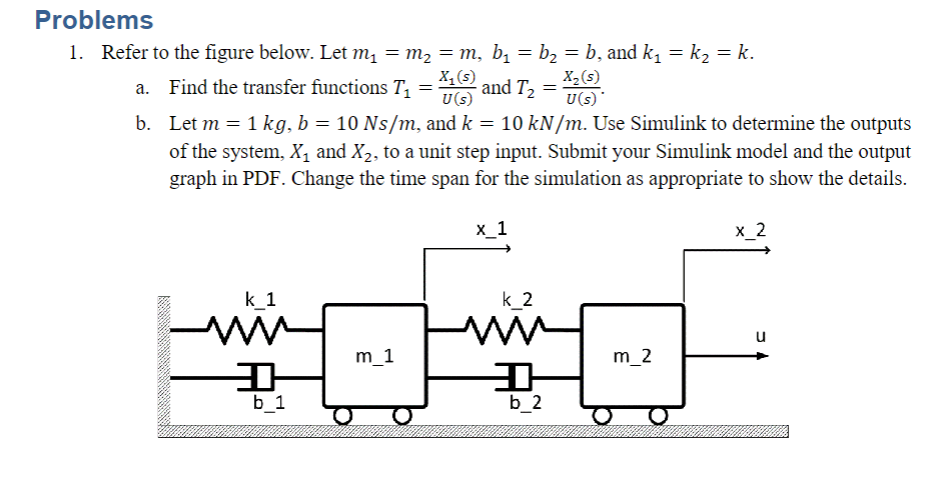
1. Refer to the figure below. Let m1=m2=m,b1=b2=b, and k1=k2=k. a. Find the transfer functions T1=U(s)X1(s) and T2=U(s)X2(s). b. Let m=1kg,b=10Ns/m, and k=10kN/m. Use Simulink to determine the outputs of the system, X1 and X2, to a unit step input. Submit your Simulink model and the output graph in PDF. Change the time span for the simulation as appropriate to show the details
Step by Step Solution
There are 3 Steps involved in it

Get step-by-step solutions from verified subject matter experts