







Question: Problem-Solving Case: Flint's Avoidable Water-Quality Disaster The 2015 discovery that drinking water in Flint, Michigan, was heavily contaminated with lead has been called a failure
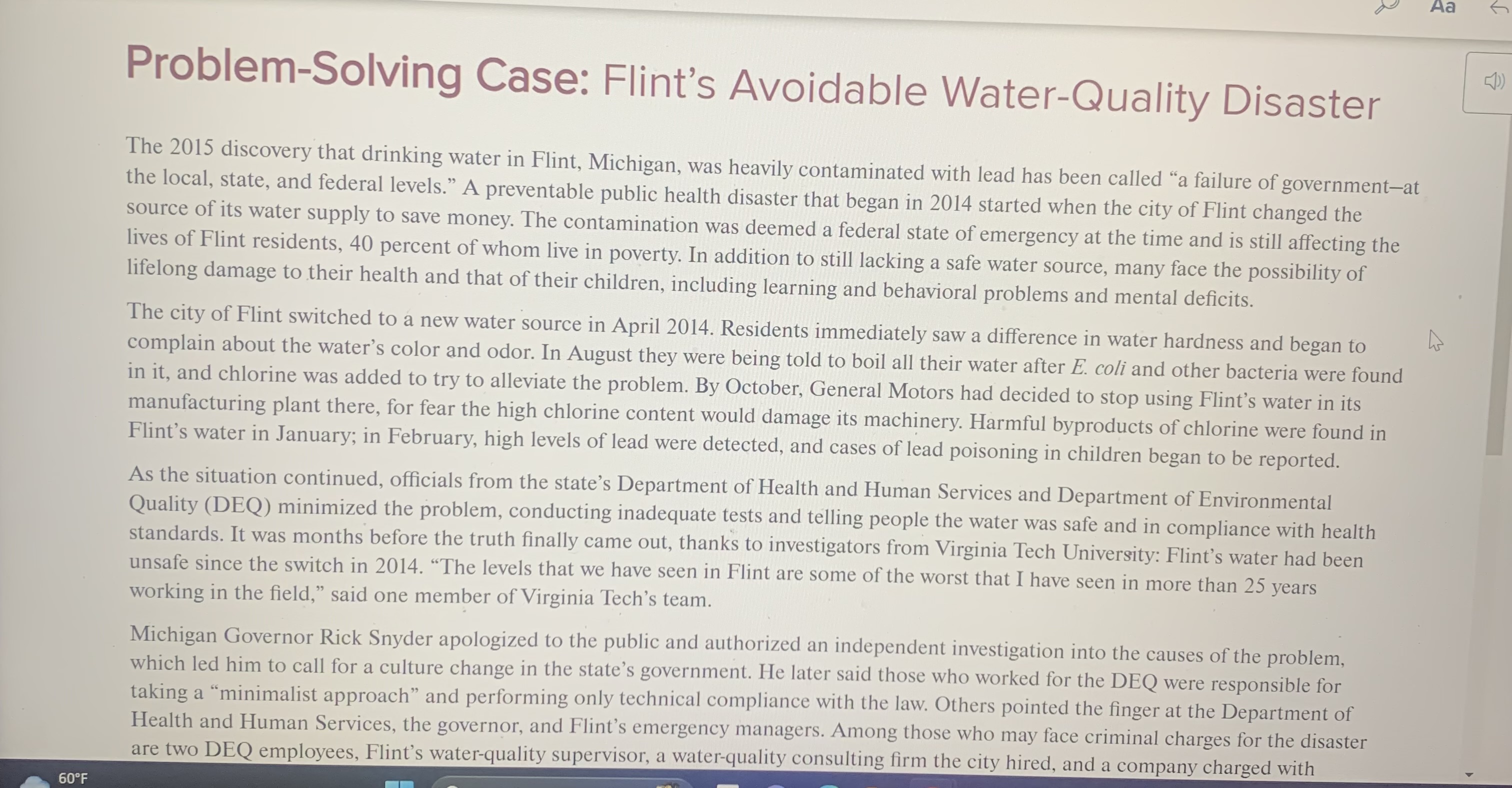
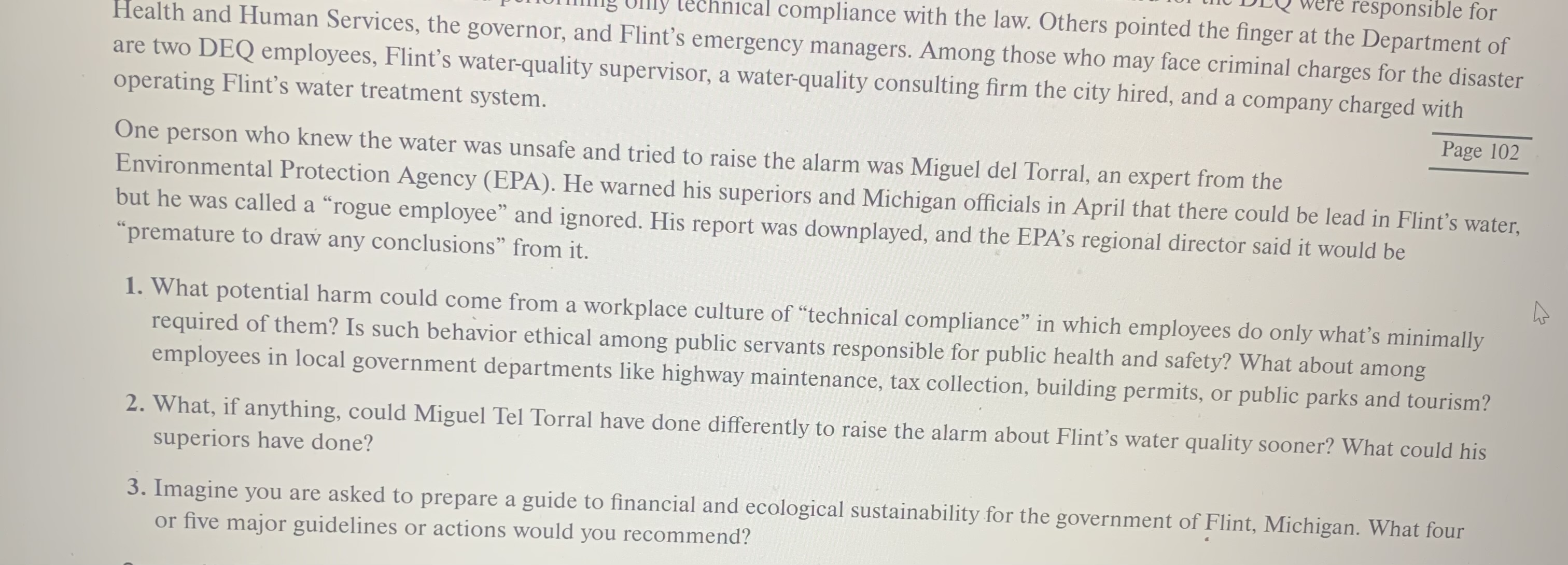
Problem-Solving Case: Flint's Avoidable Water-Quality Disaster The 2015 discovery that drinking water in Flint, Michigan, was heavily contaminated with lead has been called "a failure of government-at the local, state, and federal levels." A preventable public health disaster that began in 2014 started when the city of Flint changed the source of its water supply to save money. The contamination was deemed a federal state of emergency at the time and is still affecting the lives of Flint residents, 40 percent of whom live in poverty. In addition to still lacking a safe water source, many face the possibility of lifelong damage to their health and that of their children, including learning and behavioral problems and mental deficits. The city of Flint switched to a new water source in April 2014. Residents immediately saw a difference in water hardness and began to complain about the water's color and odor. In August they were being told to boil all their water after E. coli and other bacteria were found in it, and chlorine was added to try to alleviate the problem. By October, General Motors had decided to stop using Flint's water in its manufacturing plant there, for fear the high chlorine content would damage its machinery. Harmful byproducts of chlorine were found in Flint's water in January; in February, high levels of lead were detected, and cases of lead poisoning in children began to be reported. As the situation continued, officials from the state's Department of Health and Human Services and Department of Environmental Quality (DEQ) minimized the problem, conducting inadequate tests and telling people the water was safe and in compliance with health standards. It was months before the truth finally came out, thanks to investigators from Virginia Tech University: Flint's water had been unsafe since the switch in 2014. "The levels that we have seen in Flint are some of the worst that I have seen in more than 25 years working in the field," said one member of Virginia Tech's team. Michigan Governor Rick Snyder apologized to the public and authorized an independent investigation into the causes of the problem, which led him to call for a culture change in the state's government. He later said those who worked for the DEQ were responsible for taking a "minimalist approach" and performing only technical compliance with the law. Others pointed the finger at the Department of Health and Human Services, the governor, and Flint's emergency managers. Among those who may face criminal charges for the disaster are two DEQ employees, Flint's water-quality supervisor, a water-quality consulting firm the city hired, and a company charged with Health and Human Services, the governor, and Flint's emerithe finger at the Department of are two DEQ employees, Flint's water-quality supervisor, a chey managers. Among those who may face criminal charges for the disaster operating Flint's water treatment system. One person who knew the water was unsafe and tried to raise the alarm was Miguel del Torral, an expert from the Environmental Protection Agency (EPA). He warned his superiors and Michigan officials in April that there could be lead in Flint's water, but he was called a "rogue employee" and ignored. His report was downplayed, and the EPA's regional director said it would be "premature to draw any conclusions" from it. 1. What potential harm could come from a workplace culture of "technical compliance" in which employees do only what's minimally required of them? Is such behavior ethical among public servants responsible for public health and safety? What about among employees in local government departments like highway maintenance, tax collection, building permits, or public parks and tourism? 2. What, if anything, could Miguel Tel Torral have done differently to raise the alarm about Flint's water quality sooner? What could his superiors have done? 3. Imagine you are asked to prepare a guide to financial and ecological sustainability for the government of Flint, Michigan. What four or five major guidelines or actions would you recommend
Step by Step Solution
There are 3 Steps involved in it

Get step-by-step solutions from verified subject matter experts
 Study Help