







Question: Procedure: Part 1: Consider the discrete-time LTI system model described by, h[n]=1,21,0,n=0n=1otherwise Determine the output of this system in response to the input, x[n]=2,4,2,0,n=0n=1n=2otherwise 1.
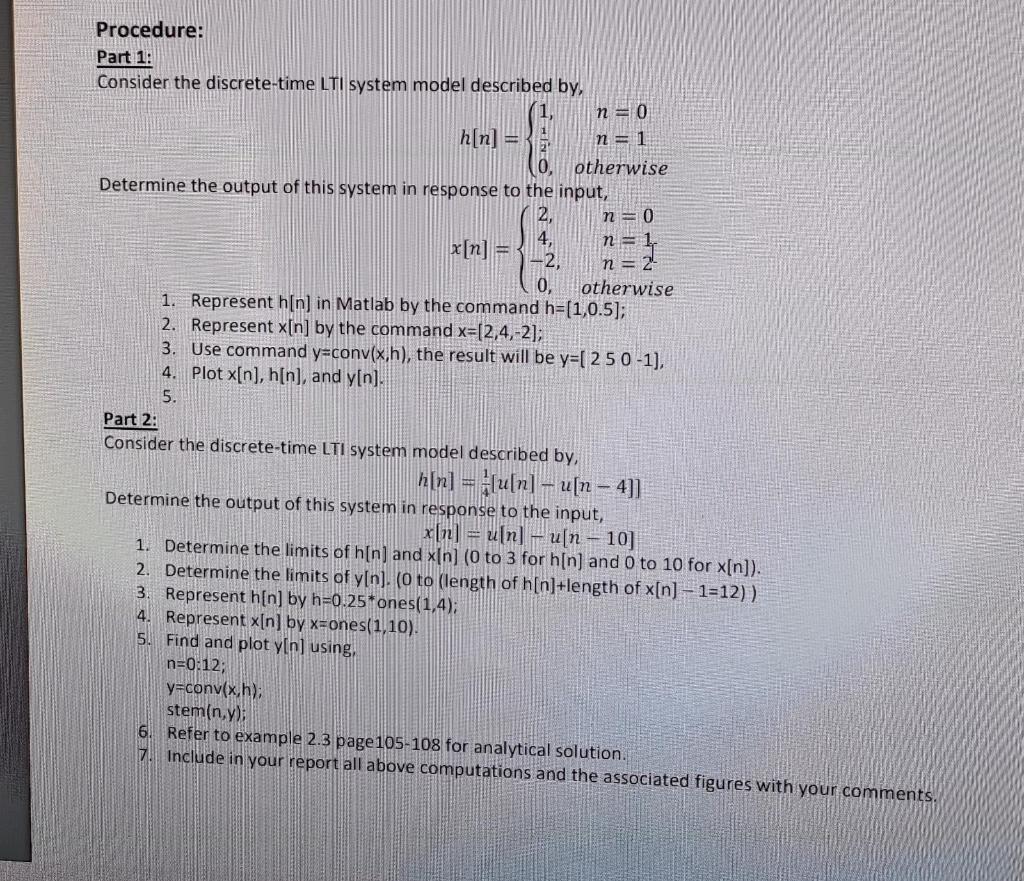
Procedure: Part 1: Consider the discrete-time LTI system model described by, h[n]=1,21,0,n=0n=1otherwise Determine the output of this system in response to the input, x[n]=2,4,2,0,n=0n=1n=2otherwise 1. Represent h[n] in Matlab by the command h=[1,0.5]; 2. Represent x[n] by the command x=[2,4,2]; 3. Use command y=conv(x,h), the result will be y=[2501], 4. Plot x[n],h[n], and y[n]. 5. Part 2: Consider the discrete-time LTI system model described by, h[n]=41[u[n]u[n4]] Determine the output of this system in response to the input, x[n]=u[n]u[n10] 1. Determine the limits of h[n] and x[n] (0 to 3 for h[n] and 0 to 10 for x[n]). 2. Determine the limits of y[n]. ( 0 to (length of h[n]+ length of x[n]1=12) ) 3. Represent h[n] by h=0.25 ones (1,4); 4. Represent x[n] by x= ones (1,10). 5. Find and plot y[n] using, n=0:12; y=conv(x,h); stem(n,y); 6. Refer to example 2.3 page105-108 for analytical solution. 7. Include in your report all above computations and the associated figures with your comments. Procedure: Part 1: Consider the discrete-time LTI system model described by, h[n]=1,21,0,n=0n=1otherwise Determine the output of this system in response to the input, x[n]=2,4,2,0,n=0n=1n=2otherwise 1. Represent h[n] in Matlab by the command h=[1,0.5]; 2. Represent x[n] by the command x=[2,4,2]; 3. Use command y=conv(x,h), the result will be y=[2501], 4. Plot x[n],h[n], and y[n]. 5. Part 2: Consider the discrete-time LTI system model described by, h[n]=41[u[n]u[n4]] Determine the output of this system in response to the input, x[n]=u[n]u[n10] 1. Determine the limits of h[n] and x[n] (0 to 3 for h[n] and 0 to 10 for x[n]). 2. Determine the limits of y[n]. ( 0 to (length of h[n]+ length of x[n]1=12) ) 3. Represent h[n] by h=0.25 ones (1,4); 4. Represent x[n] by x= ones (1,10). 5. Find and plot y[n] using, n=0:12; y=conv(x,h); stem(n,y); 6. Refer to example 2.3 page105-108 for analytical solution. 7. Include in your report all above computations and the associated figures with your comments
Step by Step Solution
There are 3 Steps involved in it

Get step-by-step solutions from verified subject matter experts
 Study Help