



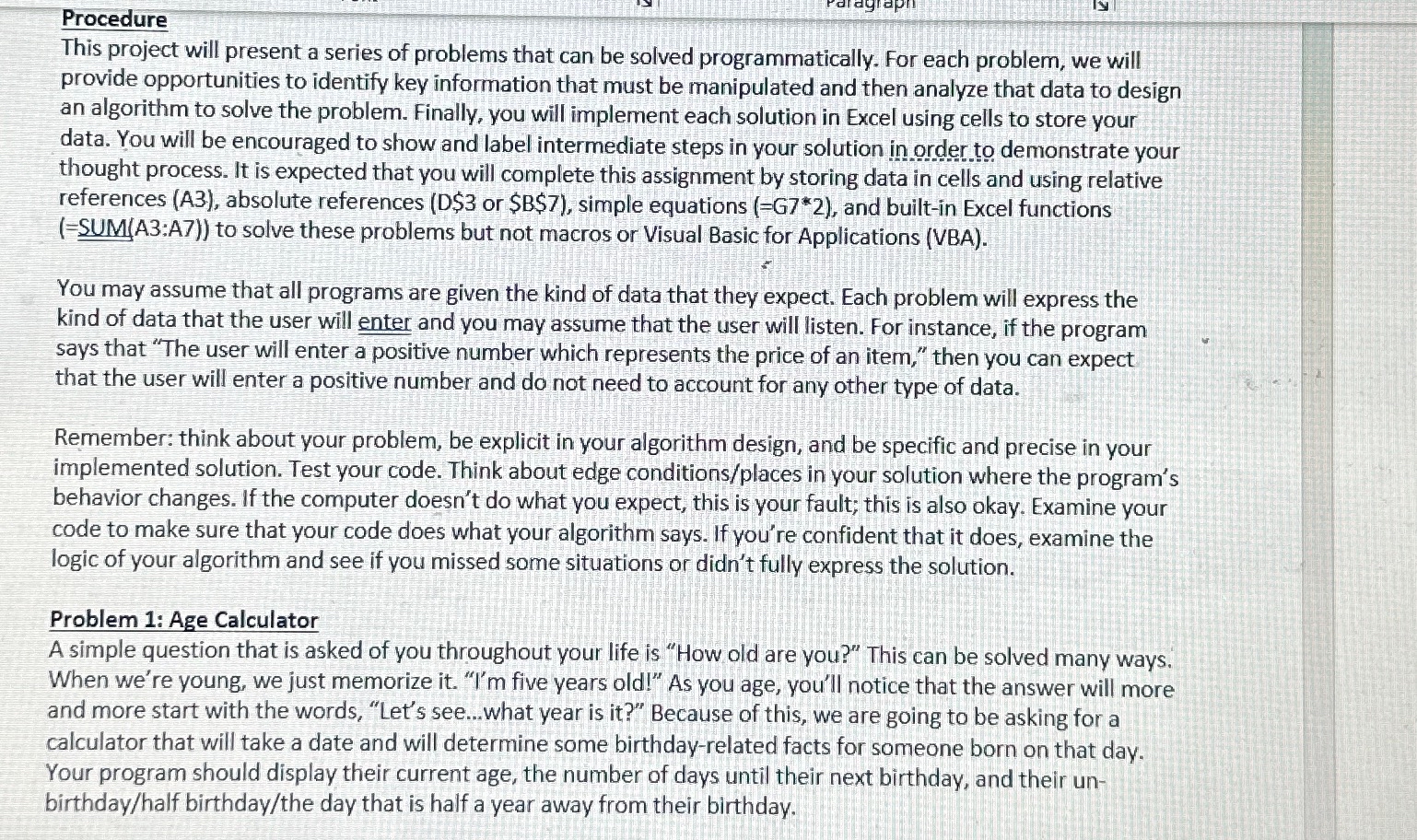
Question: Procedure This project will present a series of problems that can be solved programmatically. For each problem, we will provide opportunities to identify key information
Procedure
This project will present a series of problems that can be solved programmatically. For each problem, we will provide opportunities to identify key information that must be manipulated and then analyze that data to design an algorithm to solve the problem. Finally, you will implement each solution in Excel using cells to store your data. You will be encouraged to show and label intermediate steps in your solution in order to demonstrate your thought process. It is expected that you will complete this assignment by storing data in cells and using relative references A absolute references D$ or $B$ simple equations and builtin Excel functions SUMA:A to solve these problems but not macros or Visual Basic for Applications VBA
You may assume that all programs are given the kind of data that they expect. Each problem will express the kind of data that the user will enter and you may assume that the user will listen. For instance, if the program says that "The user will enter a positive number which represents the price of an item," then you can expect that the user will enter a positive number and do not need to account for any other type of data.
Remember: think about your problem, be explicit in your algorithm design, and be specific and precise in your implemented solution. Test your code. Think about edge conditionsplaces in your solution where the program's behavior changes. If the computer doesn't do what you expect, this is your fault; this is also okay. Examine your code to make sure that your code does what your algorithm says. If you're confident that it does, examine the logic of your algorithm and see if you missed some situations or didn't fully express the solution.
Problem : Age Calculator
A simple question that is asked of you throughout your life is "How old are you?" This can be solved many ways. When we're young, we just memorize itIm five years old!" As you age, you'll notice that the answer will more and more start with the words, "Let's see... what year is it Because of this, we are going to be asking for a calculator that will take a date and will determine some birthdayrelated facts for someone born on that day. Your program should display their current age, the number of days until their next birthday, and their unbirthdayhalf birthdaythe day that is half a year away from their birthday.
Implementation. Please go to the first tab, labeled Prob Age Calculator, in the associated Excel Spreadsheet and implement your solution. You may assume that the input will be in cell B under the label "Date of Birth." The solutions to this problem belong in B B and B in the formatted boxes provided.
It is STRONGLY recommended that you show and label intermediate calculations in the spreadsheet. You may store these calculations anywhere in the sheet but, remember, a solution that is not understandable isn't usable so make sure that your calculations and labels are logical understandable, and organized.
Procedure
This project will present a series of problems that can be solved programmatically. For each problem, we will provide opportunities to identify key information that must be manipulated and then analyze that data to design an algorithm to solve the problem. Finally, you will implement each solution in Excel using cells to store your data. You will be encouraged to show and label intermediate steps in your solution in order to demonstrate your thought process. It is expected that you will complete this assignment by storing data in cells and using relative references A absolute references D$ or $B$ simple equations and builtin Excel functions SUMA:A to solve these problems but not macros or Visual Basic for Applications VBA
You may assume that all programs are given the kind of data that they expect. Each problem will express the kind of data that the user will enter and you may assume that the user will listen. For instance, if the program says that "The user will enter a positive number which represents the price of an item," then you can expect that the user will enter a positive number and do not need to account for any other type of data.
Remember: think about your problem, be explicit in your algorithm design, and be specific and precise in your implemented solution. Test your code. Think about edge conditionsplaces in your solution where the program's behavior changes. If the computer doesn't do what you expect, this is your fault; this is also okay. Examine your code to make sure that your code does what your algorithm says. If you're confident that it does, examine the logic of your algorithm and see if you missed some situations or didn't fully express the solution.
Problem : Age Calculator
A simple question that is asked of you throughout your life is "How old are you?" This can be solved many ways. When we're young, we just memorize itIm five years old!" As
Step by Step Solution
There are 3 Steps involved in it
1 Expert Approved Answer
Step: 1 Unlock

Question Has Been Solved by an Expert!
Get step-by-step solutions from verified subject matter experts
Step: 2 Unlock
Step: 3 Unlock