







Question: Procedures: 1) Go to https://phet.colorado.edu/sims/html/bending-light/latest/bending-light_en.html and select More Tools. Select glass as the incident material and Mystery A and the material the light will
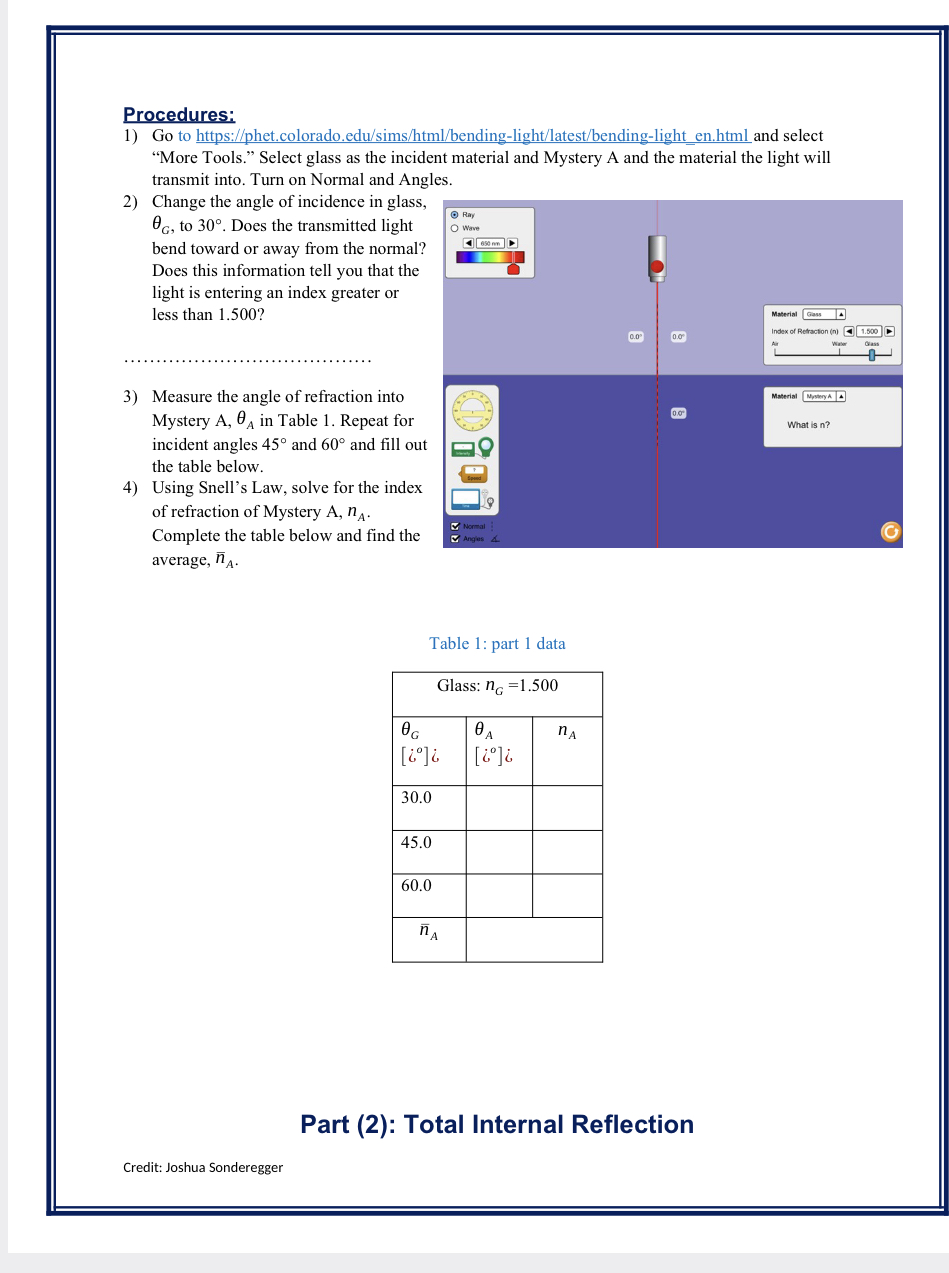
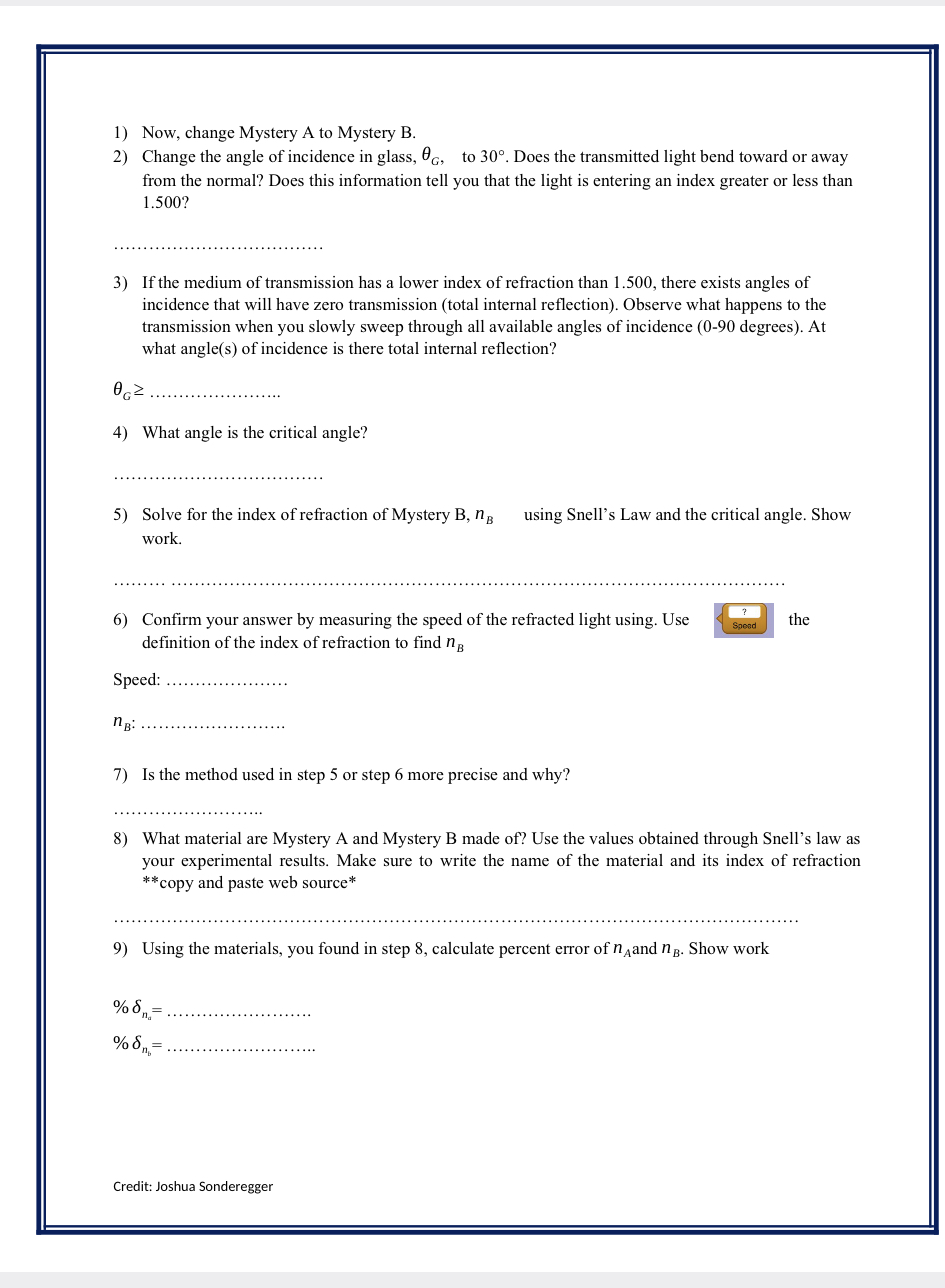
Procedures: 1) Go to https://phet.colorado.edu/sims/html/bending-light/latest/bending-light_en.html and select "More Tools." Select glass as the incident material and Mystery A and the material the light will transmit into. Turn on Normal and Angles. 2) Change the angle of incidence in glass, OG, to 30. Does the transmitted light bend toward or away from the normal? Does this information tell you that the light is entering an index greater or less than 1.500? Ray O Wave 3) Measure the angle of refraction into Mystery A, A in Table 1. Repeat for incident angles 45 and 60 and fill out the table below. 4) Using Snell's Law, solve for the index of refraction of Mystery A, NA. Complete the table below and find the average, A. Normal Angles 4 Table 1: part 1 data Glass: n=1.500 [2] [2] 30.0 45.0 60.0 Material Glass Index of Refraction (n) 0.0 0.0 Water 1.500 Glass Material Mystery A 0.0 What is n? Credit: Joshua Sonderegger Part (2): Total Internal Reflection 1) Now, change Mystery A to Mystery B. 2) Change the angle of incidence in glass, G, to 30. Does the transmitted light bend toward or away from the normal? Does this information tell you that the light is entering an index greater or less than 1.500? 3) If the medium of transmission has a lower index of refraction than 1.500, there exists angles of incidence that will have zero transmission (total internal reflection). Observe what happens to the transmission when you slowly sweep through all available angles of incidence (0-90 degrees). At what angle(s) of incidence is there total internal reflection? 4) What angle is the critical angle? 5) Solve for the index of refraction of Mystery B, NB using Snell's Law and the critical angle. Show work. ? 6) Confirm your answer by measuring the speed of the refracted light using. Use definition of the index of refraction to find n the Speed Speed: NB: 7) Is the method used in step 5 or step 6 more precise and why? 8) What material are Mystery A and Mystery B made of? Use the values obtained through Snell's law as your experimental results. Make sure to write the name of the material and its index of refraction **copy and paste web source* 9) Using the materials, you found in step 8, calculate percent error of nand n B. Show work %5- %8= Credit: Joshua Sonderegger
Step by Step Solution
There are 3 Steps involved in it

Get step-by-step solutions from verified subject matter experts
 Study Help