Question: process costing. Consider the following data for the assembly department In April 4 (Click the icon to view the data.) (Click the icon to view
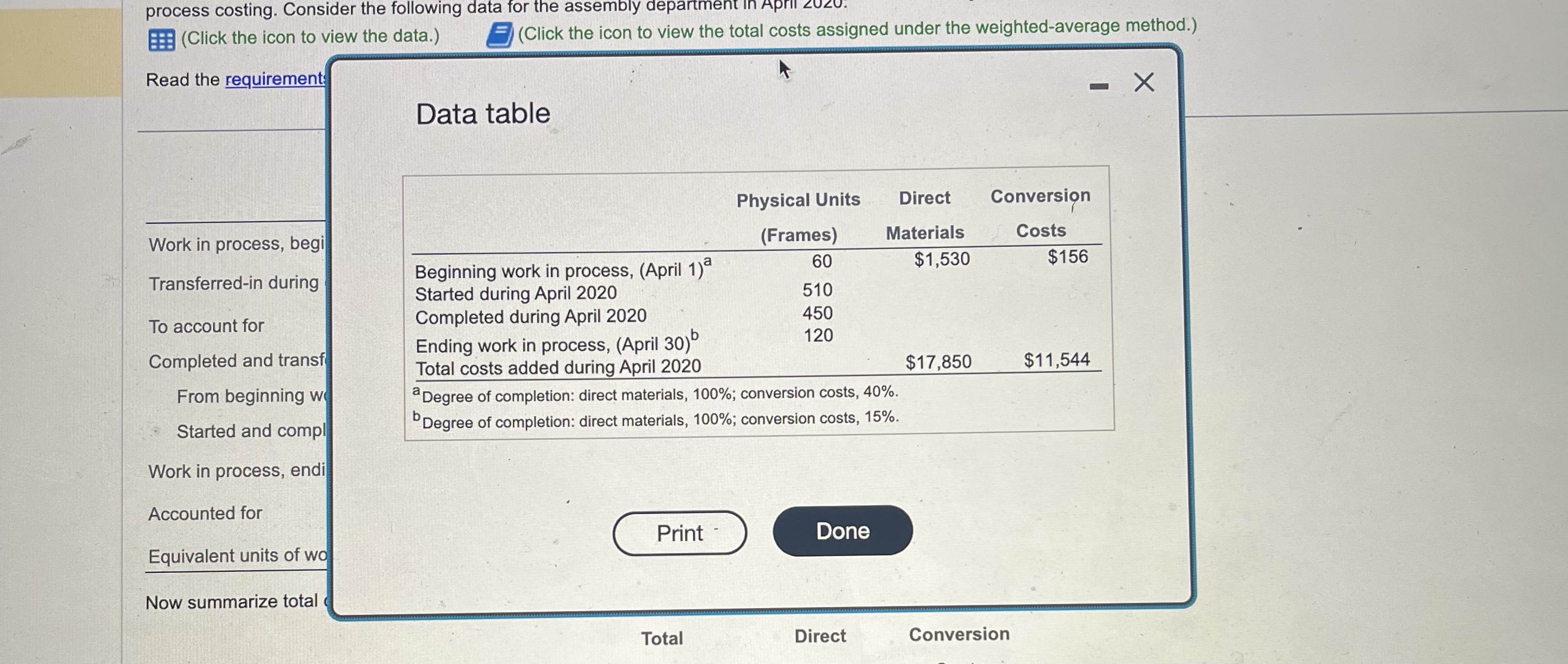
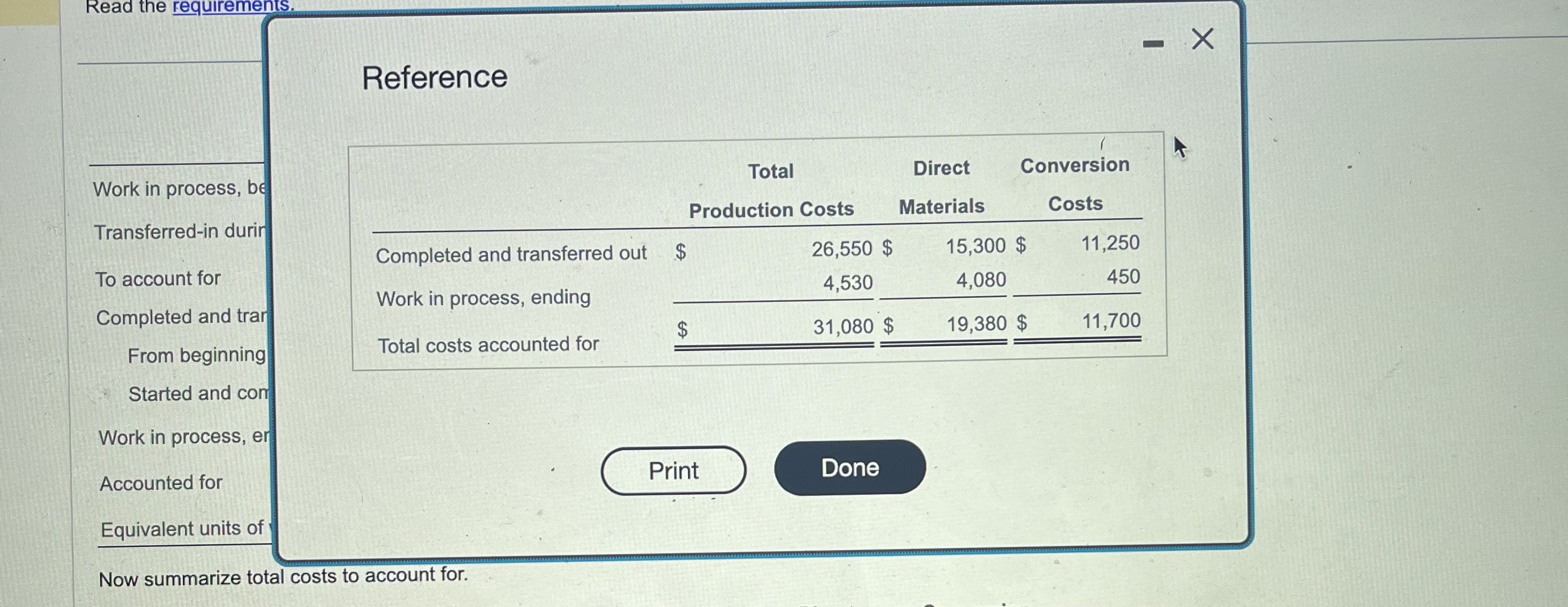
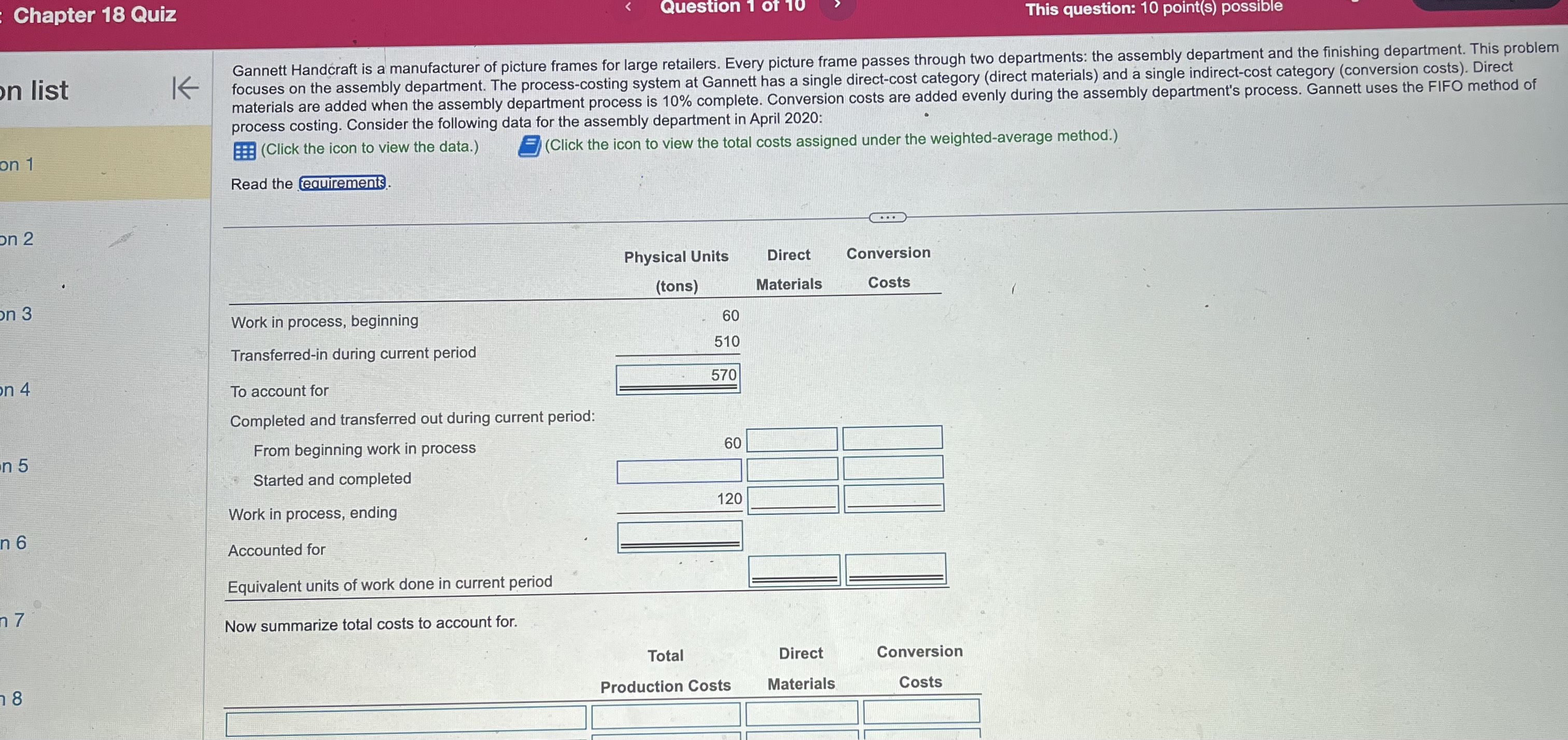
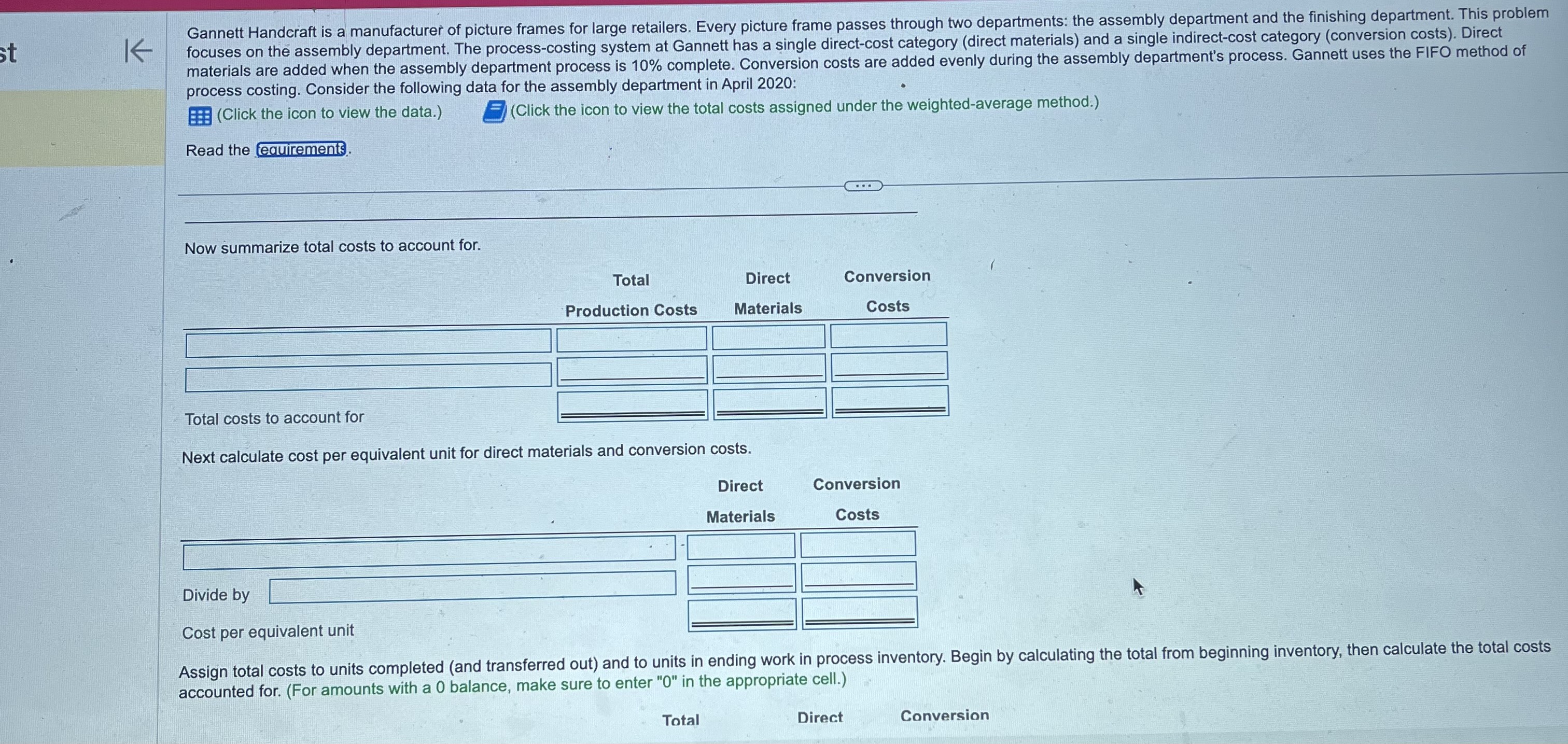
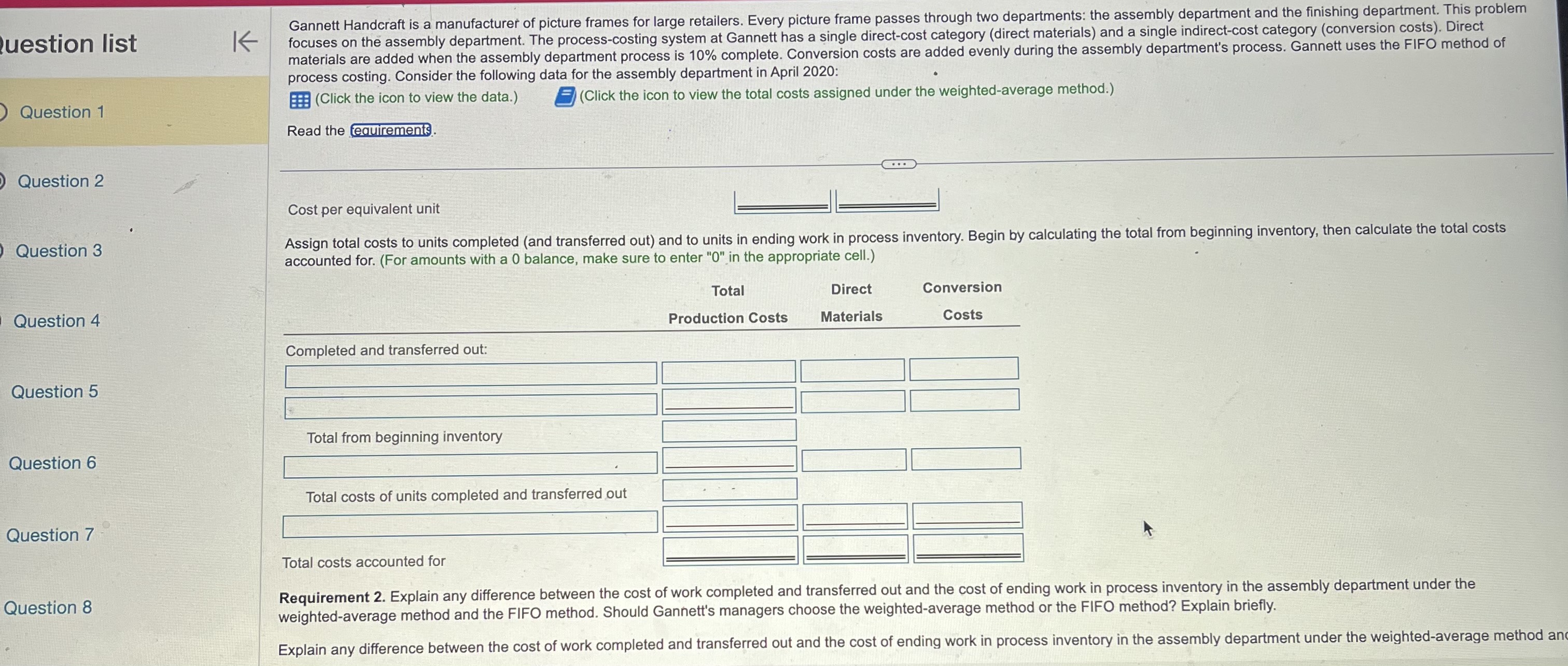
process costing. Consider the following data for the assembly department In April 4 (Click the icon to view the data.) (Click the icon to view the total costs assigned under the weighted-average method.) Read the requirement X Data table Physical Units Direct Conversion Work in process, begi (Frames) Materials Costs 60 $1,530 $156 Transferred-in during Beginning work in process, (April 1)a Started during April 2020 510 To account for Completed during April 2020 450 Ending work in process, (April 30) 120 Completed and transf Total costs added during April 2020 $17,850 $11,544 From beginning w Degree of completion: direct materials, 100%; conversion costs, 40%. Started and comp Degree of completion: direct materials, 100%; conversion costs, 15%. Work in process, endi Accounted for Print Done Equivalent units of wo Now summarize total Total Direct ConversionRead the requirements - X Reference Work in process, be Total Direct Conversion Production Costs Materials Costs Transferred-in durin Completed and transferred out $ 26,550 $ 15,300 $ 11,250 To account for Work in process, ending 4,530 4,080 450 Completed and tran Total costs accounted for $ 31,080 $ 19,380 $ 11,700 From beginning Started and com Work in process, er Accounted for Print Done Equivalent units of Now summarize total costs to account for.Chapter 18 Quiz Question 1 of 10 This question: 10 point(s) possible Gannett Handcraft is a manufacturer of picture frames for large retailers. Every picture frame passes through two departments: the assembly department and the finishing department. This problem n list K focuses on the assembly department. The process-costing system at Gannett has a single direct-cost category (direct materials) and a single indirect-cost category (conversion costs). Direct materials are added when the assembly department process is 10% complete. Conversion costs are added evenly during the assembly department's process. Gannett uses the FIFO method of process costing. Consider the following data for the assembly department in April 2020: on 1 (Click the icon to view the data.) (Click the icon to view the total costs assigned under the weighted-average method.) Read the (equirements. on 2 Physical Units Direct Conversion ( tons) Materials Costs on 3 Work in process, beginning 60 Transferred-in during current period 510 on 4 570 To account for Completed and transferred out during current period: n 5 From beginning work in process 60 Started and completed Work in process, ending 120 n 6 Accounted for Equivalent units of work done in current period Now summarize total costs to account for. Total Direct Conversion 8 Production Costs Materials CostsGannett Handcraft is a manufacturer of picture frames for large retailers. Every picture frame passes through two departments: the assembly department and the finishing department. This problem st K focuses on the assembly department. The process-costing system at Gannett has a single direct-cost category (direct materials) and a single indirect-cost category (conversion costs). Direct materials are added when the assembly department process is 10% complete. Conversion costs are added evenly during the assembly department's process. Gannett uses the FIFO method of process costing. Consider the following data for the assembly department in April 2020: (Click the icon to view the data.) (Click the icon to view the total costs assigned under the weighted-average method.) Read the requirements Now summarize total costs to account for. Total Direct Conversion Production Costs Materials Costs Total costs to account for Next calculate cost per equivalent unit for direct materials and conversion costs. Direct Conversion Materials Costs Divide by Cost per equivalent unit Assign total costs to units completed (and transferred out) and to units in ending work in process inventory. Begin by calculating the total from beginning inventory, then calculate the total costs accounted for. (For amounts with a 0 balance, make sure to enter "0" in the appropriate cell.) Total Direct ConversionGannett Handcraft is a manufacturer of picture frames for large retailers. Every picture frame passes through two departments: the assembly department and the finishing department. This problem uestion list K focuses on the assembly department. The process-costing system at Gannett has a single direct-cost category (direct materials) and a single indirect-cost category (conversion costs). Direct materials are added when the assembly department process is 10% complete. Conversion costs are added evenly during the assembly department's process. Gannett uses the FIFO method of process costing. Consider the following data for the assembly department in April 2020: Question 1 (Click the icon to view the data.) (Click the icon to view the total costs assigned under the weighted-average method:) Read the requirements Question 2 Cost per equivalent unit Question 3 Assign total costs to units completed (and transferred out) and to units in ending work in process inventory. Begin by calculating the total from beginning inventory, then calculate the total costs accounted for. (For amounts with a 0 balance, make sure to enter "0" in the appropriate cell.) Total Direct Conversion Question 4 Production Costs Materials Costs Completed and transferred out: Question 5 Total from beginning inventory Question 6 Total costs of units completed and transferred out Question 7 Total costs accounted for Question 8 Requirement 2. Explain any difference between the cost of work completed and transferred out and the cost of ending work in process inventory in the assembly department under the weighted-average method and the FIFO method. Should Gannett's managers choose the weighted-average method or the FIFO method? Explain briefly. Explain any difference between the cost of work completed and transferred out and the cost of ending work in process inventory in the assembly department under the weighted-average method an
Step by Step Solution
There are 3 Steps involved in it
1 Expert Approved Answer
Step: 1 Unlock
Question Has Been Solved by an Expert!
Get step-by-step solutions from verified subject matter experts
Step: 2 Unlock
Step: 3 Unlock
Students Have Also Explored These Related Accounting Questions!









 Study Help