







Question: Procter & Gamble (P&G) (Danigelis, 2018) In 2018, Procter 8f. Gamble (P&G), an American multinational consumer goods corporation, has reached zero manufacturing waste to landfill
Procter & Gamble (P&G) (Danigelis, 2018)
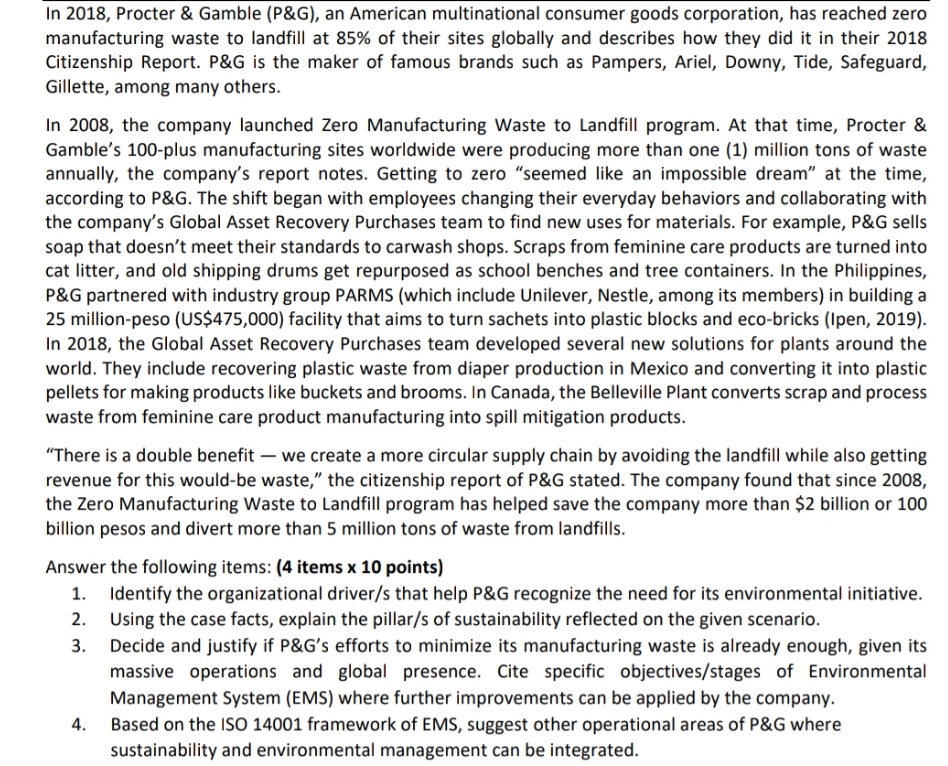
In 2018, Procter 8f. Gamble (P&G), an American multinational consumer goods corporation, has reached zero manufacturing waste to landfill at 85% of their sites globally and describes how they did it in their 2013 Citizenship Report. PsiG is the maker of famous brands such as Pampers, Ariel, Downy, Tide, Safeguard, Gillette, among many others. In 2008, the company launched Zero Manufacturing Waste to Landll program. At that time, Procter 8: Gamble's 100-plus manufacturing sites worldwide were producing more than one (1) million tons of waste annually, the company's report notes. Getting to zero "seemed like an impossible dream\" at the time, according to Patti. The shift began with employees changing their everyday behaviors and collaborating with the company' 5 Global Asset Recovery Purchases team to nd new uses for materials. For example, P316 sells soap that doesn't meet their standards to carwash shops. Scraps from feminine care products are turned into cat litter, and old shipping drums get repurposed as school benches and tree containers. In the Philippines, P&G partnered with industry group FARMS {which include Unilever, Nestle, among its members} in building a 25 million-peso (US$475,000) facility that aims to turn sachets into plastic blocks and eco-bricks (lpen, 2019}. In 2013, the Global Asset Recovery Purchases team developed several new solutions for plants around the world. They include recovering plastic waste from diaper production in Mexico and converting it into plastic pellets for making products like buckets and brooms. In Canada, the Belleville Plant converts scrap and prooess waste from feminine care product manufacturing into spill mitigation products. "There is a double benet we create a more circular supply chain by avoiding the landll while also getting revenue for this would-be waste," the citizenship report of PRIG stated. The company found that since 2003, the Zero Manufacturing Waste to Landfill program has helped save the company more than $2 billion or 100 billion pesos and divert more than 5 million tons of waste from landlls. Answer the following items: (4 items it 10 points} 1. Identify the organizational driver/s that help P816 recognize the need for its environmental initiative. 2. Using the case facts, explain the pillar/s of sustainability reflected on the given scenario. 3. Decide and justify if Pi's efforts to minimize its manufacturing waste is already enough, given its massive operations and global presence. Cite specic objectiveslstages of Environmental Management System (EMS) where further improvements can be applied by the company. 4. Based on the ISO 14001 framework of EMS, suggest other operational areas of P&G where sustainability and environmental management can be Integrated
Step by Step Solution
There are 3 Steps involved in it

Get step-by-step solutions from verified subject matter experts
 Study Help