







Question: Product maker model type A 1001 pc A 1002 pc A 1003 pc B 1004 pc B 1005 pc B 1006 pc C 1007 pc
| maker | model | type |
|---|---|---|
| A | 1001 | pc |
| A | 1002 | pc |
| A | 1003 | pc |
| B | 1004 | pc |
| B | 1005 | pc |
| B | 1006 | pc |
| C | 1007 | pc |
| D | 1008 | pc |
| D | 1009 | pc |
| D | 1010 | pc |
| E | 1011 | pc |
| E | 1012 | pc |
| E | 1013 | pc |
| E | 2001 | laptop |
| E | 2002 | laptop |
| E | 2003 | laptop |
| A | 2004 | laptop |
| A | 2005 | laptop |
| A | 2006 | laptop |
| B | 2007 | laptop |
| F | 2008 | laptop |
| F | 2009 | laptop |
| G | 2010 | laptop |
| E | 3001 | printer |
| E | 3002 | printer |
| E | 3003 | printer |
| D | 3004 | printer |
| D | 3005 | printer |
| H | 3006 | printer |
| H | 3007 | printer |
| C | 4001 | flash |
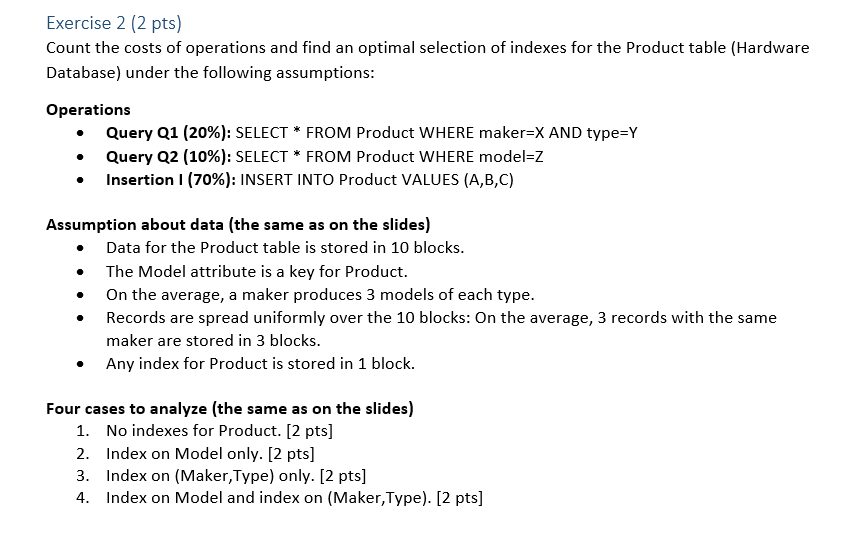
Exercise 2 (2 pts) Count the costs of operations and find an optimal selection of indexes for the Product table (Hardware Database) under the following assumptions: Operations Query Q1 (20%): SELECT * FROM Product WHERE maker-X AND type-Y Query Q2 (10%): SELECT * FROM Product WHERE model-Z insertion l (70%): INSERT INTO Product VALUES (A,B,C) Assumption about data (the same as on the slides) Data for the Product table is stored in 10 blocks. The Model attribute is a key for Product. On the average, a maker produces 3 models of each type. Records are spread uniformly over the 10 blocks: On the average, 3 records with the same maker are stored in 3 blocks . Any index for Product is stored in 1 block. Four cases to analyze (the same as on the slides) 1. 2. 3. 4. No indexes for Product. [2 pts] Index on Model only. [2 pts] Index on (Maker,Type) only. [2 pts] Index on Model and index on (Maker,Type). [2 pts] Exercise 2 (2 pts) Count the costs of operations and find an optimal selection of indexes for the Product table (Hardware Database) under the following assumptions: Operations Query Q1 (20%): SELECT * FROM Product WHERE maker-X AND type-Y Query Q2 (10%): SELECT * FROM Product WHERE model-Z insertion l (70%): INSERT INTO Product VALUES (A,B,C) Assumption about data (the same as on the slides) Data for the Product table is stored in 10 blocks. The Model attribute is a key for Product. On the average, a maker produces 3 models of each type. Records are spread uniformly over the 10 blocks: On the average, 3 records with the same maker are stored in 3 blocks . Any index for Product is stored in 1 block. Four cases to analyze (the same as on the slides) 1. 2. 3. 4. No indexes for Product. [2 pts] Index on Model only. [2 pts] Index on (Maker,Type) only. [2 pts] Index on Model and index on (Maker,Type). [2 pts]
Step by Step Solution
There are 3 Steps involved in it

Get step-by-step solutions from verified subject matter experts
 Study Help