







Question: Product Pricing using the Cost-Plus Approach Concepts; Differential Analysis for Accepting Additional Business Night Glow Inc. recently began production of a new product, the halogen
Product Pricing using the Cost-Plus Approach Concepts; Differential Analysis for Accepting Additional Business
Night Glow Inc. recently began production of a new product, the halogen light, which required the investment of $600,000 in assets. The costs of producing and selling 10,000 halogen lights are estimated as follows:
| Variable costs per unit: | |
| Direct Materials | $32 |
| Direct Labor | 12 |
| Factory Overhead | 8 |
| Selling and Administrative expenses | 7 |
| Total | $59 |
| Fixed Costs: | |
| Factory Overhead | $180,000 |
| Selling and Administrative expenses | 80,000 |
Night Glow Inc. is currently considering establishing a selling price for the halogen light. The president of Night Glow Inc. has decided to use the cost-plus approach to product pricing and has indicated that the halogen light must earn a 10% rate of return on invested assets.
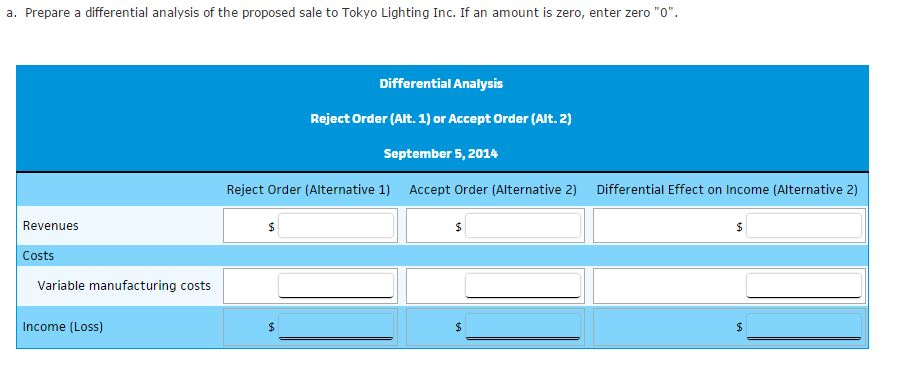
Assume that as of September 1, 2014, 7,000 units of halogen light have been produced and sold during the current year. Analysis of the domestic market indicates that 3,000 additional units of the halogen light are expected to be sold during the remainder of the year at the normal product price determined under the product cost concept. On September 5, Night Glow Inc. received an offer from Tokyo Lighting Inc. for 1,600 units of the halogen light at $57 each. Tokyo Lighting Inc. will market the units in Japan under its own brand name, and no variable selling and administrative expenses associated with the sale will be incurred by Night Glow Inc. The additional business is not expected to affect the domestic sales of the halogen light, and the additional units could be produced using existing productive, selling, and administrative capacity.
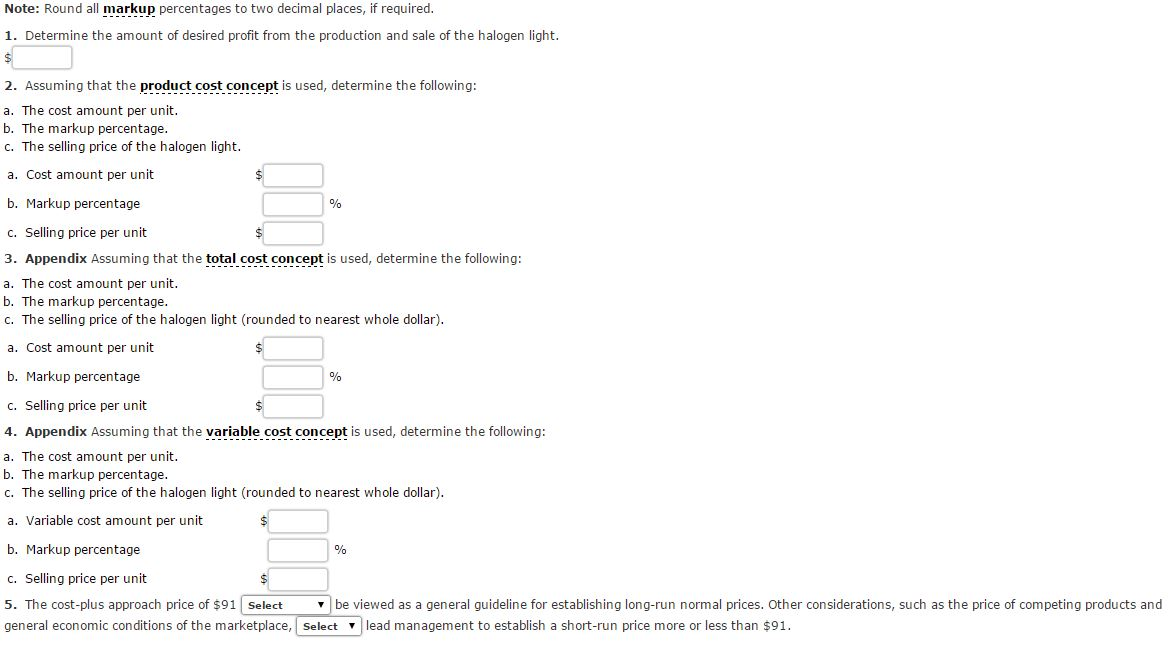
Assume that as of September 1, 2014, 7,000 units of halogen light have been produced and sold during the current year. Analysis of the domestic market indicates that 3,000 additional units of the halogen light are expected to be sold during the remainder of the year at the normal product price determined under the product cost concept. On September 5, Night Glow Inc. received an offer from Tokyo Lighting Inc. for 1,600 units of the halogen light at $57 each. Tokyo Lighting Inc. will market the units in Japan under its own brand name, and no variable selling and administrative expenses associated with the sale will be incurred by Night Glow Inc. The additional business is not expected to affect the domestic sales of the halogen light, and the additional units could be produced using existing productive, selling, and administrative capacity. Note: Round all markup percentages to two decimal places, if required. 1. Determine the amount of desired profit from the production and sale of the halogen light. 2. Assuming that the product cost concept is used, determine the following: 3. Appendix Assuming that the total cost concept is used, determine the following: 4. Appendix Assuming that the variable cost concept is used, determine the following: 5. The cost-plus approach price of $91 [ ] be viewed as a general guideline for establishing long-run normal prices. Other considerations, such as the price of competing products and general economic conditions of the marketplace, [ ] lead management to establish a short-run price more or less than $91. Assume that as of September 1, 2014, 7,000 units of halogen light have been produced and sold during the current year. Analysis of the domestic market indicates that 3,000 additional units of the halogen light are expected to be sold during the remainder of the year at the normal product price determined under the product cost concept. On September 5, Night Glow Inc. received an offer from Tokyo Lighting Inc. for 1,600 units of the halogen light at $57 each. Tokyo Lighting Inc. will market the units in Japan under its own brand name, and no variable selling and administrative expenses associated with the sale will be incurred by Night Glow Inc. The additional business is not expected to affect the domestic sales of the halogen light, and the additional units could be produced using existing productive, selling, and administrative capacity. Note: Round all markup percentages to two decimal places, if required. 1. Determine the amount of desired profit from the production and sale of the halogen light. 2. Assuming that the product cost concept is used, determine the following: 3. Appendix Assuming that the total cost concept is used, determine the following: 4. Appendix Assuming that the variable cost concept is used, determine the following: 5. The cost-plus approach price of $91 [ ] be viewed as a general guideline for establishing long-run normal prices. Other considerations, such as the price of competing products and general economic conditions of the marketplace, [ ] lead management to establish a short-run price more or less than $91
Step by Step Solution
There are 3 Steps involved in it

Get step-by-step solutions from verified subject matter experts
 Study Help