







Question: Product Pricing using the Cost-Plus Approach Methods; Differential Analysis for Accepting Additional Business Digital Displays Inc. recently began production of a new product, flat panel
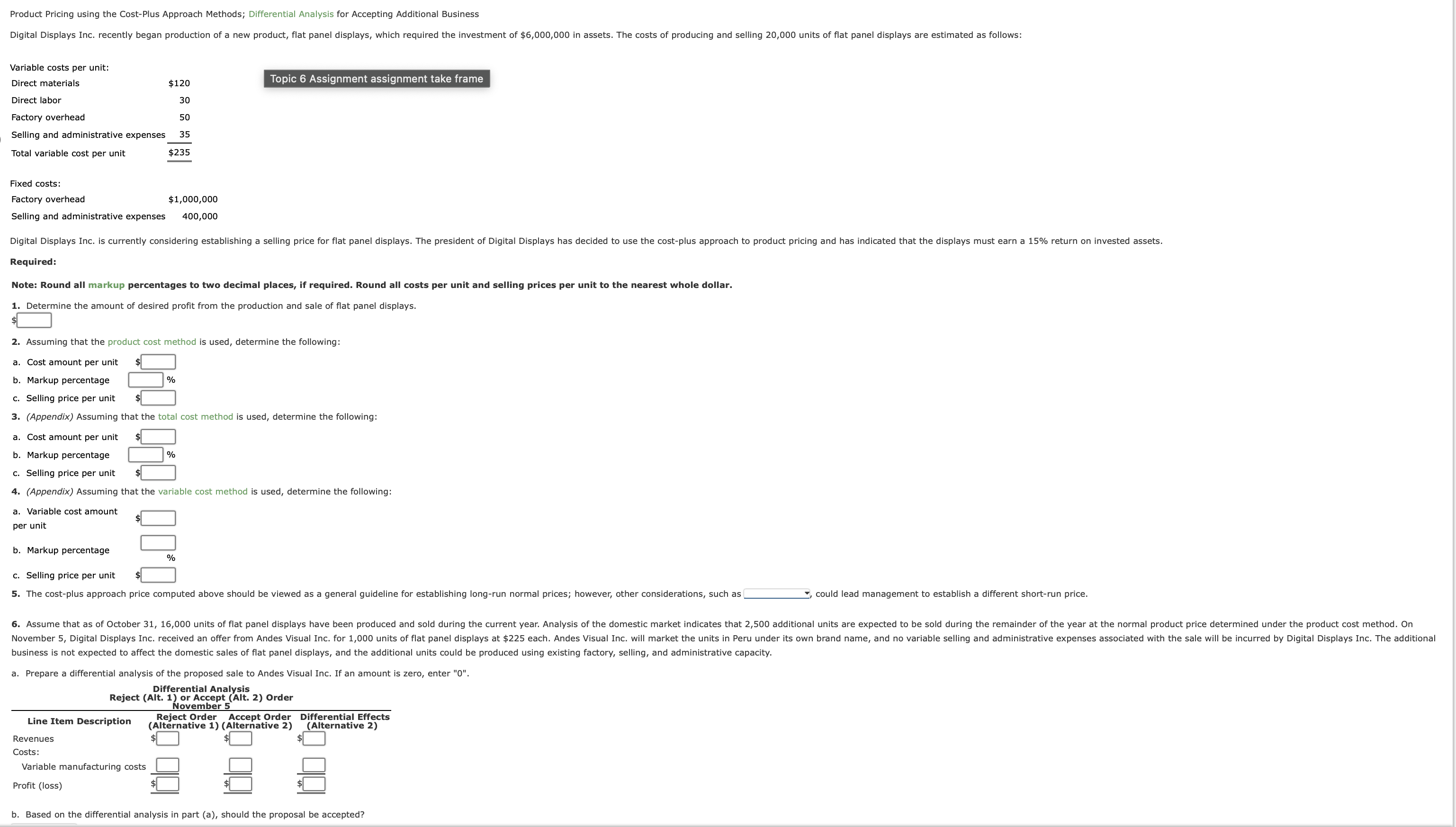
Product Pricing using the Cost-Plus Approach Methods; Differential Analysis for Accepting Additional Business Digital Displays Inc. recently began production of a new product, flat panel displays, which required the investment of $6,000,000 in assets. The costs of producing and selling 20,000 units of flat panel displays are estimated as follows: Variable costs per unit: Direct materials $120 B e Direct labor 30 Factory overhead 50 Selling and administrative expenses 35 Total variable cost per unit $235 Fixed costs: Factory overhead $1,000,000 Selling and administrative expenses 400,000 Digital Displays Inc. is currently considering establishing a selling price for flat panel displays. The president of Digital Displays has decided to use the cost-plus approach to product pricing and has indicated that the displays must earn a 15% return on invested assets. Required: Note: Round all markup percentages to two decimal places, if required. Round all costs per unit and selling prices per unit to the nearest whole dollar. 1. Determine the amount of desired profit from the production and sale of flat panel displays. 2. Assuming that the product cost method is used, determine the following: a. Cost amount per unit b. Markup percentage % c. Selling price per unit 3. (Appendix) Assuming that the total cost method is used, determine the following: a. Cost amount per unit b. Markup percentage % c. Selling price per unit 4. (Appendix) Assuming that the variable cost method is used, determine the following: a. Variable cost amount per unit b. Markup percentage % c. Selling price per unit 5. The cost-plus approach price computed above should be viewed as a general guideline for establishing long-run normal prices; however, other considerations, such as , could lead management to establish a different short-run price. 6. Assume that as of October 31, 16,000 units of flat panel displays have been produced and sold during the current year. Analysis of the domestic market indicates that 2,500 additional units are expected to be sold during the remainder of the year at the normal product price determined under the product cost method. On November 5, Digital Displays Inc. received an offer from Andes Visual Inc. for 1,000 units of flat panel displays at $225 each. Andes Visual Inc. will market the units in Peru under its own brand name, and no variable selling and administrative expenses associated with the sale will be incurred by Digital Displays Inc. The additional business is not expected to affect the domestic sales of flat panel displays, and the additional units could be produced using existing factory, selling, and administrative capaci a. Prepare a differential analysis of the proposed sale to Andes Visual Inc. If an amount is zero, enter "0". Differential Analysis Reject (Alt. 1) or Accept (Alt. 2) Order November 5 Reject Order Accept Order Differential Effects (Alternative 1) (Alternative 2) (Alternative 2) Revenues 4| 4 3| Costs: Line Item Description Variable manufacturing costs Profit (loss) $| 3| 9| b. Based on the differential analysis in part (a), should the proposal be accepted
Step by Step Solution
There are 3 Steps involved in it

Get step-by-step solutions from verified subject matter experts
 Study Help