







Question: Production Functions 1) Consider a production function Y=F(K,L), where Y stands for output, K for capital, L for labor. Assume that a rm producing Y
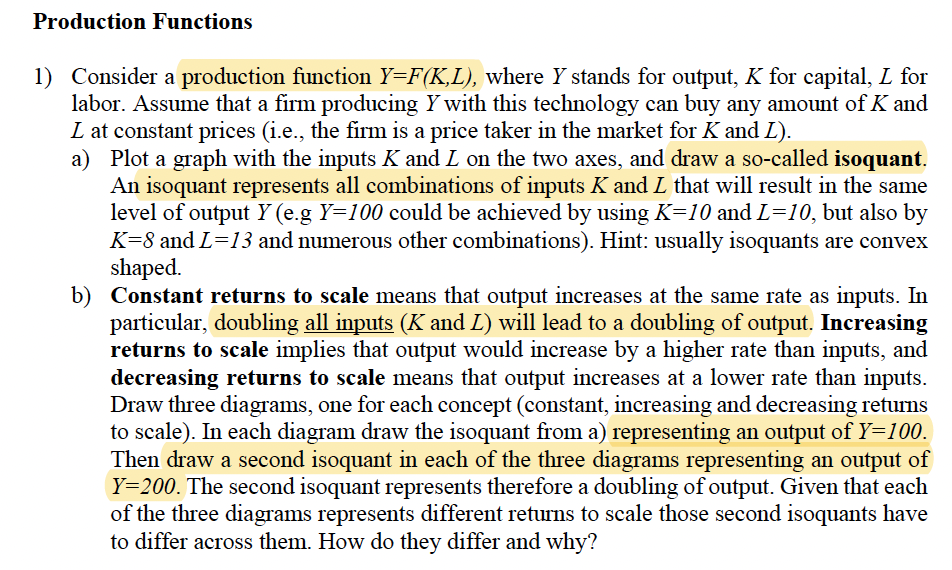
Production Functions 1) Consider a production function Y=F(K,L), where Y stands for output, K for capital, L for labor. Assume that a rm producing Y with this technology can buy any amount of K and I. at constant prices (i.e., the rm is a price taker in the market for K and L). a) Plot a graph with the inputs K and L on the two axes, and draw a so-called isoquant. An isoquant represents all combinations of inputs K and L that will result in the same level of output Y(e. g Y=I00 could be achieved by using K=I 0 andL=]0, but also by K=8 and L=13 and numerous other combinations). Hint: usually isoquants are convex shaped. b) Constant returns to scale means that output increases at the same rate as inputs. In particular, doubling all inputs (K and L) will lead to a doubling of output. Increasing returns to scale implies that output would increase by a higher rate than inputs, and decreasing returns to scale means that output increases at a lower rate than inputs. Draw three diagrams, one for each concept (constant, increasing and decreasing returns to scale). In each diagram draw the isoquant from a) representing an output of Y=J 00. Then draw a second isoquant in each of the three diagrams representing an output of Y=200. The second isoquant represents therefore a doubling of output. Given that each of the three diagrams represents different returns to scale those second isoquants have to differ across them. How do they differ and why
Step by Step Solution
There are 3 Steps involved in it

Get step-by-step solutions from verified subject matter experts
 Study Help