







Question: professional and technical writing ENGL 3405 create 2 memos (pictured in 2nd picture) (ethical case subject) !!!!!(assignemnt to do)!!!!!! (brainstorming guide - to help) (brainstroming
 (ethical case subject)
 !!!!!(assignemnt to do)!!!!!!
 (brainstorming guide - to help)
 (brainstroming guied continued -to help)
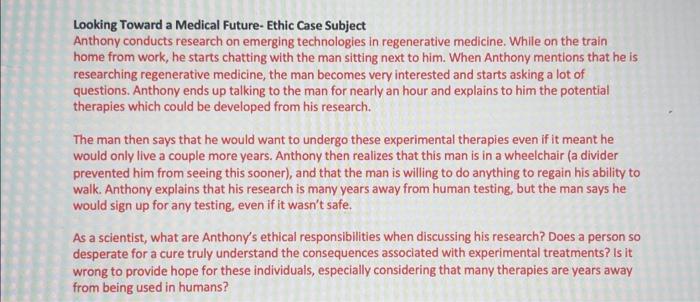
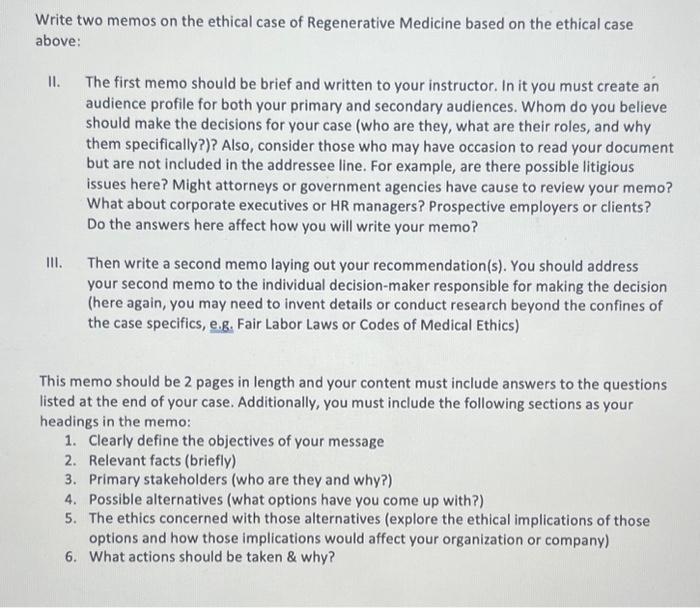
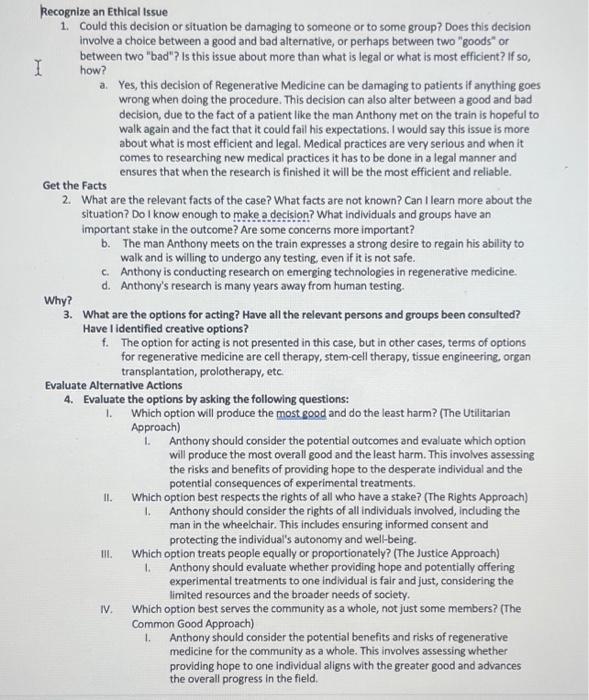
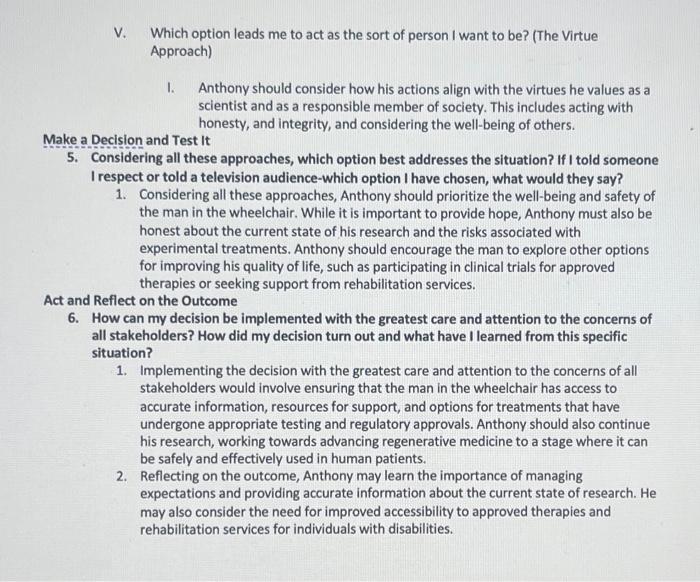
Looking Toward a Medical Future- Ethic Case Subject Anthony conducts research on emerging technologies in regenerative medicine. While on the train home from work, he starts chatting with the man sitting next to him. When Anthony mentions that he is researching regenerative medicine, the man becomes very interested and starts asking a lot of questions. Anthony ends up talking to the man for nearly an hour and explains to him the potential therapies which could be developed from his research. The man then says that he would want to undergo these experimental therapies even if it meant he would only live a couple more years. Anthony then realizes that this man is in a wheelchair (a divider prevented him from seeing this sooner), and that the man is willing to do anything to regain his ability to walk. Anthony explains that his research is many years away from human testing, but the man says he would sign up for any testing, even if it wasn't safe. As a scientist, what are Anthony's ethical responsibilities when discussing his research? Does a person so desperate for a cure truly understand the consequences associated with experimental treatments? Is it wrong to provide hope for these individuals, especially considering that many therapies are years away from being used in humans? Write two memos on the ethical case of Regenerative Medicine based on the ethical case above: II. The first memo should be brief and written to your instructor. In it you must create an audience profile for both your primary and secondary audiences. Whom do you believe should make the decisions for your case (who are they, what are their roles, and why them specifically?)? Also, consider those who may have occasion to read your document but are not included in the addressee line. For example, are there possible litigious issues here? Might attorneys or government agencies have cause to review your memo? What about corporate executives or HR managers? Prospective employers or clients? Do the answers here affect how you will write your memo? III. Then write a second memo laying out your recommendation(s). You should address your second memo to the individual decision-maker responsible for making the decision (here again, you may need to invent details or conduct research beyond the confines of the case specifics, e.g. Fair Labor Laws or Codes of Medical Ethics) This memo should be 2 pages in length and your content must include answers to the questions listed at the end of your case. Additionally, you must include the following sections as your headings in the memo: 1. Clearly define the objectives of your message 2. Relevant facts (briefly) 3. Primary stakeholders (who are they and why?) 4. Possible alternatives (what options have you come up with?) 5. The ethics concerned with those alternatives (explore the ethical implications of those options and how those implications would affect your organization or company) 6. What actions should be taken \& why? Recognize an Ethical issue 1. Could this decision or situation be damaging to someone or to some group? Does this decision involve a choice between a good and bad alternative, or perhaps between two "goods" or between two "bad"? is this issue about more than what is legal or what is most efficient? If so, how? a. Yes, this decision of Regenerative Medicine can be damaging to patients if anything goes wrong when doing the procedure. This decision can also alter between a good and bad decision, due to the fact of a patient like the man Anthony met on the train is hopeful to walk again and the fact that it could fail his expectations. I would say this issue is more about what is most efficient and legal. Medical practices are very serious and when it comes to researching new medical practices it has to be done in a legal manner and ensures that when the research is finished it will be the most efficient and reliable. Get the Facts 2. What are the relevant facts of the case? What facts are not known? Can I learn more about the situation? Do I know enough to make a decision? What individuals and groups have an important stake in the outcome? Are some concerns more important? b. The man Anthony meets on the train expresses a strong desire to regain his ability to walk and is willing to undergo any testing, even if it is not safe. c. Anthony is conducting research on emerging technologies in regenerative medicine. d. Anthony's research is many years away from human testing. Why? 3. What are the options for acting? Have all the relevant persons and groups been consulted? Have I identified creative options? f. The option for acting is not presented in this case, but in other cases, terms of options for regenerative medicine are cell therapy, stem-cell therapy, tissue engineering, organ transplantation, prolotherapy, etc. Evaluate Alternative Actions 4. Evaluate the options by asking the following questions: 1. Which option will produce the most good and do the least harm? (The Utilitarian Approach) 1. Anthony should consider the potential outcomes and evaluate which option will produce the most overall good and the least harm. This involves assessing the risks and benefits of providing hope to the desperate individual and the potential consequences of experimental treatments. II. Which option best respects the rights of all who have a stake? (The Rights Approach) 1. Anthony should consider the rights of all individuals involved, including the man in the wheelchair. This includes ensuring informed consent and protecting the individual's autonomy and well-being. III. Which option treats people equally or proportionately? (The Justice Approach) 1. Anthony should evaluate whether providing hope and potentially offering experimental treatments to one individual is fair and just, considering the limited resources and the broader needs of society. IV. Which option best serves the community as a whole, not just some members? (The Common Good Approach) 1. Anthony should consider the potential benefits and risks of regenerative medicine for the community as a whole. This involves assessing whether providing hope to one individual aligns with the greater good and advances the overall progress in the field. V. Which option leads me to act as the sort of person I want to be? (The Virtue Approach) I. Anthony should consider how his actions align with the virtues he values as a scientist and as a responsible member of society. This includes acting with honesty, and integrity, and considering the well-being of others. Make a Decision and Test it 5. Considering all these approaches, which option best addresses the situation? If I told someone I respect or told a television audience-which option I have chosen, what would they say? 1. Considering all these approaches, Anthony should prioritize the well-being and safety of the man in the wheelchair. While it is important to provide hope, Anthony must also be honest about the current state of his research and the risks associated with experimental treatments. Anthony should encourage the man to explore other options for improving his quality of life, such as participating in clinical trials for approved therapies or seeking support from rehabilitation services. Act and Reflect on the Outcome 6. How can my decision be implemented with the greatest care and attention to the concerns of all stakeholders? How did my decision turn out and what have I learned from this specific situation? 1. Implementing the decision with the greatest care and attention to the concerns of all stakeholders would involve ensuring that the man in the wheelchair has access to accurate information, resources for support, and options for treatments that have undergone appropriate testing and regulatory approvals. Anthony should also continue his research, working towards advancing regenerative medicine to a stage where it can be safely and effectively used in human patients. 2. Reflecting on the outcome, Anthony may learn the importance of managing expectations and providing accurate information about the current state of research. He may also consider the need for improved accessibility to approved therapies and rehabilitation services for individuals with disabilities
Step by Step Solution
There are 3 Steps involved in it

Get step-by-step solutions from verified subject matter experts
 Study Help