







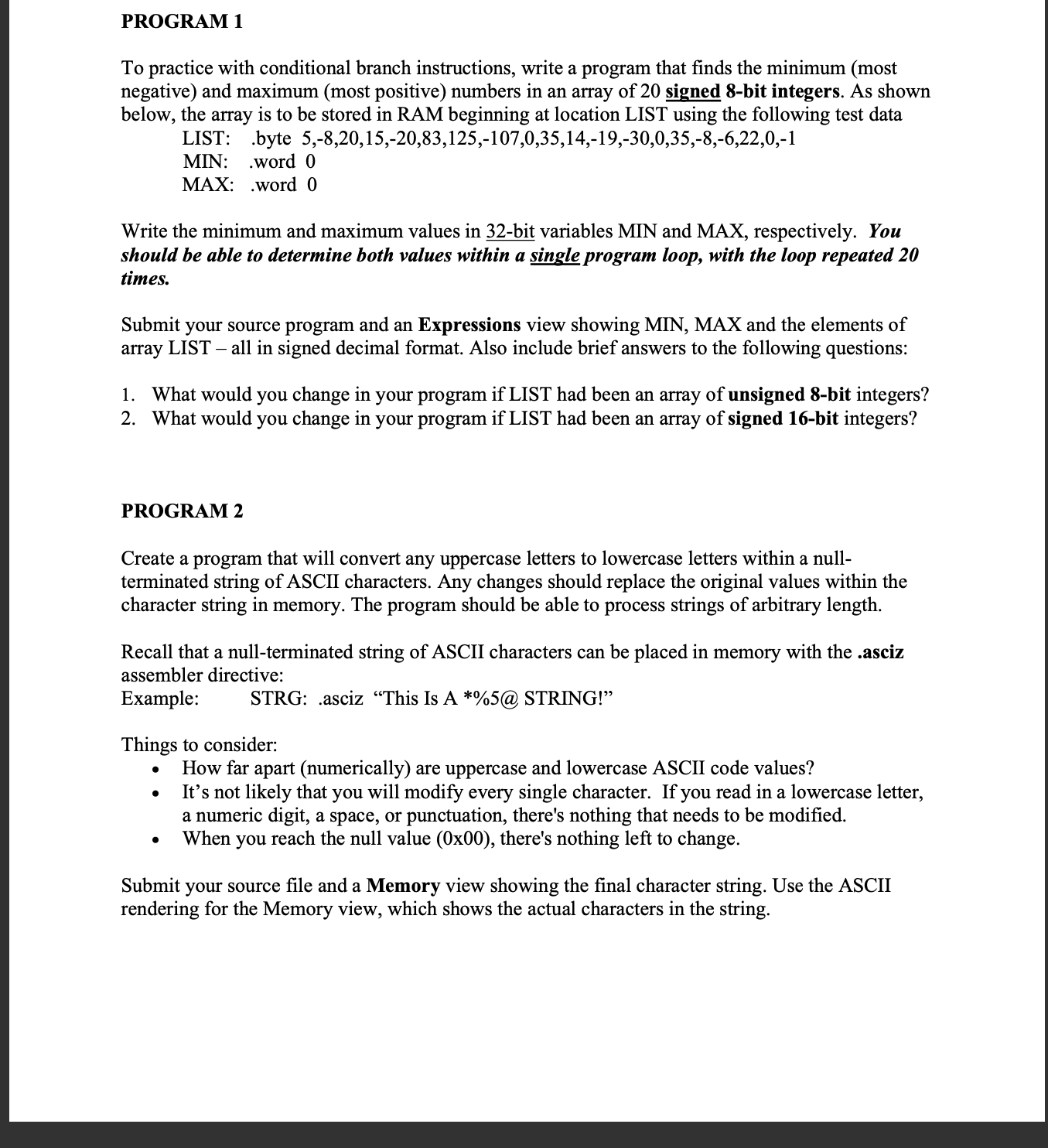
Question: PROGRAM 1 ( WRITE IN ASSEMBLY ) To practice with conditional branch instructions, write a program that finds the minimum ( most negative ) and
PROGRAM WRITE IN ASSEMBLY
To practice with conditional branch instructions, write a program that finds the minimum most
negative and maximum most positive numbers in an array of signed bit integers. As shown
below, the array is to be stored in RAM beginning at location LIST using the following test data
LIST: byte
MIN: word
MAX: word
Write the minimum and maximum values in bit variables MIN and MAX, respectively. You
should be able to determine both values within a single program loop, with the loop repeated
times.
Submit your source program and an Expressions view showing MIN, MAX and the elements of
array LIST all in signed decimal format. Also include brief answers to the following questions:
What would you change in your program if LIST had been an array of unsigned bit integers?
What would you change in your program if LIST had been an array of signed bit integers?
PROGRAM WRITE IN ASSEMBLY
Create a program that will convert any uppercase letters to lowercase letters within a null
terminated string of ASCII characters. Any changes should replace the original values within the
character string in memory. The program should be able to process strings of arbitrary length.
Recall that a nullterminated string of ASCII characters can be placed in memory with the asciz
assembler directive:
Example: STRG: asciz "This Is A @ STRING!"
Things to consider:
How far apart numerically are uppercase and lowercase ASCII code values?
It's not likely that you will modify every single character. If you read in a lowercase letter,
a numeric digit, a space, or punctuation, there's nothing that needs to be modified.
When you reach the null value there's nothing left to change.
Submit your source file and a Memory view showing the final character string. Use the ASCII
rendering for the Memory view, which shows the actual characters in the string.
Step by Step Solution
There are 3 Steps involved in it
1 Expert Approved Answer
Step: 1 Unlock

Question Has Been Solved by an Expert!
Get step-by-step solutions from verified subject matter experts
Step: 2 Unlock
Step: 3 Unlock
 Study Help