







Question: Program Design and Additional or Modified Requirements: these requirements must be followed in addition to what is defined in the textbook. If it is not
Program Design and Additional or Modified Requirements: these requirements must be followed in addition to what is defined in the textbook. If it is not the same as what is described in the textbook, please follow the description/requirements in this document.
1. Inputs and Data structures:
1.1 This C program must read a 9 x 9 Sudoku puzzle from an input text file named SudokuPuzzle.txt into a 9 x 9 matrix (2 dimension int array), e.g., sudokuPuzzle[9][9]. This file must consists of 9 rows. The i-th row in the file SudokuPuzzle.txt consists of the 9 integers in the i-th row of a given Sudoku puzzle, where tab (\t) must be used to separate those numbers in each row of the file. For example, the first two rows in this file for the puzzle shown in
Figure 4.26 should be 6 2 4 5 3 9 1 8 7 5 1 9 7 2 8 6 3 4
This C program must print the matrix sudokuPuzzle[ ][ ] after reading it from the input file (Hint: fgets() can be used for reading a line from a file into a char array, whose size (like 50) needs to be large enough to hold all characters in each line including the newline character. Please study how to open/close a file in C, how to use fgets() to read each line from a file, and how to read each integer from a string where integers are separated by tab (\t) and the last integer is followed by a new line character or NULL.)
1.2 The following shared data structures must be declared as global variables such that they are shared by all threads
1.2.1 sudokuPuzzle[9][9], a two-dimension integer array recording all numbers in the given Sudoku puzzle.
1.2.2 a 9-element Boolean array for 9 columns, where elements [0] through [8] are true or false if columns 1 through 9 in the Sudoku puzzle are valid or invalid, respectively. (Hint: you might have to use typedef int bool; and then use #define to define your own TRUE and FALSE.)
1.2.3 a 9-element Boolean array for 9 rows, where elements [0] through [8] are true or false if rows 1 through 9 in the Sudoku puzzle are valid or invalid, respectively.
1.2.4 a 9-element Boolean array for 9 3 x 3 subgrids, where elements [0] through [8] are true or false if 3 x 3 subgrids 1 through 9 in the Sudoku puzzle are valid or invalid, respectively. Subgrids are numbered from left to right, top to down. The 1st 3 x 3 subgrid is the intersection of rows 1 through 3 and columns 1 through 3, the 2nd 3 x 3 subgrid is the intersection of rows 1 through 3 and columns 4 through 6, , the 4th 3 x 3 subgrid is the intersection of rows 4 through 6 and columns 1 through 3, , the 9th 3 x 3 subgrid is the intersection of rows 7 through 9 and columns 7 through 9.
1.3 typedef a structure to represent the index (row and column) range of the elements in a Sudoku puzzle to be processed by each worker thread created by the parent thread. This structure must include the following four integers. o int topRow; //index (0, 1, , or 8) of top row to be checked by a worker thread o int bottomRow; //index (0, 1, , or 8) of bottom row to be checked by a worker thread o int leftColumn; //index (0, 1, , or 8) of left column to be checked by a worker thread o int rightColumn; //index (0, 1, , or 8) of right column to be checked by a worker thread For example, in the format of (, , , ), the 1st column is represented by (0, 8, 0, 0), the 3rd column is represented by (0, 8, 2, 2), the 8th row is represented by (7, 7, 0, 8), the 2nd subgrid is represented by (0, 2, 3, 5), the 7th subgrid is represented by (6, 8, 0, 2), etc.
2. Worker threads: in this program, the parent thread must create 27 worker threads, one for each column, row, or subgrid.
2.1 The parent thread first initializes 9 structures in an array of structures type-defined in 1.3 to represent 9 columns, where for the k-th column, topRow is 0, bottomRow is 8, and both leftColumn and rightColumn are (k 1). Next, the parent thread creates 9 worker threads, one for each column, and records the thread id of each worker thread in a tid_column[] array. To the worker thread for the k-th column, the parent thread passes the address of the structure initialized earlier for the k-th column as a parameter.
2.2 The parent thread first initializes 9 structures in an array of structures type-defined in 1.3 to represent 9 rows, where for the k-th row, both topRow and bottomRow are (k 1), leftColumn is 0, and rightColumn is 8. Next, the parent thread creates 9 worker threads, one for each row, and records the thread id of each worker thread in a tid_row[] array. To the worker thread for the k-th row, the parent thread passes the address of the structure initialized earlier for the k-th row as a parameter.
2.3 The parent thread first initializes 9 structures in an array of structures type-defined in 1.3 to represent 9 subgrids, where for the 1st, 2nd, and 3rd subgrids, topRow is 0 and bottomRow is 2, for the 4th, 5th, and 6th subgrids, topRow is 3 and bottomRow is 5, for the 7th, 8th, and 9th subgrids, topRow is 6 and bottomRow is 8, for the 1st, 4th, and 7th subgrids, leftColumn is 0 and rightColumn is 2, for the 2nd, 5th, and 8th subgrids, leftColumn is 3 and rightColumn is 5, and for the 3rd, 6th, and 9th subgrids, leftColumn is 6 and rightColumn is 8. Next, the parent thread creates 9 worker threads, one for each subgrid, and records the thread id of each worker thread in a tid_subgrid[] array. To the worker thread for the k-th subgrid, the parent thread passes the address of the structure initialized earlier for the k-th subgrid as a parameter.
2.4 Each worker thread must check all the nine cells in the Sudoku puzzle that are assigned to this worker thread (hint: index range in sudokuPuzzle[][] is topRow must be replaced by the corresponding value TRow: , BRow: , LCol:, RCol: valid! o Otherwise, if those nine cells do NOT contain each of 9 digits (1 through 9) exactly once, 1) set the corresponding entry in the Boolean array in 1.2.2 for columns, 1.2.3 for rows, or 1.2.4 for subgrids as FALSE 2) Display the following message in a new line to stdout, where each must be replaced by the corresponding value TRow: , BRow: , LCol:, RCol: invalid!
2.5 The parent thread must wait for all 27 worker threads to complete, then the parent thread 1) Display the contents of tid_column[] array and the Boolean array declared in 1.2.2 in nine lines to stdout, where each must be replaced by the corresponding value Column:
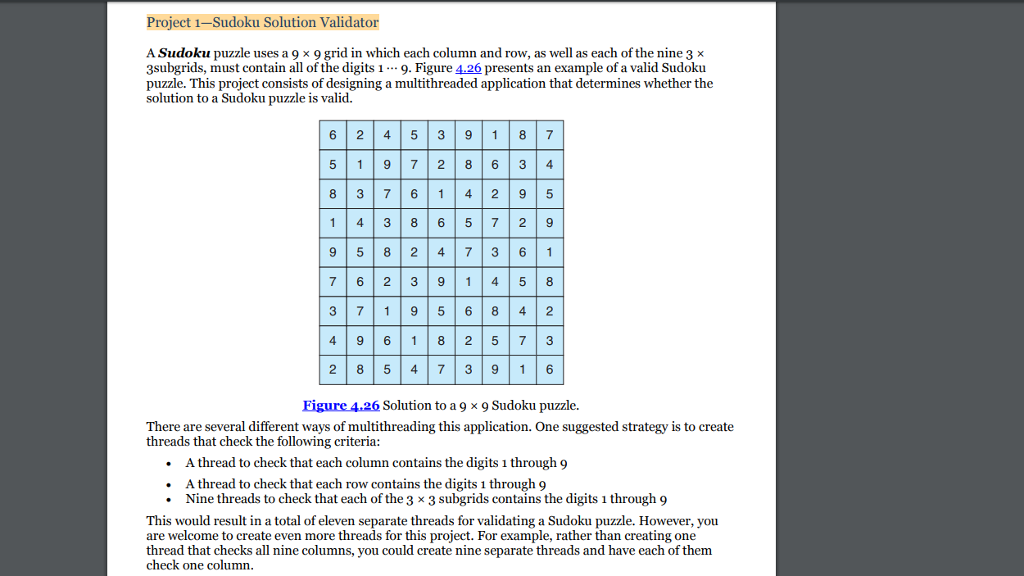
Project 1-Sudoku Solution Validator A Sudoku puzzle uses a 9 x 9 grid in which each column and row, as well as each of the nine 3 x 3subgrids, must contain all of the digits 1 9. Figure 4.26 presents an example of a valid Sudoku puzzle. This project consists of designing a multithreaded application that determines whether the solution to a Sudoku puzzle is valid. 6 24 5 3 9 1 8 7 5 19 72 8 6 3 4 837 6 1 4 2 9 5 1 4 3 86 5 7 2 9 9 5 8 2 4 7 3 6 1 7 6 2 391 4 5 8 3 71 9 5 6 8 4 2 4 9 6 18 2 5 7 3 285 47 3 9 1 6 Eigure 4.26 Solution to a9 x 9 Sudoku puzzle. There are several different ways of multithreading this application. One suggested strategy is to create threads that check the following criteria: A thread to check that each column contains the digits i through 9 A thread to check that each row contains the digits 1 through 9 Nine threads to check that each of the 3 x 3 subgrids contains the digits i through 9 This would result in a total of eleven separate threads for validating a Sudoku puzzle. However, you are welcome to create even more threads for this project. For example, rather than creating one thread that checks all nine columns, you could create nine separate threads and have each of them check one column
Step by Step Solution
There are 3 Steps involved in it

Get step-by-step solutions from verified subject matter experts
 Study Help