







Question: program in c++~ DESCRIPTION OF A SORTING ALGORITHM Suppose we want to sort n integers of an array A in ascending order using the algorithm
program in c++~
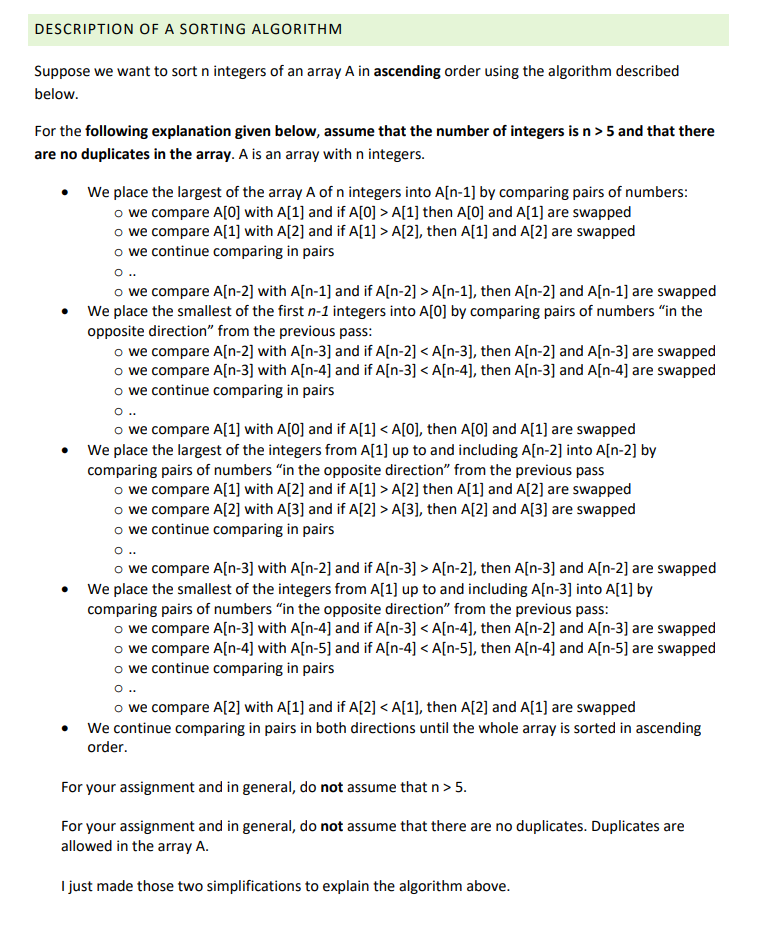
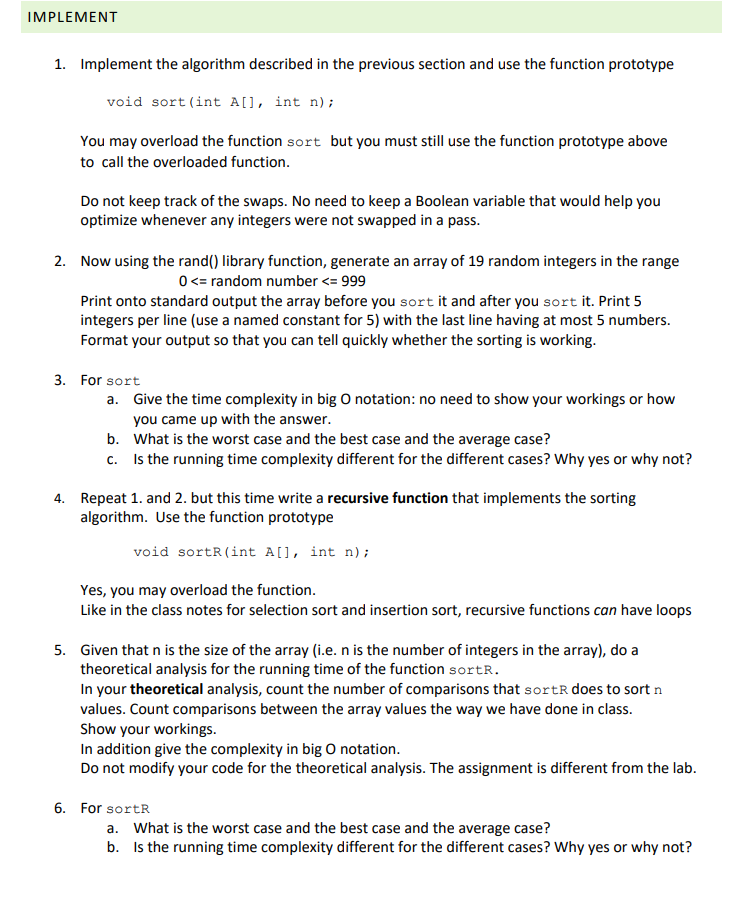
DESCRIPTION OF A SORTING ALGORITHM Suppose we want to sort n integers of an array A in ascending order using the algorithm described below. For the following explanation given below, assume that the number of integers is n>5 and that there are no duplicates in the array. A is an array with n integers. - We place the largest of the array A of n integers into A[n1] by comparing pairs of numbers: we compare A[0] with A[1] and if A[0]>A[1] then A[0] and A[1] are swapped we compare A[1] with A[2] and if A[1]>A[2], then A[1] and A[2] are swapped we continue comparing in pairs we compare A[n2] with A[n1] and if A[n2]>A[n1], then A[n2] and A[n1] are swapped - We place the smallest of the first n1 integers into A[0] by comparing pairs of numbers "in the opposite direction" from the previous pass: we compare A[n2] with A[n3] and if A[n2]A[2] then A[1] and A[2] are swapped we compare A[2] with A[3] and if A[2]>A[3], then A[2] and A[3] are swapped we continue comparing in pairs we compare A[n3] with A[n2] and if A[n3]>A[n2], then A[n3] and A[n2] are swapped - We place the smallest of the integers from A[1] up to and including A[n3] into A[1] by comparing pairs of numbers "in the opposite direction" from the previous pass: we compare A[n3] with A[n4] and if A[n3]5. For your assignment and in general, do not assume that there are no duplicates. Duplicates are allowed in the array A. I just made those two simplifications to explain the algorithm above. 1. Implement the algorithm described in the previous section and use the function prototype voidsort(intA[],intn); You may overload the function sort but you must still use the function prototype above to call the overloaded function. Do not keep track of the swaps. No need to keep a Boolean variable that would help you optimize whenever any integers were not swapped in a pass. 2. Now using the rand() library function, generate an array of 19 random integers in the range 0
Step by Step Solution
There are 3 Steps involved in it

Get step-by-step solutions from verified subject matter experts
 Study Help