







Question: Program P1 integer A, B; input (A); while (A > 0) 1) 2) 3) 4) { 5) 6) 1; if (A 25) B = A
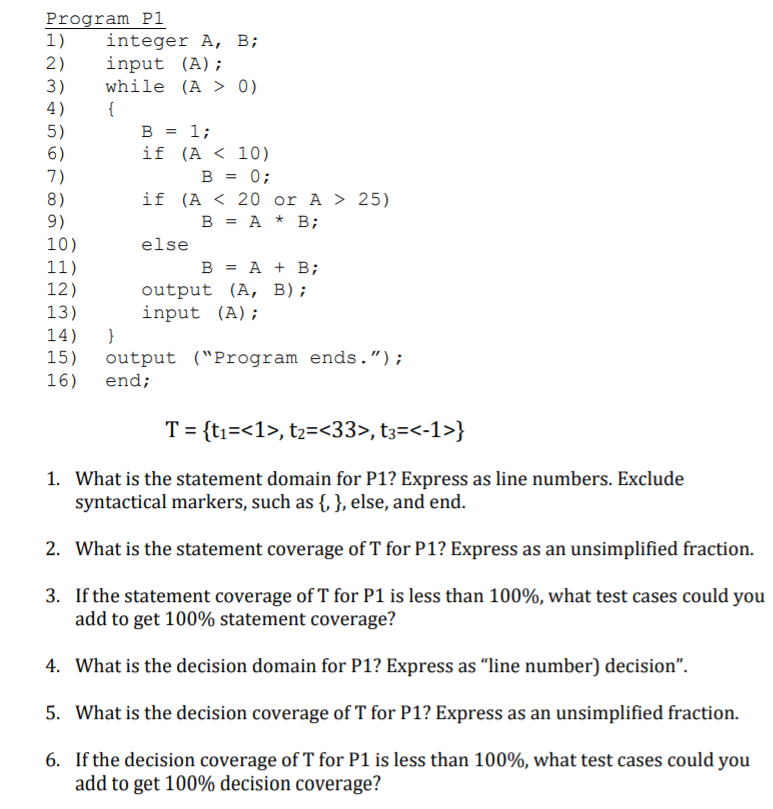
Program P1 integer A, B; input (A); while (A > 0) 1) 2) 3) 4) { 5) 6) 1; if (A 25) B = A * B; B 7) %3D 8) 9) 10) else 11) B = A + B; %3D 12) output (A, B); input (A); 13) } 14) 15) output ("Program ends."); end; 16) T = {ti=, t2=, t3=} 1. What is the statement domain for P1? Express as line numbers. Exclude syntactical markers, such as {, }, else, and end. 2. What is the statement coverage of T for P1? Express as an unsimplified fraction. 3. If the statement coverage of T for P1 is less than 100%, what test cases could you add to get 100% statement coverage? 4. What is the decision domain for P1? Express as "line number) decision". 5. What is the decision coverage of T for P1? Express as an unsimplified fraction. 6. If the decision coverage of T for P1 is less than 100%, what test cases could you add to get 100% decision coverage? Program P1 integer A, B; input (A); while (A > 0) 1) 2) 3) 4) { 5) 6) 1; if (A 25) B = A * B; B 7) %3D 8) 9) 10) else 11) B = A + B; %3D 12) output (A, B); input (A); 13) } 14) 15) output ("Program ends."); end; 16) T = {ti=, t2=, t3=} 1. What is the statement domain for P1? Express as line numbers. Exclude syntactical markers, such as {, }, else, and end. 2. What is the statement coverage of T for P1? Express as an unsimplified fraction. 3. If the statement coverage of T for P1 is less than 100%, what test cases could you add to get 100% statement coverage? 4. What is the decision domain for P1? Express as "line number) decision". 5. What is the decision coverage of T for P1? Express as an unsimplified fraction. 6. If the decision coverage of T for P1 is less than 100%, what test cases could you add to get 100% decision coverage
Step by Step Solution
There are 3 Steps involved in it

Get step-by-step solutions from verified subject matter experts
 Study Help