







Question: Program03 Help typedef unsigned int word; typedef short int bool; //////////////////////////////////////////////////////////////////////////// // create an empty queue with capacity one float* create_queue(word *tail, word *size) {
Program03 Help
typedef unsigned int word; typedef short int bool;
////////////////////////////////////////////////////////////////////////////
// create an empty queue with capacity one float* create_queue(word *tail, word *size) { *tail = 0; *size = 1; return (float*)malloc(sizeof(float)); }
////////////////////////////////////////////////////////////////////////////
// add a new value to the queue void que(float* *queue, word *tail, word *size, const float new_value) {
}
bool is_full(word tail, word size) {
}
// double the capacity of the queue void grow(float* *queue, word *size) {
}
////////////////////////////////////////////////////////////////////////////
bool is_empty(word tail) {
}
// remove (and return) the value at the head of the queue (if not empty) float deque(float* *queue, word *tail, word *size) {
}
bool is_lthf(word tail, word size) {
}
// half the capacity of the queue void shrink(float* *queue, word *size) {
}
------------------------------------------------------------
Please solve the program above by using C programming language as soon as possible. Provide the output of the problem as well.
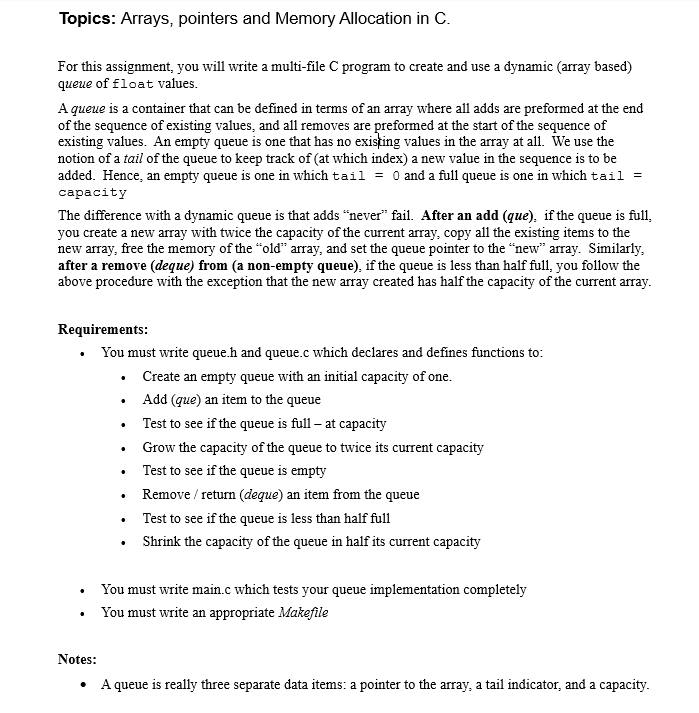
Topics: Arrays, pointers and Memory Allocation in C. For this assignment, you will write a multi-file C program to create and use a dynamic (array based) queue of float values. A queue is a container that can be defined in terms of an array where all adds are preformed at the end of the sequence of existing values, and all removes are preformed at the start of the sequence of existing values. An empty queue is one that has no existing values in the array at all. We use the notion of a tail of the queue to keep track of at which index) a new value in the sequence is to be added. Hence, an empty queue is one in which tail = 0 and a full queue is one in which tail = capacity The difference with a dynamic queue is that adds "never" fail. After an add (que), if the queue is full, you create a new array with twice the capacity of the current array, copy all the existing items to the new array, free the memory of the "old" array, and set the queue pointer to the new array. Similarly, after a remove (deque) from a non-empty queue). if the queue is less than half full, you follow the above procedure with the exception that the new array created has half the capacity of the current array. Requirements: You must write queue.h and queue.c which declares and defines functions to: Create an empty queue with an initial capacity of one. Add (que) an item to the queue Test to see if the queue is full at capacity Grow the capacity of the queue to twice its current capacity Test to see if the queue is empty Remove / return (deque) an item from the queue Test to see if the queue is less than half full Shrink the capacity of the queue in half its current capacity . You must write main.c which tests your queue implementation completely You must write an appropriate Makefile Notes: A queue is really three separate data items: a pointer to the array, a tail indicator, and a capacity
Step by Step Solution
There are 3 Steps involved in it

Get step-by-step solutions from verified subject matter experts
 Study Help