







Question: Programming and logic 1: Java Attached Files: BusinessAccountTester.java (940 B) This is an exercise in creating an aggregation of objects similar to the aggregation discussed
Programming and logic 1: Java
Attached Files:
 BusinessAccountTester.java (940 B)
This is an exercise in creating an aggregation of objects similar to the aggregation discussed and reviewed using the chapter_6 zip file, I want you to do something similar per the following UML diagrams. I will provide you with a program to test your files with. Neither the class variables nor the methods are static (ie. leave out the static modifier).
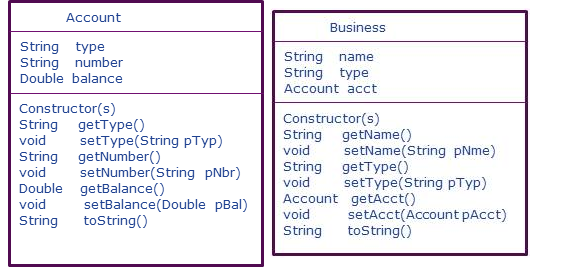
*** I do not know how to upload files so I copied and paste file below*****
BusinessAccountTester.java
public class BusinessAccountTester { public static void main(String[] args) { Account acct_1 = new Account(); acct_1.setType("Checking"); acct_1.setNumber("4332 7789 4223 0987"); acct_1.setBalance(4250.00);
Account acct_2 = new Account(); acct_2.setType("Savings"); acct_2.setNumber("6543 2231 5432 7088"); acct_2.setBalance(3475.99);
Business bus_1 = new Business(); bus_1.setName("Joe's Pizza"); bus_1.setType("Food"); bus_1.setAcct(acct_2);
Business bus_2 = new Business(); bus_2.setName("Carl's Excavating"); bus_2.setType("Landscaping"); bus_2.setAcct(acct_1); System.out.println("Now output the instance variable values for the 2 Businesses "); System.out.println(bus_1.toString()); System.out.println(); System.out.println(bus_2.toString()); System.out.println(" Thank you for your patience"); } }
Step by Step Solution
There are 3 Steps involved in it

Get step-by-step solutions from verified subject matter experts
 Study Help