







Question: Programming in Java: The maximum load that can be placed at the end of a symmetrical wooden beam, such as the rectangular beam shown in
Programming in Java:
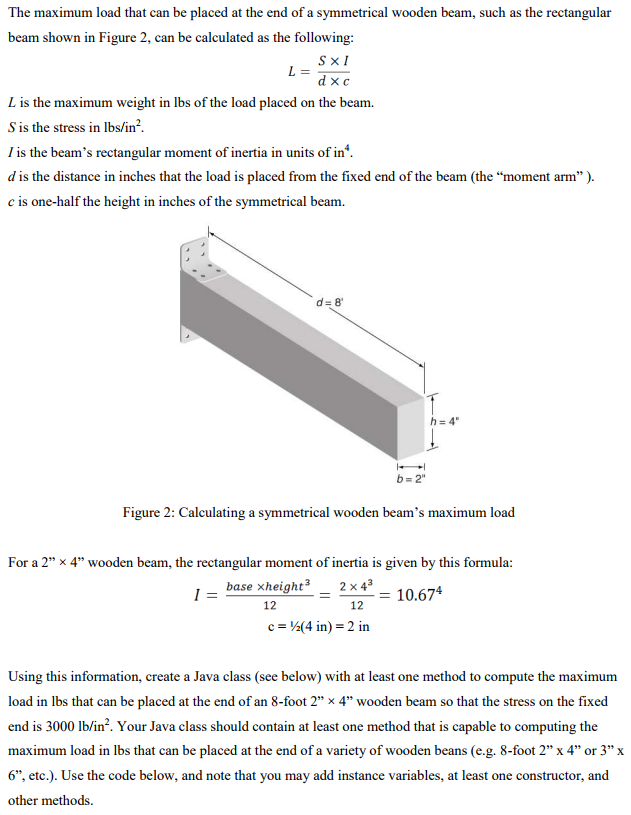
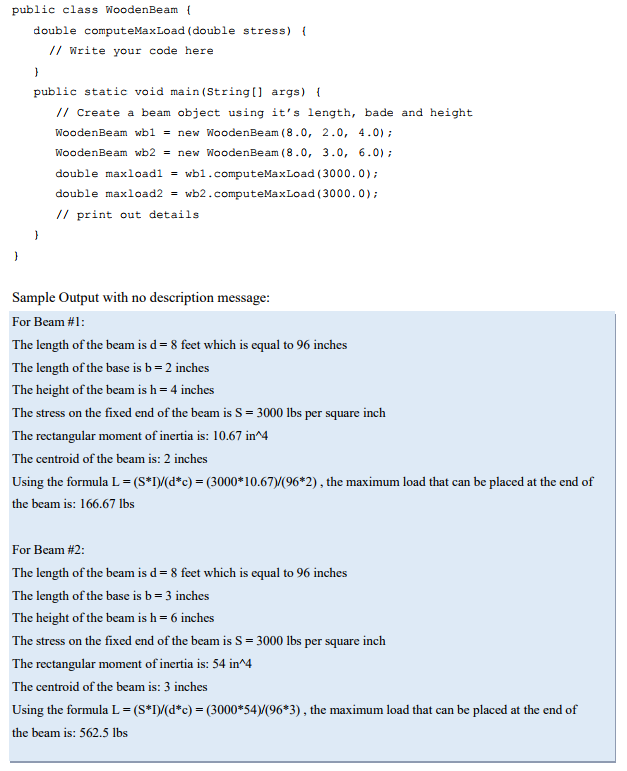
The maximum load that can be placed at the end of a symmetrical wooden beam, such as the rectangular beam shown in Figure 2, can be calculated as the following: L is the maximum weight in lbs of the load placed on the beam. S is the stress in lbs/in I is the beam's rectangular moment of inertia in units of in d is the distance in inches that the load is placed from the fixed end of the beam (the "moment arm" c is one-half the height in inches of the symmetrical beam. d=8' h=4 Figure 2: Calculating a symmetrical wooden beam's maximum load For a 2 x 4 wooden beam, the rectangular moment of inertia is given by this formula: base xheight3-2x4-10.674 12 12 c= (4 in)-2 in Using this information, create a Java class (see below) with at least one method to compute the maximum load in lbs that can be placed at the end of an 8-foot 2" x 4" wooden beam so that the stress on the fixed end is 3000 lb/in*. Your Java class should contain at least one method that is capable to computing the maximum load in lbs that can be placed at the end of a variety of wooden beans (e.g. 8-foot 2 x 4 or 3 x 6", etc.). Use the code below, and note that you may add instance variables, at least one constructor, and other methods
Step by Step Solution
There are 3 Steps involved in it

Get step-by-step solutions from verified subject matter experts
 Study Help