







Question: programming languagae C, please. thanks 8. The mathematical combinations function C(n, k) is usually defined in terms of factorials, as follows: C(n , k) =
programming languagae C, please. thanks
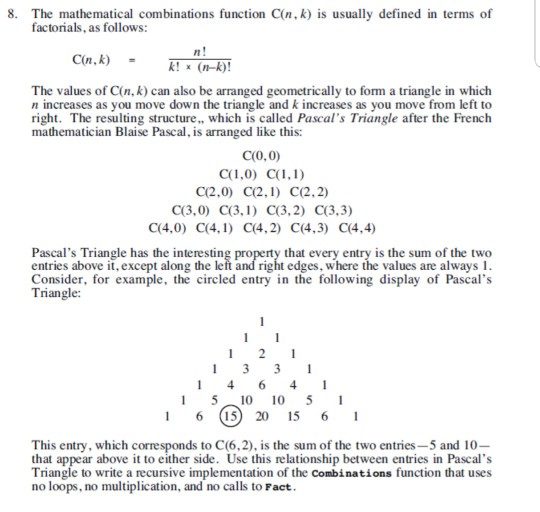
8. The mathematical combinations function C(n, k) is usually defined in terms of factorials, as follows: C(n , k) = k! (n-k)! The values of C(n, k) can also be arranged geometrically to form a triangle in which n increases as you move down the triangle and k increases as you move from left to right. The resulting structure,, which is called Pascal's Triangle after the French mathematician Blaise Pascal, is arranged like this: C(0,0) C,0) C1,1) C(2,0) C(2,1) C(2,2) C(3,0) C(3,1) C(3,2) C(3,3) C(4,0) C(4,1) C(4,2) C(4,3) C(4,4) Pascal's Triangle has the interestin entries above it, except along the le Consider, for example, the circled entry in the following display of Pascal's Triangle: ty that every entry is the sum of the two right edges, where the values are always 1 133 15 10 105 1 6 15 20 15 61 This entry, which corresponds to C(6,2), is the sum of the two entries-5 and 10- that appear above it to either side. Use this relationship between entries in Pascal's Triangle to write a recursive implementation of the Combinations function that uses no loops, no multiplication, and no calls to Fact
Step by Step Solution
There are 3 Steps involved in it

Get step-by-step solutions from verified subject matter experts
 Study Help