







Question: Programming language is C++. Show finished code and an example of the output on PuTTY when done. Use g++ -std=c++17 to compile the code with
Programming language is C++. Show finished code and an example of the output on PuTTY when done. Use g++ -std=c++17 to compile the code with the chrono.cpp and chrono.h file on PuTTY.
//chrono.h
//file chrono.h
#include "std_lib_facilities_4.h"
namespace Chrono { enum class Month { jan = 1, feb, mar, apr, may, jun, jul, aug, sep, oct, nov, dec };
class Date { public: class Invalid {}; //to throw as exception
Date(int y, Month m, int d); //check for valid date and initialize Date(); //default constructor // the default copy operations are fine
/onmodifying operations: int day() const { return d; } Month month() const { return m; } int year() const { return y; }
Date &operator++(); //modifying operations: void add_day(int n); void add_month(int n); void add_year(int n);
private: int y; Month m; int d;
};
bool is_date(int y, Month m, int d); //true for valid date bool leapyear(int y); //true if y is a leap year
bool operator==(const Date& a, const Date & b); bool operator!=(const Date& a, const Date& b);
ostream& operator
istream& operator>>(istream& is, Date& dd);
} //Chrono
//chrono.cpp
#include "Chrono.h"
namespace Chrono { //member function defintions:
Date::Date(int yy, Month mm, int dd) :y{ yy }, m{ mm }, d{ dd } { if (!is_date(yy, mm, dd)) throw Invalid{};
}
const Date& default_date() { static Date dd{ 2001,Month::jan,1 }; //start of 21st century return dd; }
Date::Date() :y{ default_date().year() }, m{ default_date().month() }, d{ default_date().day() } { }
Date& Date::operator++() { d = d + 1; if (is_date == false) { d = 1; } d = 1; if (m == Month::dec) { m == Month::jan; y = y + 1; }
else { int oldM = (int)m; oldM = oldM + 1; m = static_cast
return *this; }
void Date::add_day(int n) { // }
void Date::add_month(int n) { // }
void Date::add_year(int n) { if (m == Month::feb&&d == 29 && !leapyear(y + n)) { //beware of leap years! m = Month::mar; //use March 1 instead of February 29 d = 1; } y += n; } //helper functions:
bool is_date(int y, Month m, int d) { //assume that y is valid
if (d
int days_in_month = 31; //most months have 31 days
switch (m) { case Month::feb: //the length of February varies days_in_month = (leapyear(y)) ? 29 : 28; break; case Month::apr:case Month::jun: case Month::sep:case Month::nov: days_in_month = 30; //the rest have 30 days break; }
if (days_in_month
return true; } bool leapyear(int y) { //see exercise 10 } bool operator==(const Date& a, const Date& b) { return a.year() == b.year() && a.month() == b.month() && a.day() == b.day(); }
bool operator!=(const Date& a, const Date& b) { return !(a == b); } ostream& operator
istream& operator >> (istream& is, Date& dd) { int y, m, d; char ch1, ch2, ch3, ch4; is >> ch1 >> y >> ch2 >> m >> ch3 >> d >> ch4; if (!is) return is; if (ch1 != '(' || ch2 != ',' || ch3 != ',' || ch4 != ')') { is.clear(ios_base::failbit); return is; }
dd = Date(y, Month(m), d);
return is; }
enum class Day { sunday, monday, tuesday, wednesday, thursday, friday, saturday };
Day day_of_week(const Date& d) { return Day::sunday; } Day next_Sunday(const Date& d) { return Day:: sunday; } Day next_weekday(const Date& d) { return Day::sunday; }
} //Chrono
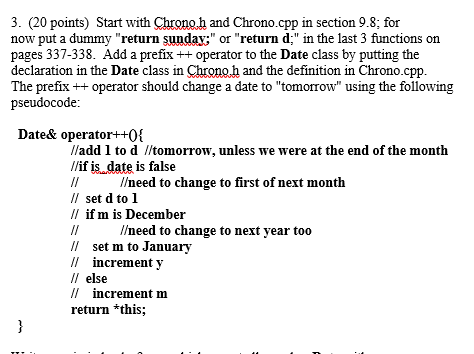
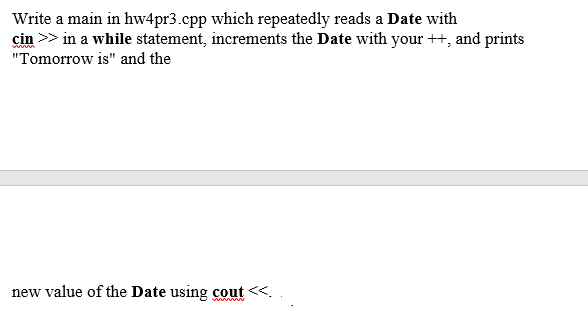
3. (20 points) Start with Chrono,h and Chrono.cpp in section 9.8; for now put a dummy "return Sunday; or "return d in the last 3 functions on pages 337-338. Add a prefix operator to the Date class by putting the declaration in the Date class in Chrono,h and the definition in Chrono.cpp. The prefix operator should change a date to "tomorrow" using the following pseudocode: Date& operator ++0{ /addlto d //tomorrow, unless we were at the end ofthe month //if is date is false /eed to change to first of next month set d to 1 if m is December Ineed to change to next year too set m to January increment y else increment m return this
Step by Step Solution
There are 3 Steps involved in it

Get step-by-step solutions from verified subject matter experts
 Study Help