







Question: Programming Languge Concepts. Please answer the entire question. There are other SIMILAR questions posted. Please do not provide a duplicate or incorrect solution! 2. The
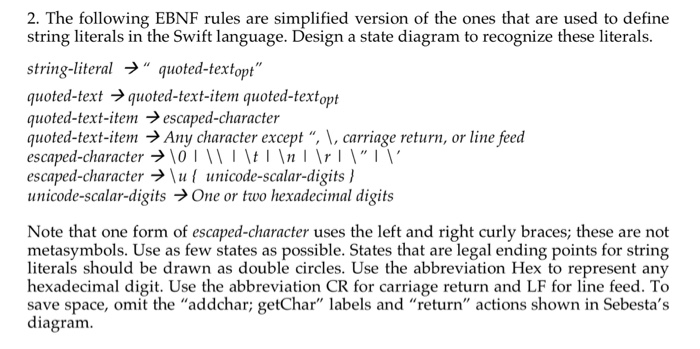
2. The following EBNF rules are simplified version of the ones that are used to define string literals in the Swift language. Design a state diagram to recognize these literals. string-literal >" quoted-textopt" quoted-text quoted-text-item quoted-textopt quoted-text-item escaped-character quoted-text-item >Any character except ", \, carriage return, or line feed escaped-character10III I escaped-character \u I unicode-scalar-digits l unicode-scalar-digits One two hexadecimal digits Note that one form of escaped-character uses the left and right curly braces; these are not metasymbols. Use as few states as possible. States that are legal ending points for string literals should be drawn as double circles. Use the abbreviation Hex to represent any hexadecimal digit. Use the abbreviation CR for carriage return and LF for line feed. To save space, omit the "addchar; getChar" labels and "return" actions shown in Sebesta's diagram
Step by Step Solution
There are 3 Steps involved in it

Get step-by-step solutions from verified subject matter experts
 Study Help