







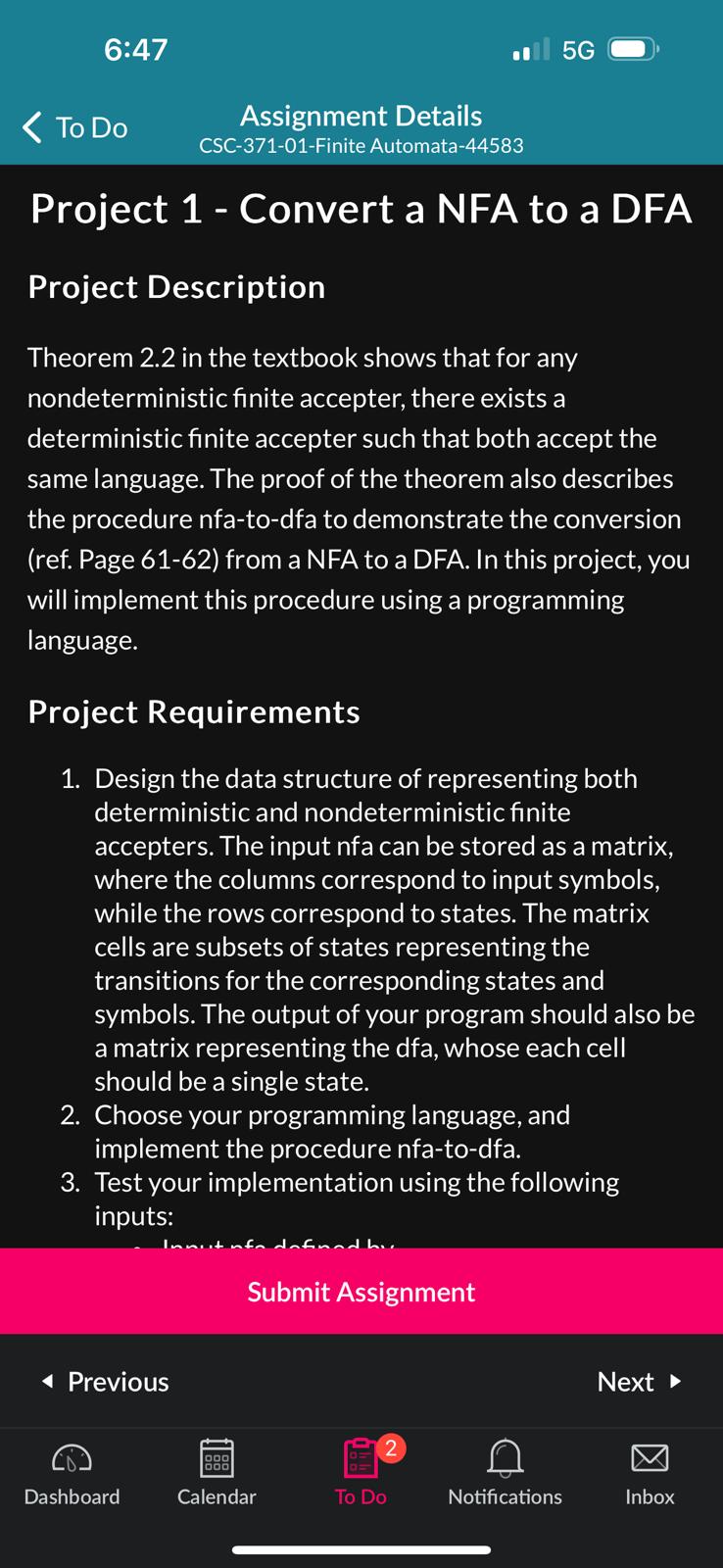
Question: Project 1 - Convert a NFA to a DFA Project Description Theorem 2 . 2 in the textbook shows that for any nondeterministic finite accepter,
Project Convert a NFA to a DFA
Project Description
Theorem in the textbook shows that for any
nondeterministic finite accepter, there exists a
deterministic finite accepter such that both accept the
same language. The proof of the theorem also describes
the procedure nfatodfa to demonstrate the conversion
ref Page from a NFA to a DFA. In this project, you
will implement this procedure using a programming
language.
Project Requirements
Design the data structure of representing both
deterministic and nondeterministic finite
accepters. The input nfa can be stored as a matrix,
where the columns correspond to input symbols,
while the rows correspond to states. The matrix
cells are subsets of states representing the
transitions for the corresponding states and
symbols. The output of your program should also be
a matrix representing the dfa, whose each cell
should be a single state.
Choose your programming language, and
implement the procedure nfatodfa.
Test your implementation using the following
inputs:
Submit Assignment Assignment Details
implement the procedure nfatodfa.
Test your implementation using the following
inputs:
Input nfa defined by
with initial state and final state
Input nfa defined by
with initial state and final state
Input nfd defined by
with initial state and final state
Input nfd defined by
Convert a NFA to a DFA Assignment Details
with initial state and final state
Input nfd defined by
with initial state and final state
Input nfd defined by
with initial state and final state
Project Submission
The data structure design.
The program design such as class diagram if you're
using OO language or program structure if you're
using procedural language and source co
for any nondeterministic finite accepter, there exists a deterministic finite accepter such that both accept the same language. The proof of the theorem also describes the procedure nfatodfa to demonstrate the conversion ref Page from a NFA to a DFA. In this project, you will implement this procedure using a programming language.
qdelta qlambda q
with initial state q and final state q
Input nfd defined by
delta q aq qdelta q bq qdelta q aq dqlambda q q
with initial state q and final state q
Input nfd defined by
delta q aq qdelta q bqdelta q aqdelta q bq
delta q bq
with initial state q and final state q
Project Submission
The data structure design.
The program design such as class diagram if youre using OO language or program structure if youre using procedural language and source code.
The test results for the given inputs. You may add more tests.
Step by Step Solution
There are 3 Steps involved in it
1 Expert Approved Answer
Step: 1 Unlock

Question Has Been Solved by an Expert!
Get step-by-step solutions from verified subject matter experts
Step: 2 Unlock
Step: 3 Unlock
 Study Help