







Question: Project 1 - Image Server In this project you will create a drawing eDSL ( you can take inspiration in your design from the Shape
Project Image Server
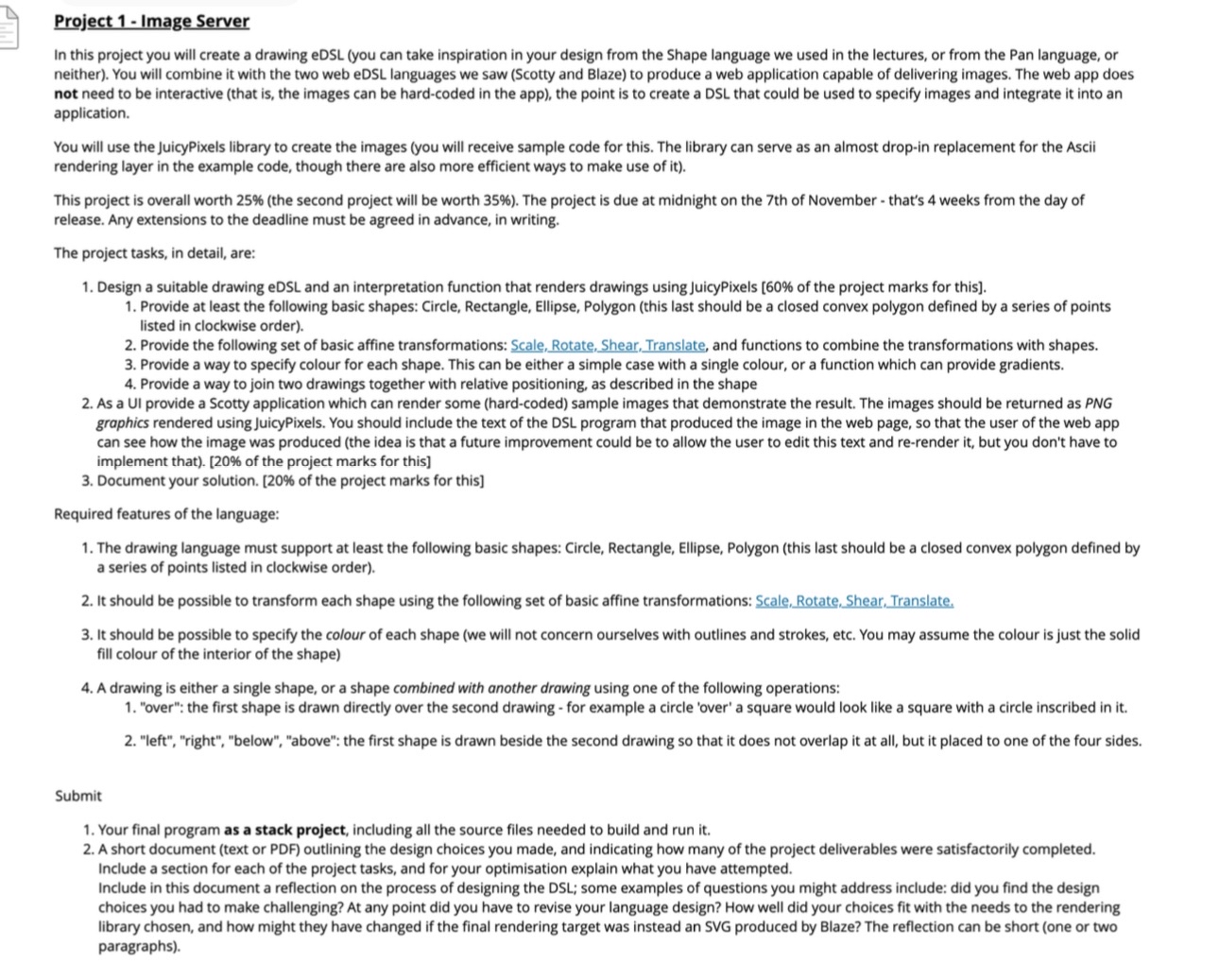
In this project you will create a drawing eDSL you can take inspiration in your design from the Shape language we used in the lectures, or from the Pan language, or neither You will combine it with the two web eDSL languages we saw Scotty and Blaze to produce a web application capable of delivering images. The web app does not need to be interactive that is the images can be hardcoded in the app the point is to create a DSL that could be used to specify images and integrate it into an application.
You will use the JuicyPixels library to create the images you will receive sample code for this. The library can serve as an almost dropin replacement for the Ascii rendering layer in the example code, though there are also more efficient ways to make use of it
This project is overall worth the second project will be worth The project is due at midnight on the th of November that's weeks from the day of release. Any extensions to the deadline must be agreed in advance, in writing.
The project tasks, in detail, are:
Design a suitable drawing eDSL and an interpretation function that renders drawings using JuicyPixels of the project marks for this
Provide at least the following basic shapes: Circle, Rectangle, Ellipse, Polygon this last should be a closed convex polygon defined by a series of points listed in clockwise order
Provide the following set of basic affine transformations: Scale, Rotate, Shear, Translate, and functions to combine the transformations with shapes.
Provide a way to specify colour for each shape. This can be either a simple case with a single colour, or a function which can provide gradients.
Provide a way to join two drawings together with relative positioning, as described in the shape
As a UI provide a Scotty application which can render some hardcoded sample images that demonstrate the result. The images should be returned as PNG graphics rendered using JuicyPixels. You should include the text of the DSL program that produced the image in the web page, so that the user of the web app can see how the image was produced the idea is that a future improvement could be to allow the user to edit this text and rerender it but you don't have to implement that of the project marks for this
Document your solution. of the project marks for this
Required features of the language:
The drawing language must support at least the following basic shapes: Circle, Rectangle, Ellipse, Polygon this last should be a closed convex polygon defined by a series of points listed in clockwise order
It should be possible to transform each shape using the following set of basic affine transformations: Scale, Rotate, Shear, Translate,
It should be possible to specify the colour of each shape we will not concern ourselves with outlines and strokes, etc. You may assume the colour is just the solid fill colour of the interior of the shape
A drawing is either a single shape, or a shape combined with another drawing using one of the following operations:
"over": the first shape is drawn directly over the second drawing for example a circle 'over' a square would look like a square with a circle inscribed in it
"left", "right", "below", "above": the first shape is drawn beside the second drawing so that it does not overlap it at all, but it placed to one of the four sides.
Submit
Your final program as a stack project, including all the source files needed to build and run it
A short document text or PDF outlining the design choices you made, and indicating how many of the project deliverables were satisfactorily completed. Include a section for each of the project tasks, and for your optimisation explain what you have attempted.
Include in this document a reflection on the process of designing the DSL; some examples of questions you might address include: did you find the design choices you had to make challenging? At any point did you have to revise your language design? How well did your choices fit with the needs to the rendering library chosen, and how might they have changed if the final rendering target was instead an SVG produced by Blaze? The reflection can be short one or two paragraphs
Step by Step Solution
There are 3 Steps involved in it
1 Expert Approved Answer
Step: 1 Unlock

Question Has Been Solved by an Expert!
Get step-by-step solutions from verified subject matter experts
Step: 2 Unlock
Step: 3 Unlock
 Study Help