



Question: Project Cost and Procurement Management Project Cost and Procurement Management 1.1 With reference to the case study provided, highlight the reasos behind the adjustments in
Project Cost and Procurement Management 
Project Cost and Procurement Management
1.1 With reference to the case study provided, highlight the reasons behind the adjustments in prices for project commodities and supplies. (10 marks) SECTION A [40 MARKS] Read the case study below and answer the questions that follow. DEALING WITH PRICE INCREASES For many years, inflation rates in much of the worid remained low, a relc of the 1970 s that little concemed most procurement, supply-chain, project and operations leaders. Specific commodities would experience sharp price increases, but those forces typicaly eased before they could trigger broad-based price pressures across swaths of the economy. However, that has since changed, and merchants today are planning and buying for ther categories amid one of the hardest inflationary emironments industy has seen in decades. When a supplier brings a price increase to a merchant, especialy in this economic environment, the buyer may not have the right tools, capacty, or time to determine whether a price increase is warranted. How can an organzation know that shorttem price increases are fair and in ine with expectations? How can companies prepare to deal with the long-term consequences of inflationay markets? No one can perfectly predet the next set of inflasonary pressures, but irs reasonable to assume that they will retum eventually. Project managers can prepare now to minimize the impact when that day amives. Some of the strategies that need to be incorporated include employing a range of sourcing and contracting techniques to reduce exposure to additional costs. For example, diversitying the suppler base for priority raw materials gives companies greator ablity to substtute other sources should prices spike. In some circumstances, it is possble to parther with suppliers to share supply-chan risk by using fixed, longterm contracts. Project managers can include terms and conditions in contracts to adjust the timing of contract expiration and risk exposure. For exampie, volumes might be agreed on for the long term, with pricing updated frequently as the market changes. Other approaches include using putlic indexes or developing synthetic price indexes - that is, tying contact prices to a market price for a particular class of commodities or underlying cost divers. Using collas to restrict price changes to a specfied range and matching contract terms with those of suppler contracts can also heip in structuring risk and allocating it faily. Customers may also be wiling and able to absorb some degree of risk, perhaps in exchange for reduced prices or other concessions. In additon, project leaders can transfer risk extemaly by collaborating with other companies in pursut of shared goa's. Such cooperation can create a win-win situation that reduces both cost and risk. For instance, a manutacturer can gain access to raw materia's outside its home market by contracting to swap or share raw materals with another manulacturer, alowing both companios to reduce costs and giving them the flexibilty they noed to mirimize supply-chain risk
1.1 With reference to the case study provided, highlight the reasos behind the adjustments in prices for project commodities and supplies
1.3 Discuss the benefits and weaknesses of project estimation. 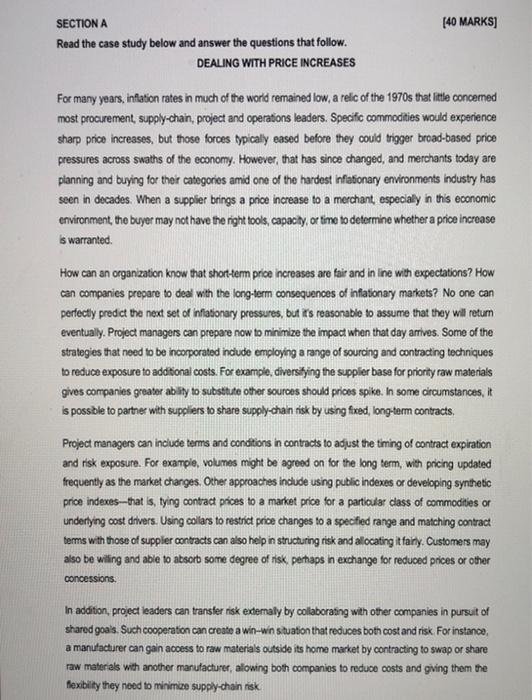
Step by Step Solution
There are 3 Steps involved in it
1 Expert Approved Answer
Step: 1 Unlock

Question Has Been Solved by an Expert!
Get step-by-step solutions from verified subject matter experts
Step: 2 Unlock
Step: 3 Unlock