







Question: Project Name:- EX5_2_TMR1_16Bit_INT_Delay_100mSec Description:- The previous program uses Timer 0 , which is an 8-bit Timer. When using a 16-bit timer, this results in less
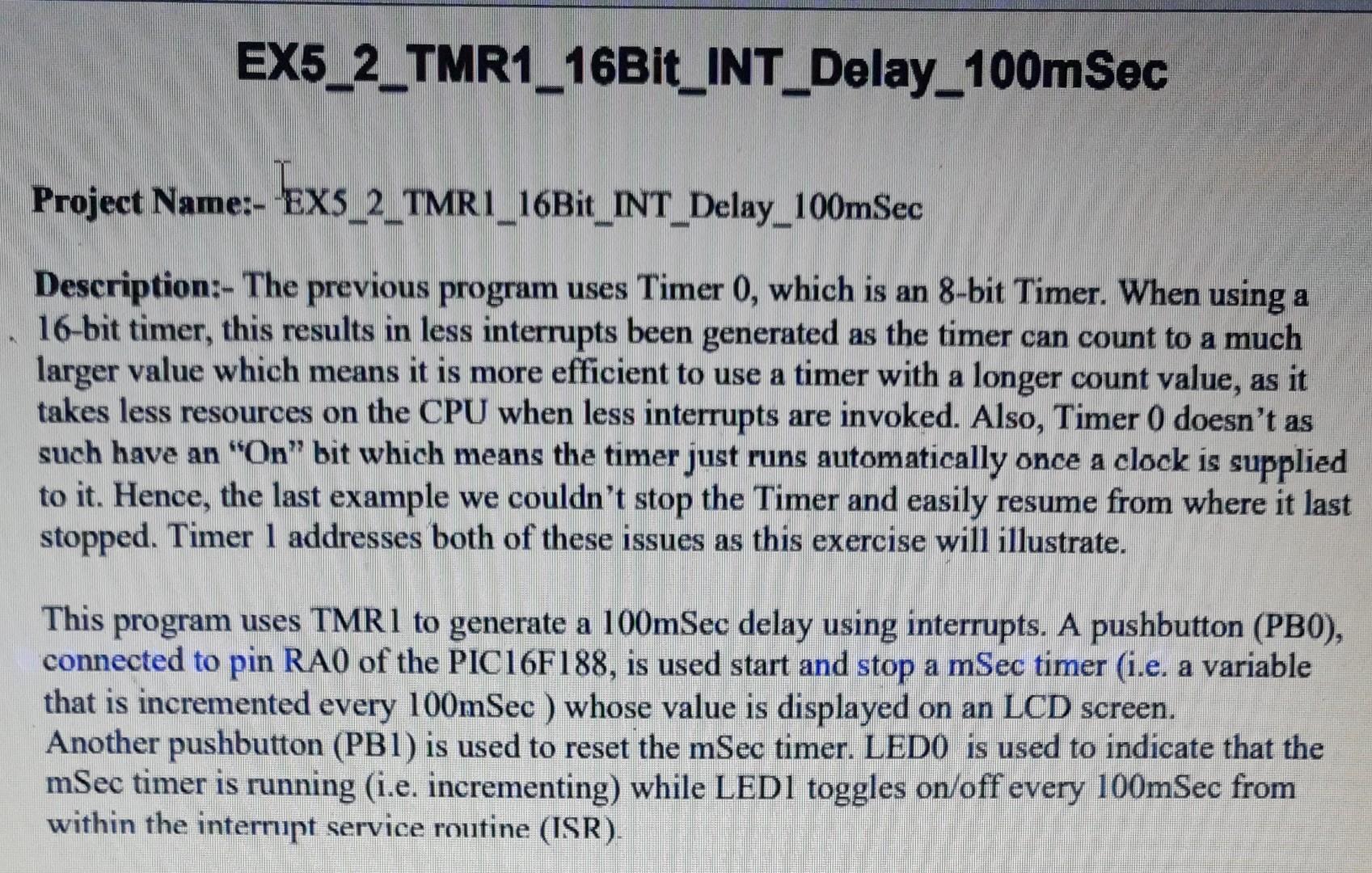
Project Name:- EX5_2_TMR1_16Bit_INT_Delay_100mSec Description:- The previous program uses Timer 0 , which is an 8-bit Timer. When using a 16-bit timer, this results in less interrupts been generated as the timer can count to a much larger value which means it is more efficient to use a timer with a longer count value, as it takes less resources on the CPU when less interrupts are invoked. Also, Timer 0 doesn't as such have an "On" bit which means the timer just runs automatically once a clock is supplied to it. Hence, the last example we couldn't stop the Timer and easily resume from where it last stopped. Timer 1 addresses both of these issues as this exercise will illustrate. This program uses TMR1 to generate a 100mSec delay using interrupts. A pushbutton (PB0), connected to pin RA0 of the PIC16F188, is used start and stop a mSec timer (i.e. a variable that is incremented every 100mSec ) whose value is displayed on an LCD screen. Another pushbutton (PB1) is used to reset the mSec timer. LED0 is used to indicate that the mSec timer is running (i.e. incrementing) while LED1 toggles on/off every 100mSec from within the interrupt service routine (ISR)
Step by Step Solution
There are 3 Steps involved in it

Get step-by-step solutions from verified subject matter experts
 Study Help