







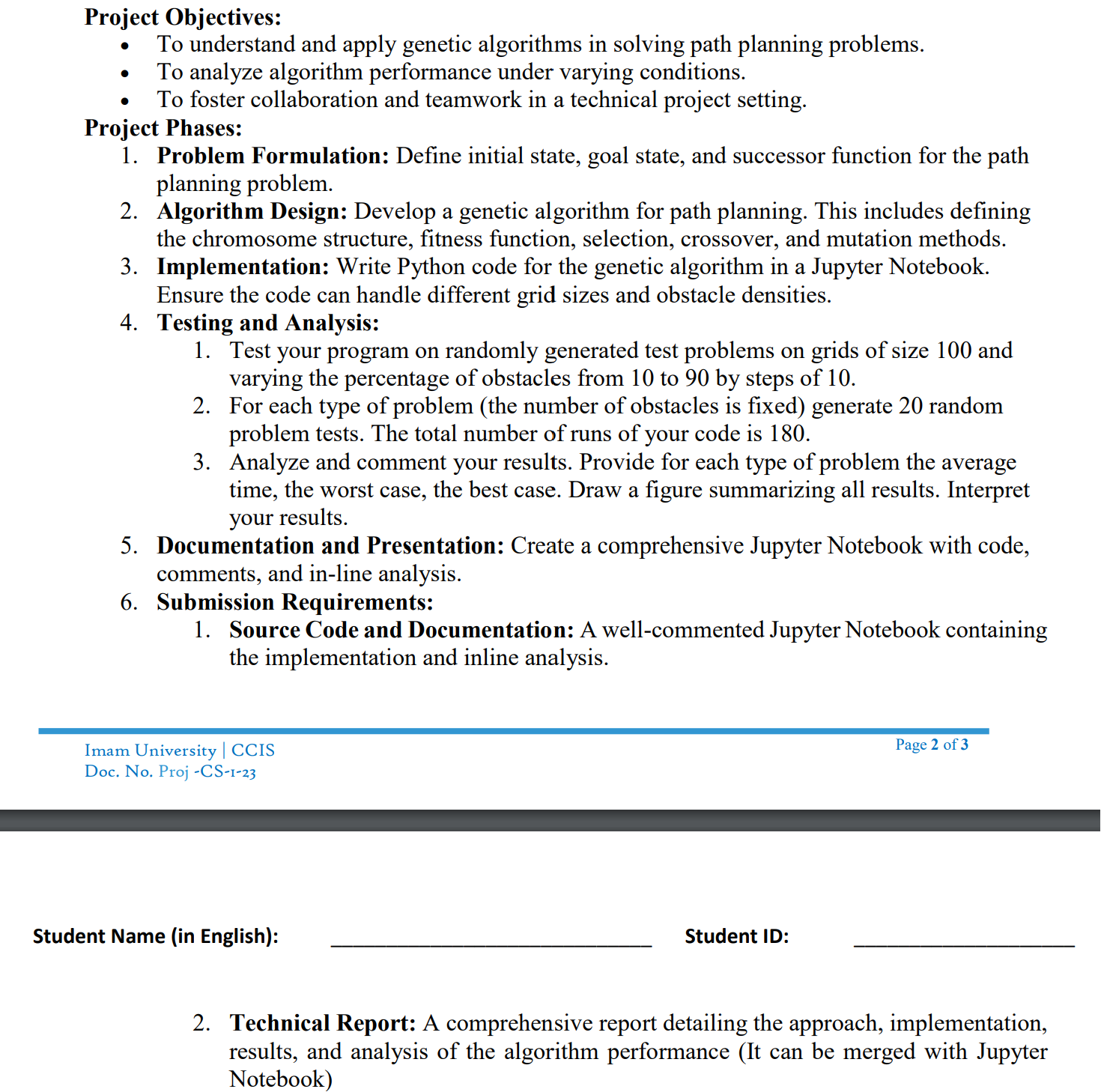
Question: Project Objectives: To understand and apply genetic algorithms in solving path planning problems. To analyze algorithm performance under varying conditions. To foster collaboration and teamwork
Project Objectives:
To understand and apply genetic algorithms in solving path planning problems.
To analyze algorithm performance under varying conditions.
To foster collaboration and teamwork in a technical project setting.
Project Phases:
Problem Formulation: Define initial state, goal state, and successor function for the path
planning problem.
Algorithm Design: Develop a genetic algorithm for path planning. This includes defining
the chromosome structure, fitness function, selection, crossover, and mutation methods.
Implementation: Write Python code for the genetic algorithm in a Jupyter Notebook.
Ensure the code can handle different grid sizes and obstacle densities.
Testing and Analysis:
Test your program on randomly generated test problems on grids of size and
varying the percentage of obstacles from to by steps of
For each type of problem the number of obstacles is fixed generate random
problem tests. The total number of runs of your code is
Analyze and comment your results. Provide for each type of problem the average
time, the worst case, the best case. Draw a figure summarizing all results. Interpret
your results.
Documentation and Presentation: Create a comprehensive Jupyter Notebook with code,
comments, and inline analysis.
Submission Requirements:
Source Code and Documentation: A wellcommented Jupyter Notebook containing
the implementation and inline analysis.
Technical Report: A comprehensive report detailing the approach, implementation,
results, and analysis of the algorithm performance It can be merged with Jupyter
Notebook
Step by Step Solution
There are 3 Steps involved in it
1 Expert Approved Answer
Step: 1 Unlock

Question Has Been Solved by an Expert!
Get step-by-step solutions from verified subject matter experts
Step: 2 Unlock
Step: 3 Unlock
 Study Help