







Question: Project S requires an initial outlay at t = 0 of $17,000, and its expected cash flows would be $5,500 per year for 5 years.
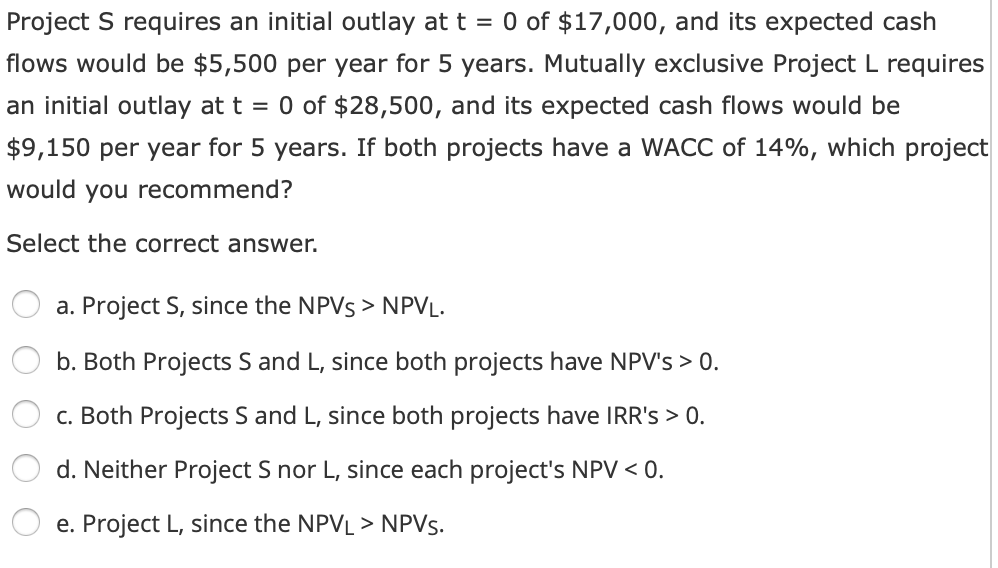
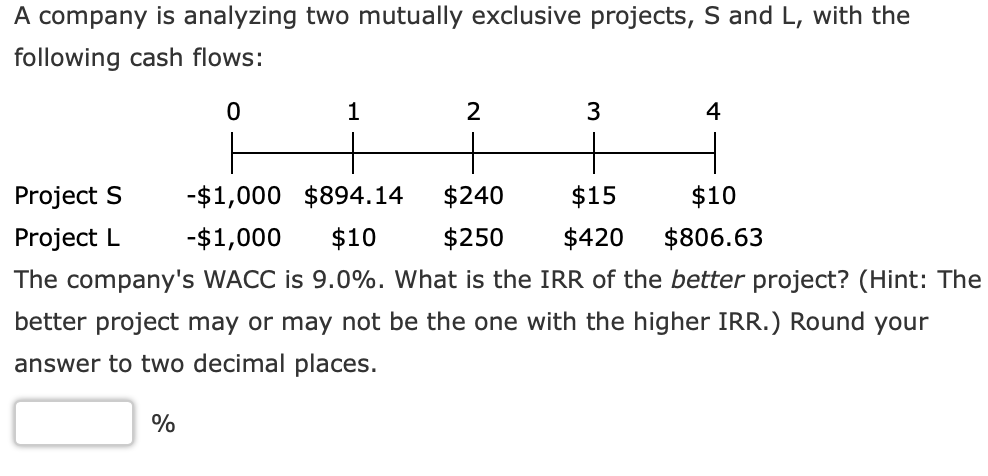
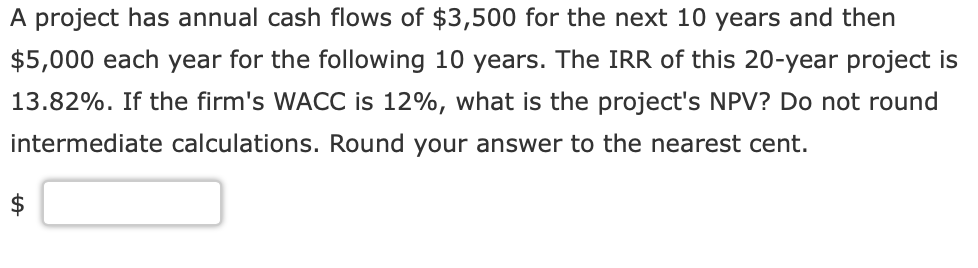
Project S requires an initial outlay at t = 0 of $17,000, and its expected cash flows would be $5,500 per year for 5 years. Mutually exclusive Project L requires an initial outlay at t = 0 of $28,500, and its expected cash flows would be $9,150 per year for 5 years. If both projects have a WACC of 14%, which project would you recommend? Select the correct answer. a. Project S, since the NPVs > NPVL. b. Both Projects S and L, since both projects have NPV's > 0. c. Both Projects S and L, since both projects have IRR's > 0. d. Neither Project S nor L, since each project's NPV NPVS. A company is analyzing two mutually exclusive projects, S and L, with the following cash flows: 0 1 2 3 4 Projects -$1,000 $894.14 $240 $15 $10 Project L -$1,000 $10 $250 $420 $806.63 The company's WACC is 9.0%. What is the IRR of the better project? (Hint: The better project may or may not be the one with the higher IRR.) Round your answer to two decimal places. % A project has annual cash flows of $3,500 for the next 10 years and then $5,000 each year for the following 10 years. The IRR of this 20-year project is 13.82%. If the firm's WACC is 12%, what is the project's NPV? Do not round intermediate calculations. Round your answer to the nearest cent. $
Step by Step Solution
There are 3 Steps involved in it

Get step-by-step solutions from verified subject matter experts
 Study Help