





Question: Project Statement: Pythagoras (https://plato.stanford. edu/entries/pythagoras) is well known for this Pythagorean Theorem that states: In a right triangle, the square of the hypothenuse is the
Project Statement: Pythagoras
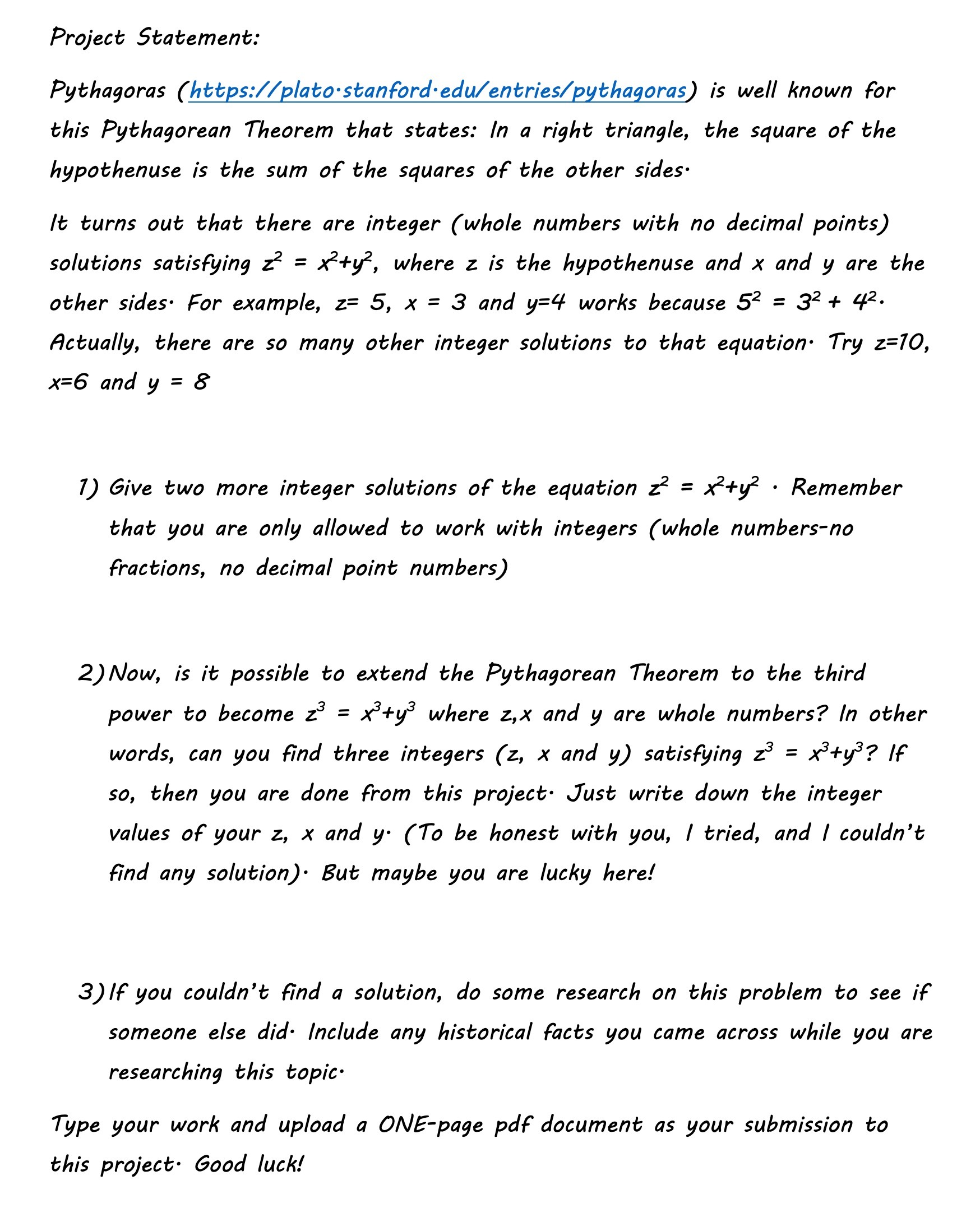
Project Statement: Pythagoras (https://plato.stanford. edu/entries/pythagoras) is well known for this Pythagorean Theorem that states: In a right triangle, the square of the hypothenuse is the sum of the squares of the other sides. It turns out that there are integer ( whole numbers with no decimal points) solutions satisfying z2 = > +y?, where z is the hypothenuse and x and y are the other sides. For example, z= 5, x = 3 and y=4 works because 52 = 32 + 42. Actually, there are so many other integer solutions to that equation. Try z=10, x=6 and y = 8 1) Give two more integer solutions of the equation z = >ty . Remember that you are only allowed to work with integers (whole numbers-no fractions, no decimal point numbers) 2) Now, is it possible to extend the Pythagorean Theorem to the third power to become z = xty where z, x and y are whole numbers? In other words, can you find three integers (z, x and y) satisfying z3 = x3+y3? If so, then you are done from this project. Just write down the integer values of your z, x and y. ( To be honest with you, I tried, and I couldn't find any solution) . But maybe you are lucky here! 3) If you couldn't find a solution, do some research on this problem to see if someone else did. Include any historical facts you came across while you are researching this topic. Type your work and upload a ONE-page pdf document as your submission to this project. Good luck

Step by Step Solution

There are 3 Steps involved in it

1 Expert Approved Answer
Step: 1 Unlock blur-text-image

Question Has Been Solved by an Expert!

Get step-by-step solutions from verified subject matter experts

Step: 2 Unlock
Step: 3 Unlock

Students Have Also Explored These Related Mathematics Questions!