Question: Project tailoring is an important consideration for most projects. Which of the following is the least likely project consideration? A. Project manager's skills and competency.
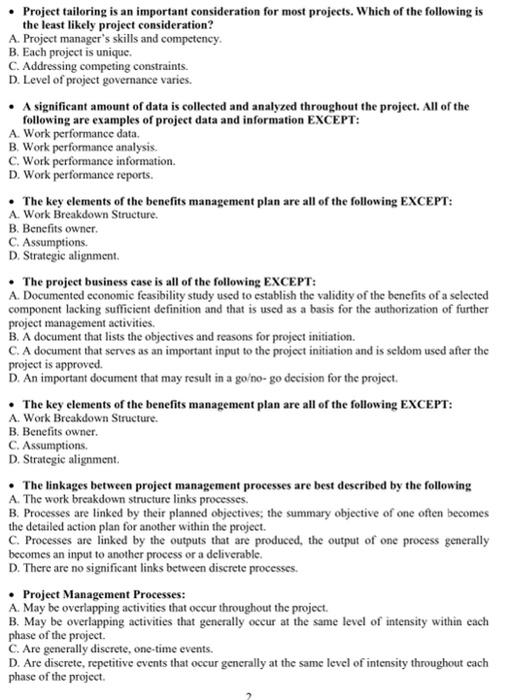
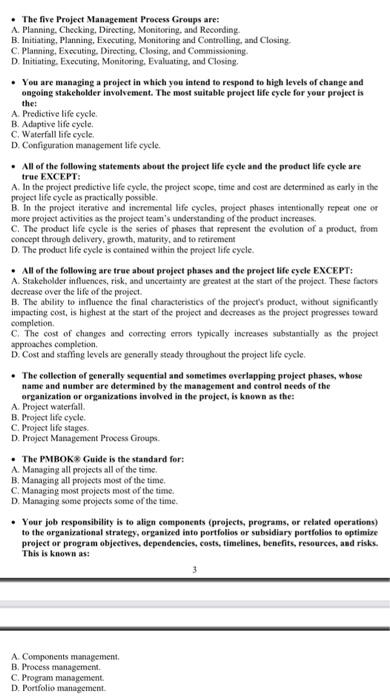
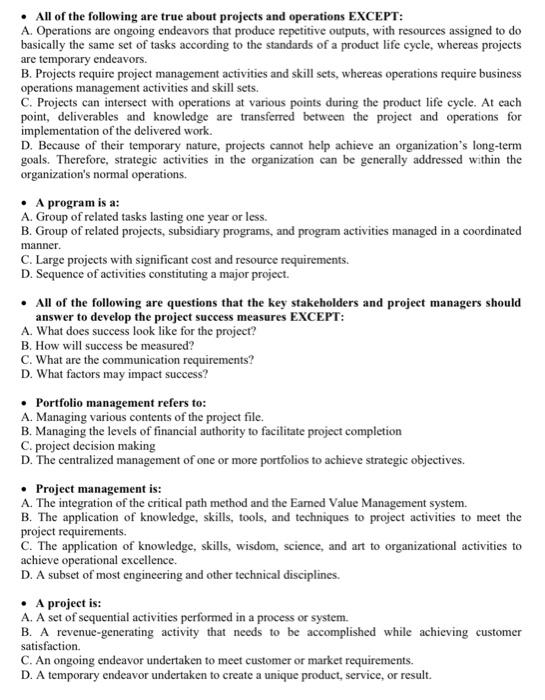
Project tailoring is an important consideration for most projects. Which of the following is the least likely project consideration? A. Project manager's skills and competency. B. Each project is unique. C. Addressing competing constraints. D. Level of project governance varies. A significant amount of data is collected and analyzed throughout the project. All of the following are examples of project data and information EXCEPT: A. Work performance data, B. Work performance analysis. C. Work performance information. D. Work performance reports. The key elements of the benefits management plan are all of the following EXCEPT: A Work Breakdown Structure. B. Benefits owner C. Assumptions D. Strategic alignment The project business case is all of the following EXCEPT: A. Documented economic feasibility study used to establish the validity of the benefits of a selected component lacking sufficient definition and that is used as a basis for the authorization of further project management activities. B. A document that lists the objectives and reasons for project initiation C. A document that serves as an important input to the project initiation and is seldom used after the project is approved D. An important document that may result in a goo- go decision for the project. The key elements of the benefits management plan are all of the following EXCEPT: A. Work Breakdown Structure. B. Benefits owner. C. Assumptions D. Strategic alignment The linkages between project management processes are best described by the following A. The work breakdown structure links processes B. Processes are linked by their planned objectives, the summary objective of one often becomes the detailed action plan for another within the project. C. Processes are linked by the outputs that are produced, the output of one process generally becomes an input to another process or a deliverable. D. There are no significant links between discrete processes. Project Management Processes: A. May be overlapping activities that occur throughout the project. B. May be overlapping activities that generally occur at the same level of intensity within each phase of the project C. Are generally discrete, one-time events. D. Are discrete, repetitive events that occur generally at the same level of intensity throughout cach phase of the project The five Project Management Process Groups are: A. Planning. Checking, Directing. Monitoring, and Recording. B. Initiating, Planning, Executing. Monitoring and Controlling, and Closing C. Planning, Executing Directing. Closing, and Commissioning, D.Initiating. Executing, Monitoring. Evaluating, and Closing, . You are managing a project in which you intend to respond to high levels of change and ongoing stakeholder involvement. The most suitable project life cycle for your project is the: A Predictive life cycle B. Adaptive life cycle C Waterfall life cycle D. Configuration management life cycle. . All of the following statements about the project life cycle and the product life cycle are A. In the project predictive life cycle, the project scope, time and cost are determined as early in the project life cycle as practically possible. B. In the project iterative and incremental life cycles, project phases intentionally repeat one or more project activities as the project team's understanding of the product increases C. The product life cycle is the series of phases that represent the evolution of a product, from concept through delivery, growth, maturity, and to retirement D. The product life cycle is contained within the project life cycle. true EXCEPT: . All of the following are true about project phases and the project life cycle EXCEPT: A. Stakeholder influences, risk, and uncertainty are greatest at the start of the project. These factors decrease over the life of the project. B. The ability to influence the final characteristics of the project's product, without significantly impacting cost, is highest at the start of the project and decreases as the project progresses toward completion C. The cost of changes and correcting errors typically increases substantially as the project D. Cost and staffing levels are generally steady throughout the project life cycle. The collection of generally sequential and sometimes overlapping project phases, whose name and number are determined by the management and control needs of the organization or organizations involved in the project, is known as the: A Project waterfall B. Project life cycle. C Project life stages D. Project Management Process Groups The PMBOK Guide is the standard for: A. Managing all projects all of the time. B. Managing all projects most of the time. C. Managing most projects most of the time D. Managing some projects some of the time. Your job responsibility is to align components (projects, programs, or related operations) to the organizational strategy, organized into portfolios or subsidiary portfolios to optimize project or program objectives, dependencies, costs, timelines, benefits, resources, and risks. This is known as: 3 A Components management B. Process management C. Program management D. Portfolio management All of the following are true about projects and operations EXCEPT: A. Operations are ongoing endeavors that produce repetitive outputs, with resources assigned to do basically the same set of tasks according to the standards of a product life cycle, whereas projects are temporary endeavors. B. Projects require project management activities and skill sets, whereas operations require business operations management activities and skill sets. C. Projects can intersect with operations at various points during the product life cycle. At each point, deliverables and knowledge are transferred between the project and operations for implementation of the delivered work. D. Because of their temporary nature, projects cannot help achieve an organization's long-term goals. Therefore, strategic activities in the organization can be generally addressed within the organization's normal operations. A program is a: A. Group of related tasks lasting one year or less. B. Group of related projects, subsidiary programs, and program activities managed in a coordinated manner. C. Large projects with significant cost and resource requirements. D. Sequence of activities constituting a major project. All of the following are questions that the key stakeholders and project managers should answer to develop the project success measures EXCEPT: A. What does success look like for the project? B. How will success be measured? C. What are the communication requirements? D. What factors may impact success? Portfolio management refers to: A. Managing various contents of the project file. B. Managing the levels of financial authority to facilitate project completion C. project decision making D. The centralized management of one or more portfolios to achieve strategic objectives. Project management is: A. The integration of the critical path method and the Earned Value Management system. B. The application of knowledge, skills, tools, and techniques to project activities to meet the project requirements. C. The application of knowledge, skills, wisdom, science, and art to organizational activities to achieve operational excellence. D. A subset of most engineering and other technical disciplines. A project is: A. A set of sequential activities performed in a process or system. B. A revenue-generating activity that needs to be accomplished while achieving customer satisfaction. C. An ongoing endeavor undertaken to meet customer or market requirements. D. A temporary endeavor undertaken to create a unique product, service, or result









 Study Help