







Question: * - ProjectCS 1 1 2 Programming 2 . pdf Project: Design and implement a library management system in Java, considering the following requirements: Objects
ProjectCSProgrammingpdf
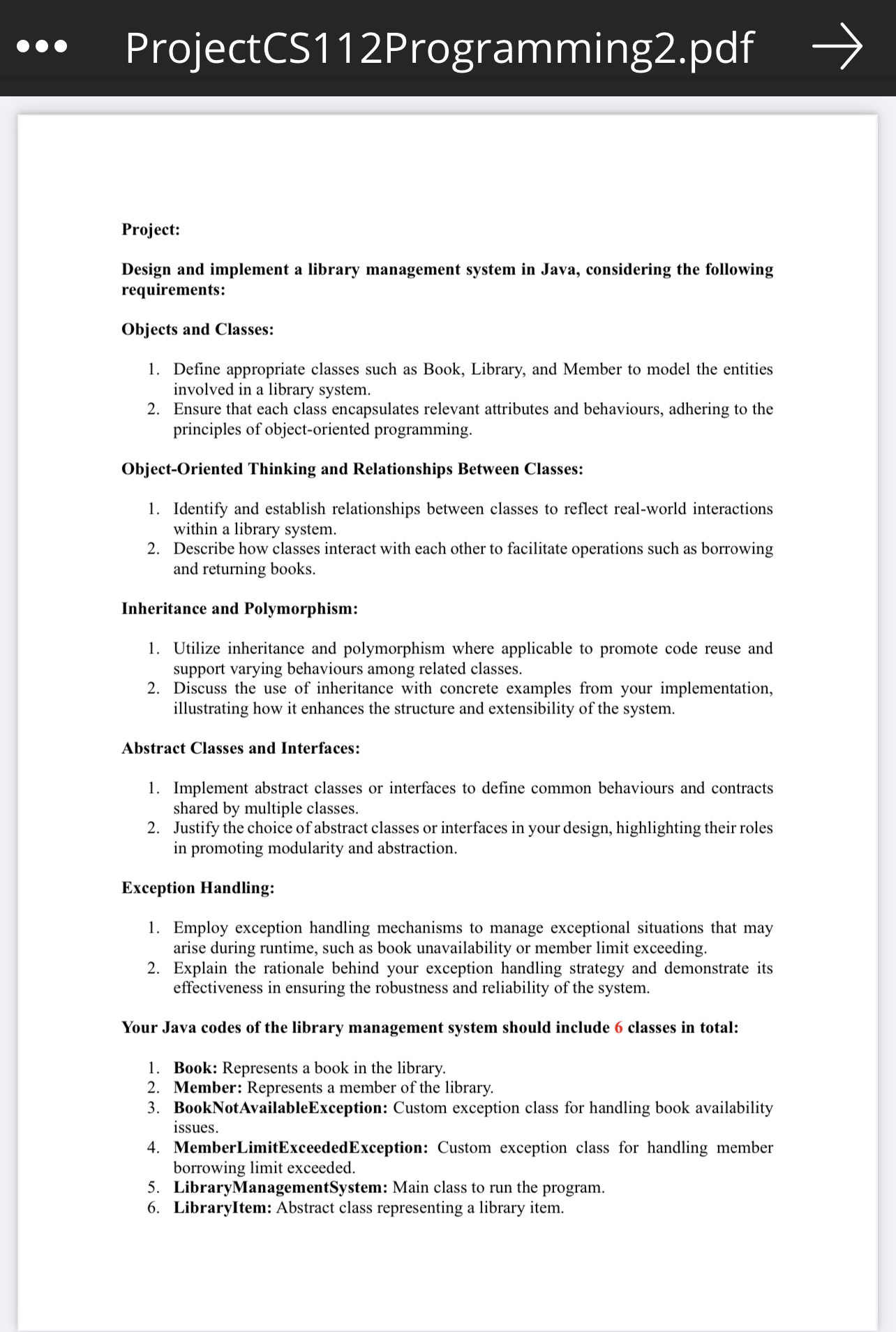
Project:
Design and implement a library management system in Java, considering the following requirements:
Objects and Classes:
Define appropriate classes such as Book, Library, and Member to model the entities involved in a library system.
Ensure that each class encapsulates relevant attributes and behaviours, adhering to the principles of objectoriented programming.
ObjectOriented Thinking and Relationships Between Classes:
Identify and establish relationships between classes to reflect realworld interactions within a library system.
Describe how classes interact with each other to facilitate operations such as borrowing and returning books.
Inheritance and Polymorphism:
Utilize inheritance and polymorphism where applicable to promote code reuse and support varying behaviours among related classes.
Discuss the use of inheritance with concrete examples from your implementation, illustrating how it enhances the structure and extensibility of the system.
Abstract Classes and Interfaces:
Implement abstract classes or interfaces to define common behaviours and contracts shared by multiple classes.
Justify the choice of abstract classes or interfaces in your design, highlighting their roles in promoting modularity and abstraction
Exception Handling:
Employ exception handling mechanisms to manage exceptional situations that may arise during runtime, such as book unavailability or member limit exceeding.
Explain the rationale behind your exception handling strategy and demonstrate its effectiveness in ensuring the robustness and reliability of the system.
Your Java codes of the library management system should include classes in total:
Book: Represents a book in the library.
Member: Represents a member of the library.
BookNotAvailableException: Custom exception class for handling book availability issues.
MemberLimitExceededException: Custom exception class for handling member borrowing limit exceeded.
LibraryManagementSystem: Main class to run the program.
LibraryItem: Abstract class representing a library item.
Additionally, there is interface:
Borrowable: Interface defining methods for borrowing and returning items.
In addition to the implementation, you are also asked to prepare a concise Library Management System Report that:
Summarizes the key functionalities and features of your library management system.
Reflects on the design decisions made, including the selection of classes, relationships, and inheritance structures.
Evaluates the effectiveness of your exception handling approach and its impact on the overall system stability.
Comments on the readability, maintainability, and extensibility of your codebase, highlighting any areas for improvement or future enhancements.
In total, there are different classes and interface. So you must upload different java files with java extensions.
You are also required to upload the Library Management System Report in a pdf format. The report must be written in English.
ProjectCSProgrammingpdf
Project:
Design and implement a library management system in Java, considering the following requirements:
Objects and Classes:
Define appropriate classes such as Book, Library, and Member to model the entities involved in a library system.
Ensure that each class encapsulates relevant attributes and behaviours, adhering to the principles of objectoriented programming.
ObjectOriented Thinking and Relationships Between Classes:
Identify and establish relationships between classes to reflect realworld interactions within a library system.
Describe how classes interact with each other to facilitate operations such as borrowing and returning books.
Inheritance and Polymorphism:
Utilize inheritance and polymorphism where applicable to promote code reuse and support varying behaviours among related classes.
Discuss the use of inheritance with concrete examples from your implementation, illustrating how it enhances the structure and extensibility of the system.
Abstract Classes and Interfaces:
Implement abstract classes or interfaces to define common behaviours and contracts shared by multiple classes.
Justify the choice of abstract classes or interfaces in your design, highlighting their roles in promoting modularity and abstraction
Exception Handling:
Employ exception handling mechanisms to manage exceptional situations that may arise during runtime, such as book unavailability or member limit exceeding.
Explain the rationale behind your exception handling strategy and demonstrate its effectiveness in ensuring the robustness and reliability of the system.
Your Java codes of the library management system should include classes in total:
Book: Represents a book in the library.
Member: Represents a member of the library.
BookNotAvailableException: Custom exception class for handling book availability issues.
MemberLimitExceededException: Custom exception class fo
Step by Step Solution
There are 3 Steps involved in it
1 Expert Approved Answer
Step: 1 Unlock

Question Has Been Solved by an Expert!
Get step-by-step solutions from verified subject matter experts
Step: 2 Unlock
Step: 3 Unlock
 Study Help