



Question: Proof: Let a, b ? N, and assuem that a, b are relatively prime. Then ab is a sum of 2 squares if and only
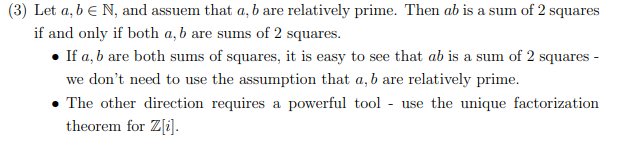
Proof: Let a, b ? N, and assuem that a, b are relatively prime. Then ab is a sum of 2 squares if and only if both a, b are sums of 2 squares.
hint: ? If a, b are both sums of squares, it is easy to see that ab is a sum of 2 squares - we don't need to use the assumption that a, b are relatively prime.
? The other direction requires a powerful tool - use the unique factorization theorem for Z[i].
Step by Step Solution
There are 3 Steps involved in it
1 Expert Approved Answer
Step: 1 Unlock

Question Has Been Solved by an Expert!
Get step-by-step solutions from verified subject matter experts
Step: 2 Unlock
Step: 3 Unlock