







Question: proofs Part II: Constructing proofs (50 pt.) You must write down all proofs in Part IlIl and Part IV in acceptable mathematical language: make sure
proofs
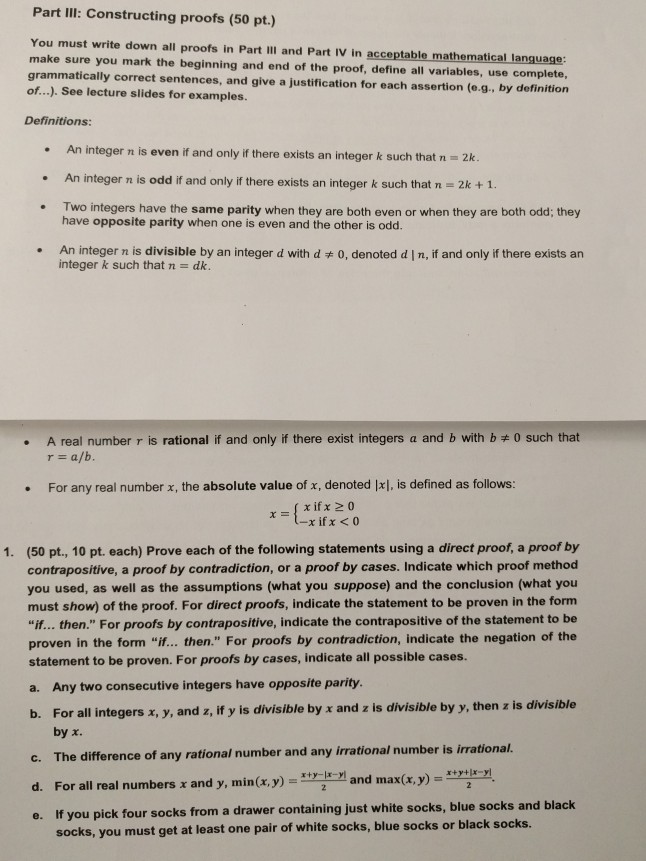
Part II: Constructing proofs (50 pt.) You must write down all proofs in Part IlIl and Part IV in acceptable mathematical language: make sure you mark the beginning and end of the proof, define all variables, use complete grammatically correct sentences, and give a justification for each assertion (e.g., by definition of...). See lecture slides for examples. Definitions: An integer n is even if and only if there exists an integer k such that n -2k . An integer n is odd if and only if there exists an integer k such that n 2k + 1. Two integers have the same parity when they are both even or when they are both odd: they have opposite parity when one is even and the other is odd. An integer n is divisible by an integer d with d integer k such that n = dk. 0, denoted d I n, if and only if there exists an A real number r is rational if and only if there exist integers a and b with b r = a/b. 0 such that For any real number x, the absolute value of x, denoted 1 is defined as follows: . (50 pt., 10 pt. each) Prove each of the following statements using a direct proof, a proof by contrapositive, a proof by contradiction, or a proof by cases. Indicate which proof method you used, as well as the assumptions (what you suppose) and the conclusion (what you must show) of the proof. For direct proofs, indicate the statement to be proven in the form "if then." For proofs by contrapositive, indicate the contrapositive of the statement to be proven in the form "if... then." For proofs by contradiction, indicate the negation of the statement to be proven. For proofs by cases, indicate all possible cases. 1. Any two consecutive integers have opposite parity. For all integers x, y, and z, if y is divisible by x and z is divisible by y, then z is divisible a. b. x. The difference of any rational number and any irrational number is irrational. d. For all real numbers x and y, min(x, y-1 and max(x. e. If you c. pick four socks from a drawer containing just white socks, blue socks and black socks, you must get at least one pair of white socks, blue socks or black socks
Step by Step Solution
There are 3 Steps involved in it

Get step-by-step solutions from verified subject matter experts
 Study Help