







Question: Propose a numerical method and implementation for solving the following problems. Briefly describe the method/implementation and justify your choice, including considerations such as robustness,
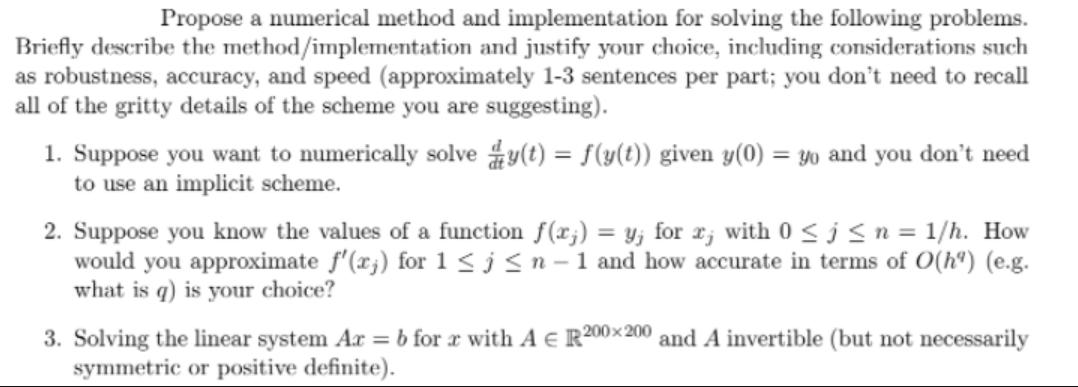
Propose a numerical method and implementation for solving the following problems. Briefly describe the method/implementation and justify your choice, including considerations such as robustness, accuracy, and speed (approximately 1-3 sentences per part; you don't need to recall all of the gritty details of the scheme you are suggesting). 1. Suppose you want to numerically solve y(t) = f(y(t)) given y(0) = yo and you don't need to use an implicit scheme. 2. Suppose you know the values of a function f(x) = y; for x, with 0 j n = 1/h. How would you approximate f'(x) for 1 jn-1 and how accurate in terms of O(h) (e.g. what is q) is your choice? 3. Solving the linear system Ar = b for x with A E R200x200 and A invertible (but not necessarily symmetric or positive definite). Propose a numerical method and implementation for solving the following problems. Briefly describe the method/implementation and justify your choice, including considerations such as robustness, accuracy, and speed (approximately 1-3 sentences per part; you don't need to recall all of the gritty details of the scheme you are suggesting). 1. Suppose you want to numerically solve y(t) = f(y(t)) given y(0) = yo and you don't need to use an implicit scheme. 2. Suppose you know the values of a function f(x) = y for x, with 0 j n = 1/h. How would you approximate f'(x) for 1 j n -1 and how accurate in terms of O(h) (e.g. what is q) is your choice? 3. Solving the linear system Ar = b for x with A E R200x200 and A invertible (but not necessarily symmetric or positive definite).
Step by Step Solution
3.45 Rating (155 Votes )
There are 3 Steps involved in it
here is a more detailed explanation of why only part b of the figure shows physically possible refraction When light travels from one medium to another it bends because the speed of light changes as i... View full answer

Get step-by-step solutions from verified subject matter experts
 Study Help