



Question: Propose and explain a possible mechanism for the reaction below: Copper(II) Oxidation of Benzoin to Benzil Water Aspirate Vacuum In a round bottom flask, combine
Propose and explain a possible mechanism for the reaction below:
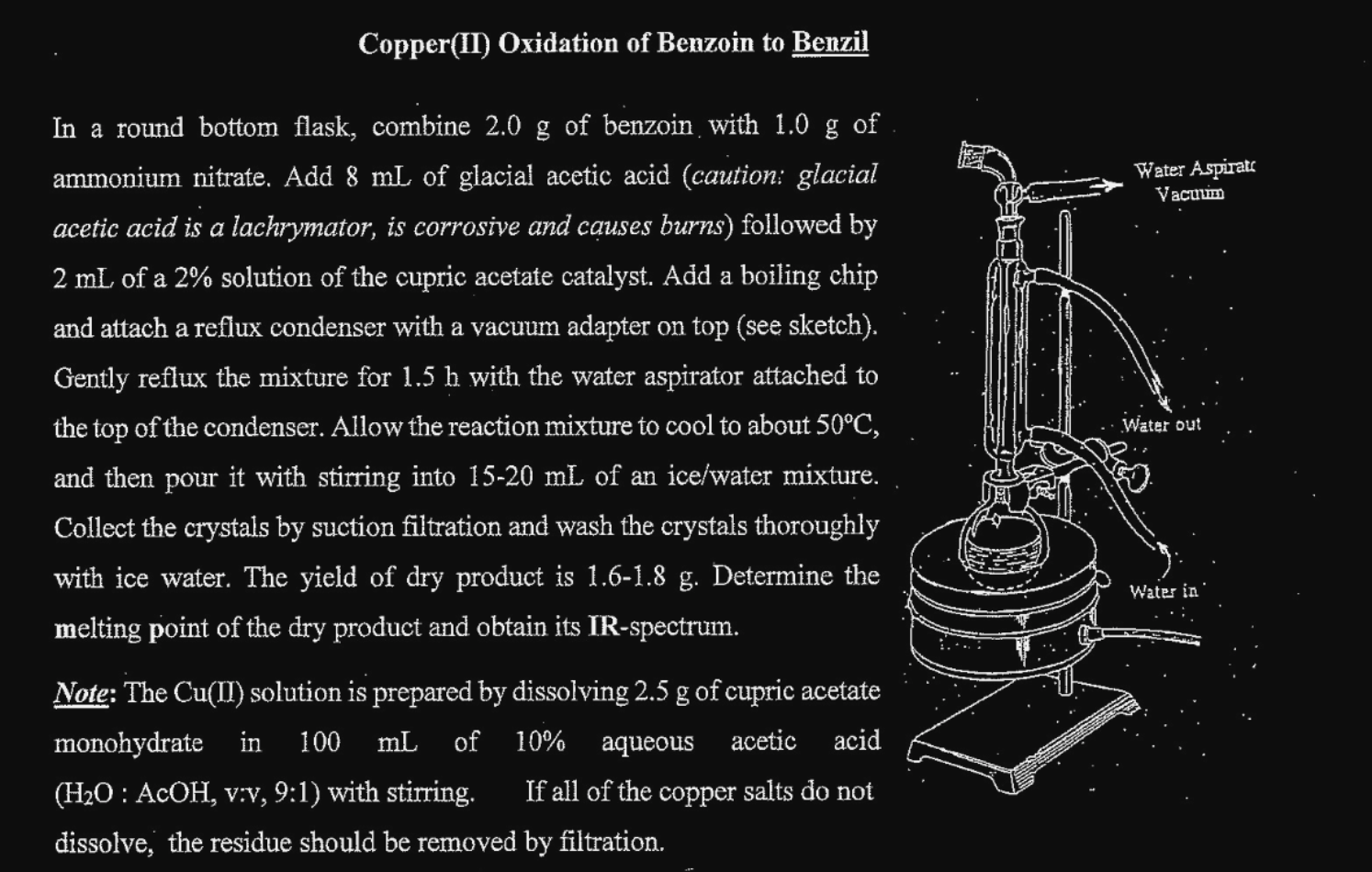
Copper(II) Oxidation of Benzoin to Benzil Water Aspirate Vacuum In a round bottom flask, combine 2.0 g of benzoin with 1.0 g of ammonium nitrate. Add 8 mL of glacial acetic acid (caution: glacial acetic acid is a lachrymator, is corrosive and causes burns) followed by 2 mL of a 2% solution of the cupric acetate catalyst. Add a boiling chip and attach a reflux condenser with a vacuum adapter on top (see sketch). Gently reflux the mixture for 1.5 h with the water aspirator attached to the top of the condenser. Allow the reaction mixture to cool to about 50C, and then pour it with stirring into 15-20 mL of an ice/water mixture. Collect the crystals by suction filtration and wash the crystals thoroughly with ice water. The yield of dry product is 1.6-1.8 g. Determine the melting point of the dry product and obtain its IR-spectrum. Water out Wates in Note: The Cu(II) solution is prepared by dissolving 2.5 g of cupric acetate monohydrate in 100 ml of 10% aqueous acetic acid (H20 : AcOH, v:v, 9:1) with stirring. If all of the copper salts do not dissolve, the residue should be removed by filtration
Step by Step Solution
There are 3 Steps involved in it

Get step-by-step solutions from verified subject matter experts