







Question: Propositional logic questions 1.Ternary Conditionals Many programming languages support a ternary conditional operator. For example, in C, C++, and Java, the expression x ? y:
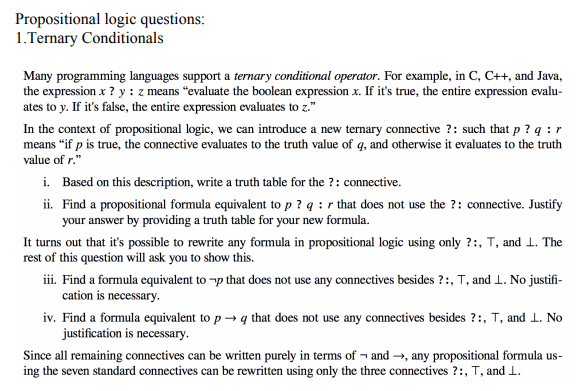
Propositional logic questions 1.Ternary Conditionals Many programming languages support a ternary conditional operator. For example, in C, C++, and Java, the expression x ? y: z means "evaluate the boolean expression x. If it's true, the entire expression evalu- ates to y. If it's false, the entire expression evaluates to z." In the context of propositional logic, we can introduce a new ternary connective ?: such that p? q: r means "if p is true, the connective evaluates to the truth value of q, and otherwise it evaluates to the truth value of r." i. connective. Based on this description, write a truth table for the ?: ii. Find a propositional formula equivalent to p? q: rthat does not use the ?: connective. Justify your answer by providing a truth table for your new formula. It turns out that it's possible to rewrite any formula in propositional logic using only ?:, T, and L. The iii. Find a formula equivalent to-p that does not use any connectives besides ? :, T, and No justifi- iv. Find a formula equivalent to p q that does not use any connectives besides ?, T, and No Since all remaining connectives can be written purely in terms ofand , any propositional formula us rest of this question will ask you to show this. cation is necessary. justification is necessary. ing the seven standard connectives can be rewritten using only the three connectives?:, T, and L
Step by Step Solution
There are 3 Steps involved in it

Get step-by-step solutions from verified subject matter experts
 Study Help