







Question: Prove by smallest counter example that the following statement P(n) is true. 11n 6 is divisible by 5 for every positive integer n. You need
Prove by smallest counter example that the following statement P(n) is true.
11n 6 is divisible by 5 for every positive integer n.
You need to include the following steps:
1. Express P(n) as a universal statement using symbols.
2. Express the opposite assumption as an existential statement.
3. Check if P(n) holds for the lower bound of the universe.
4. If P(n) holds for the lower bound of the universe, based upon bullet 2, there must be some values that make P false and we can pick the smallest counter value m. What will be the value range 'R' in the universe that we know for sure will make P(n) hold? What is the largest value in this range?
5. Prove that when the largest value in the range R makes P true, then the next value after this value also makes P true. This next value is actually the smallest counterexample m that you pick. Therefore, we have both P(m) and P(m), which is a contradiction. Therefore, the original assumption in bullet 2 is false and the original statement should be true.
My question is, would these be the correct answers to this problem: 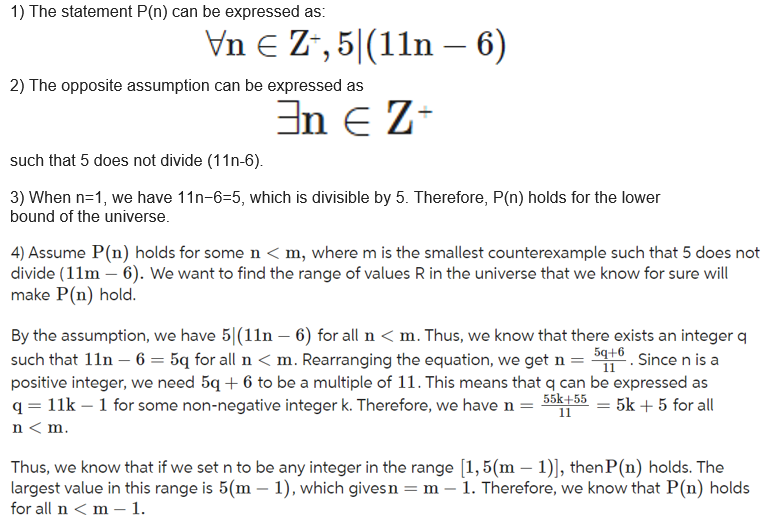
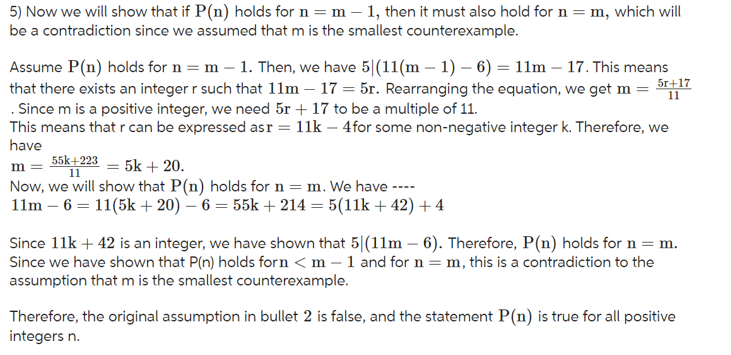
1) The statement P(n) can be expressed as: nZ+,5(11n6) 2) The opposite assumption can be expressed as nZ+ such that 5 does not divide (11n6). 3) When n=1, we have 11n6=5, which is divisible by 5 . Therefore, P(n) holds for the lower bound of the universe. 4) Assume P(n) holds for some n
Step by Step Solution
There are 3 Steps involved in it

Get step-by-step solutions from verified subject matter experts
 Study Help