







Question: Prove by structural induction. - (1) Prove that each proposition defined using the connectives 1, V, - and is logically equivalent to a proposition defined
Prove by structural induction.
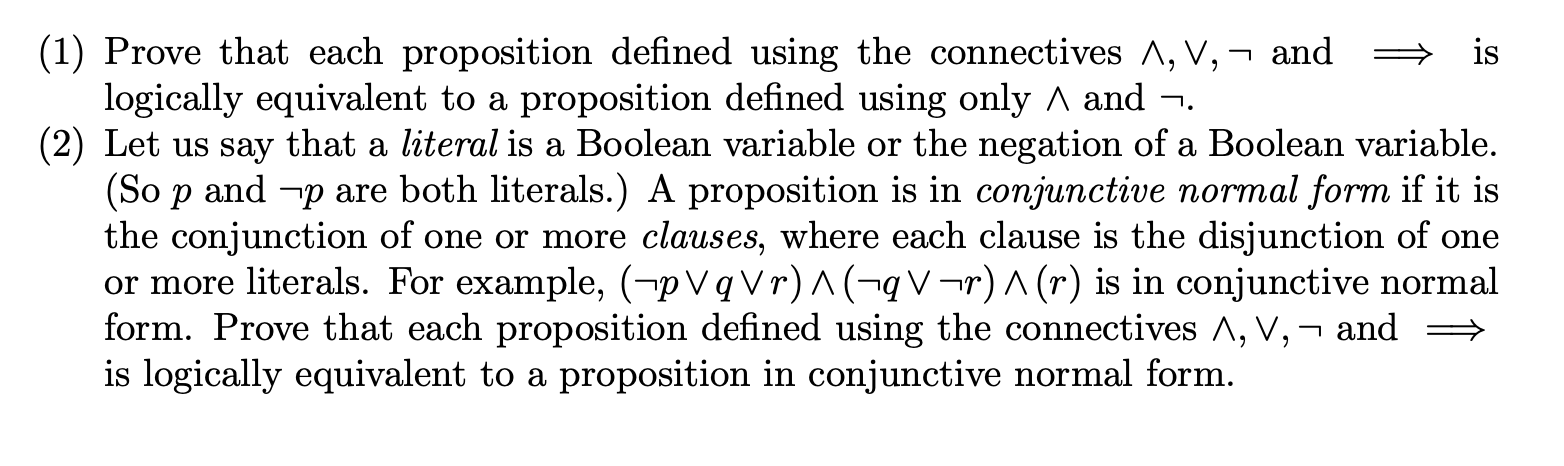
- (1) Prove that each proposition defined using the connectives 1, V, - and is logically equivalent to a proposition defined using only 1 and 2. (2) Let us say that a literal is a Boolean variable or the negation of a Boolean variable. (So p and p are both literals.) A proposition is in conjunctive normal form if it is the conjunction of one or more clauses, where each clause is the disjunction of one or more literals. For example, (pVqVr)^(-V-r) (r) is in conjunctive normal form. Prove that each proposition defined using the connectives 1, V, - and is logically equivalent to a proposition in conjunctive normal form. - (1) Prove that each proposition defined using the connectives 1, V, - and is logically equivalent to a proposition defined using only 1 and 2. (2) Let us say that a literal is a Boolean variable or the negation of a Boolean variable. (So p and p are both literals.) A proposition is in conjunctive normal form if it is the conjunction of one or more clauses, where each clause is the disjunction of one or more literals. For example, (pVqVr)^(-V-r) (r) is in conjunctive normal form. Prove that each proposition defined using the connectives 1, V, - and is logically equivalent to a proposition in conjunctive normal form
Step by Step Solution
There are 3 Steps involved in it

Get step-by-step solutions from verified subject matter experts
 Study Help