







Question: Prove, or disprove (i.e., with a counter example). (a) f(n) = O(g(n)) implies that g(n) = O(f(n)). (b) If f(n) = O(g(n)) and g(n)
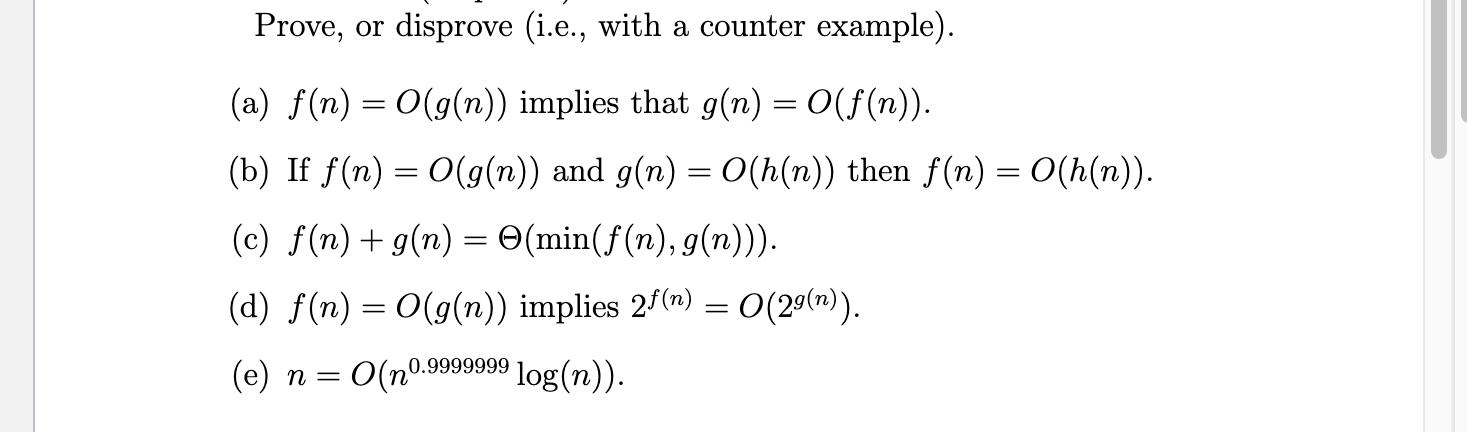
Prove, or disprove (i.e., with a counter example). (a) f(n) = O(g(n)) implies that g(n) = O(f(n)). (b) If f(n) = O(g(n)) and g(n) = O(h(n)) then f(n) = O(h(n)). (c) f(n) + g(n) = (min(f(n), g(n))). (d) f(n) = O(g(n)) implies 2f(n) = O(29(n)). 20.9999999 log(n)). (e) n = O(n0.99999
Step by Step Solution
There are 3 Steps involved in it
1 Expert Approved Answer
Step: 1 Unlock

Question Has Been Solved by an Expert!
Get step-by-step solutions from verified subject matter experts
Step: 2 Unlock
Step: 3 Unlock
 Study Help