







Question: prove that (6) (e,e)=1 (LE) a = a (iii) (.)= (iv) (Tu) v = (Tv) u Using the transformation law for vectors, prove that
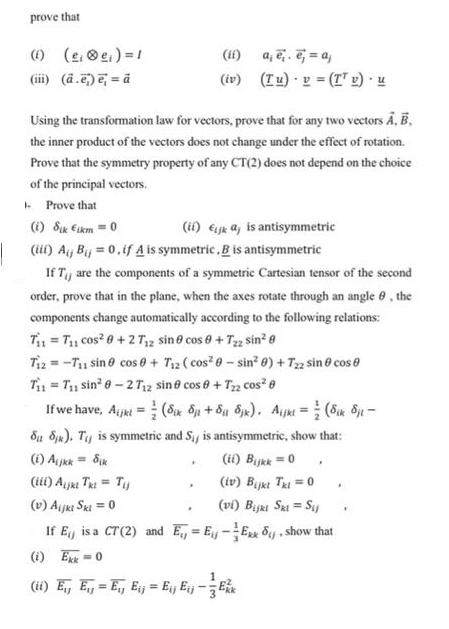
prove that (6) (e,e)=1 (LE) a = a (iii) (.)= (iv) (Tu) v = (Tv) u Using the transformation law for vectors, prove that for any two vectors A, B, the inner product of the vectors does not change under the effect of rotation. Prove that the symmetry property of any CT(2) does not depend on the choice of the principal vectors. Prove that (i) Sikkm=0 (i) kaj is antisymmetric (ii) A, B =0,if A is symmetric, B is antisymmetric If T, are the components of a symmetric Cartesian tensor of the second order, prove that in the plane, when the axes rotate through an angle, the components change automatically according to the following relations: T =T cos 8+2712 sin cos 0 + Tzz sin 8 T-T sin cos 0+ T (cos 8-sin 8) + T22 sin cos T =T sin 8-2712 sin cos 0 + T22 cos If we have, Ajkt (Six + j). Aj = (Sik 8 - 88k), Tij is symmetric and S,, is antisymmetric, show that: (i) Ajkk = Sik (ii) AjTk= Ty (v) Aijkt Ski = 0 (i) Bijkk=0 (iv) Bijkt Tki=0 . (vi) Bijkt Ski= Sij show that If E, is a CT(2) and E = E-Ex (i) Ekk = 0 (i) E, E = E, E = E, Ej Ex prove that (6) (e,e)=1 (LE) a = a (iii) (.)= (iv) (Tu) v = (Tv) u Using the transformation law for vectors, prove that for any two vectors A, B, the inner product of the vectors does not change under the effect of rotation. Prove that the symmetry property of any CT(2) does not depend on the choice of the principal vectors. Prove that (i) Sikkm=0 (i) kaj is antisymmetric (ii) A, B =0,if A is symmetric, B is antisymmetric If T, are the components of a symmetric Cartesian tensor of the second order, prove that in the plane, when the axes rotate through an angle, the components change automatically according to the following relations: T =T cos 8+2712 sin cos 0 + Tzz sin 8 T-T sin cos 0+ T (cos 8-sin 8) + T22 sin cos T =T sin 8-2712 sin cos 0 + T22 cos If we have, Ajkt (Six + j). Aj = (Sik 8 - 88k), Tij is symmetric and S,, is antisymmetric, show that: (i) Ajkk = Sik (ii) AjTk= Ty (v) Aijkt Ski = 0 (i) Bijkk=0 (iv) Bijkt Tki=0 . (vi) Bijkt Ski= Sij show that If E, is a CT(2) and E = E-Ex (i) Ekk = 0 (i) E, E = E, E = E, Ej Ex
Step by Step Solution
3.49 Rating (146 Votes )
There are 3 Steps involved in it
To prove the given statements lets go through each one individually 1 1 To prove this we need to show that the contraction of an empty tensor is equal to 1 However by convention the contraction of an ... View full answer

Get step-by-step solutions from verified subject matter experts
 Study Help