







Question: Prove that for every a > 1 and b > 1, a^log_2 b = b^log_2 a. Give a formula for the number of digits in
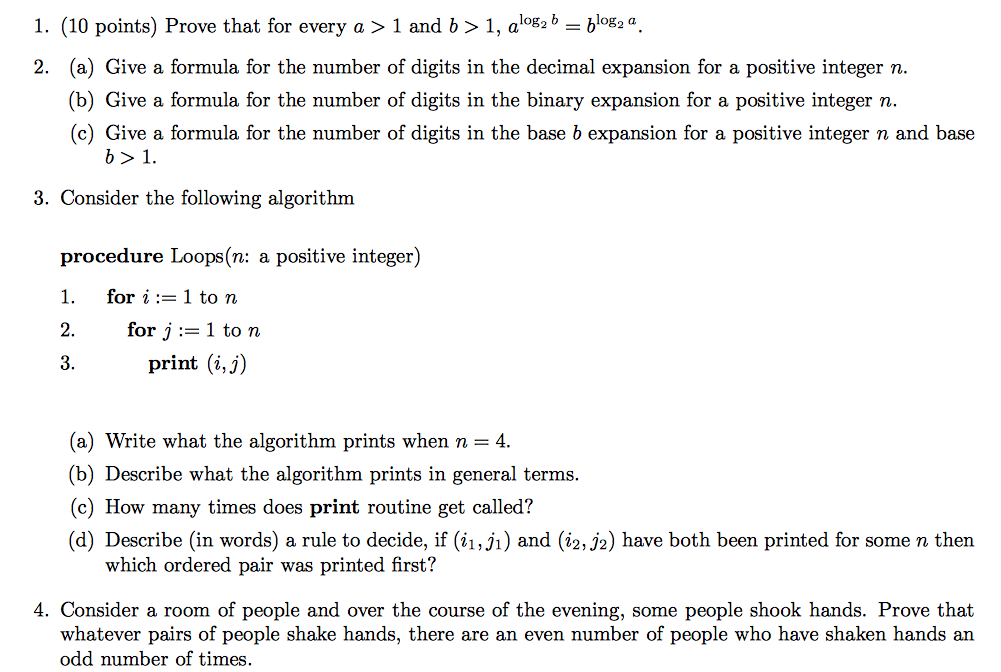
Prove that for every a > 1 and b > 1, a^log_2 b = b^log_2 a. Give a formula for the number of digits in the decimal expansion for a positive integer n. Give a formula for the number of digits in the binary expansion for a positive integer n. Give a formula for the number of digits in the base b expansion for a positive integer n and base b > 1. Consider the following algorithm procedure Loops(n: a positive integer) Write what the algorithm prints when n = 4. Describe what the algorithm prints in general terms. How many times does print routine get called? Describe (in words) a rule to decide, if (i_1, j_1) and (i_2, j_2) have both been printed for some n then which ordered pair was printed first? Consider a room of people and over the course of the evening, some people shook hands. Prove that whatever pairs of people shake hands, there are an even number of people who have shaken hands an odd number of times
Step by Step Solution
There are 3 Steps involved in it

Get step-by-step solutions from verified subject matter experts
 Study Help